CHEAP ENOUGH TO LOSE.
SENT ANYWAY.
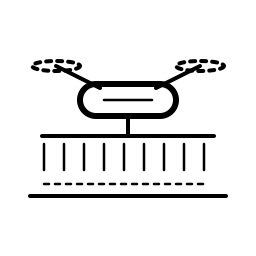
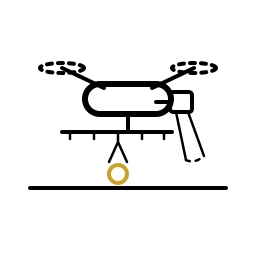
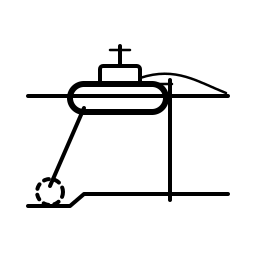
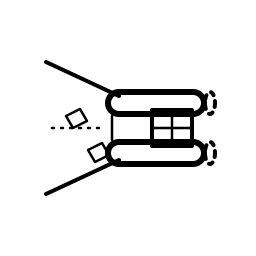
The Air family's smallest body — a tube-launched, motor-cruising scout priced to lose, not to last.
Forward Scouting · Route Overwatch · Disposable ISR · Salvo Depth
The smallest airframe in the Air family: a tube-launched, motor-cruising scout, moulded to be cheap, flown on a preset leg, and recorded — not transmitted. It brings the picture home if it can. If it can't, the next one is already in the case.
The Air family's smallest body — a tube-launched, motor-cruising scout priced to lose, not to last.
Forward Scouting · Route Overwatch · Disposable ISR · Salvo Depth
Kestrel CS-160 is a tube-launched, motor-cruising scout, sized and priced to be the cheapest possible way to put a passive eye somewhere and get a look. It is not built to be the best aircraft in the roster. It is built to be the one you can afford to commit without asking for it back.
It takes its place at the cheap end of a family of airframes sharing one launcher-and-doctrine logic. Goose anchors the family, and lends Kestrel its launch tube — throttled down from an interceptor's exit speed to a scout's gentle departure. Owl works the night, orbiting a watch point in near silence; Loon is the long-legged eye, flown for hours and tens of kilometres past where Kestrel's battery gives out; Raven is the family's deliberate radio exception, built to carry the network rather than avoid it. Kestrel does none of that particularly well, and that is the point — it does the cheapest possible version of forward looking, in numbers the others were never built to survive.
The whole engineering argument is restraint. A single-digit part count for the entire airframe — two body-shell mouldings, two wing panels, a tail set, one sensor nose — cut on the same 5-axis dies as the rest of the family. One mechanism has to work every time: the wing-deploy hinge. Everything else is built to be cheap to mould and forgiving of a rough landing, not built to survive one. Kestrel inverts the interceptor's design problem: Goose survives one violent launch and one terminal impact; Kestrel is built to survive many gentle ones, and to be shrugged off on the one it doesn't.
A scout that comes home four times in five is already cheaper than one built to come home every time. Kestrel is moulded, priced and flown on that arithmetic — cost per look, not cost per airframe.
Kestrel rides out of the same accumulator-valve-tube family Goose uses to throw its interceptor round — just throttled back. Where Goose leaves the tube at ~189 m/s, Kestrel needs only enough push to fly away clean: ~40 m/s, at an average shock of roughly 27 g over the stroke. That is closer to a rough parcel drop than anything the family's interceptors are built to survive, and it is why commodity COTS electronics are credible on this airframe at all.
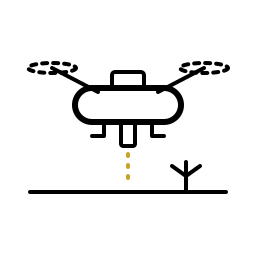
The wings — folded flat for the tube — snap open on a spring hinge the instant the airframe clears the muzzle. It is the one mechanism on the aircraft that has to work every single time: a scout whose wings don't open is a write-off before it starts, not an attrition statistic. Once open, a small electric motor and folding prop hold a modest cruise, and the airframe flies the leg it was given before launch — a preset route with no live edit, or a visual-only autonomous hold with nothing transmitted in either mode. There is no fibre tier on the base scout, and no radio or GPS in any tier: nothing for a jammer to find, because Kestrel gives it nothing to find.
The nose carries whichever eye the mission calls for. A base EO Scout core records visible imagery to onboard storage; a thermal-biased Night Scout core does the same after dark; a passive Listener nose records acoustic or RF activity without ever transmitting; a stripped Pathfinder nose carries no sensor at all — ballast, and optionally a passive radar reflector, the cheapest body in the whole fleet, flown when the mission is presence rather than picture. Every nose is sensor-only. None of them can act on what they see.
The airframe's own drawing package is honest about what happens next: most legs end in a belly landing on whatever ground is under the aircraft when the battery runs down, and the record comes home with it. Some legs don't end that way. Both outcomes are priced into the same design — which is the whole idea.

The complete data card for the Kestrel scout — dimensions, performance, launch, sensors, construction and compliance, grouped the way a fleet buyer compares them. Every figure is stated at the airframe's single 1.2 kg design working point.
Every figure descends from the airframe's single 1.2 kg design working point. Endurance, range and radius are central-case values; the 1-in-5 loss rate is a planning convention, not a measured rate. No unit cost is published — cost per look, not cost per airframe, is the design metric.
Every Canadian Shield airframe runs on the same magazine-depth argument. Kestrel runs it at the smallest scale in the roster, and states it as arithmetic rather than slogan.
Run the numbers the way the engineering file does: at a 1-in-5 per-sortie loss rate, one airframe delivers roughly five looks before it's gone. At 1-in-3, about 3.3. At coin-flip odds, two. No dollar figure is claimed anywhere in the package — Kestrel has no costed bill of materials, and we say so rather than invent one — but the shape of the argument doesn't need a price tag to hold: every airframe that comes home divides its cost across one more look, and every one that doesn't was already paid for by the ones that did.
The manufacturing thesis carries the same logic into the mould shop. Kestrel's body, wing panels and tail are moulded GF-nylon, on the family's owned 5-axis tooling — the same class of dies that cuts the Goose round, extending the sovereign-manufacturing case the Air family already runs on its lead interceptor and the Forward Manufacturing Cell built around it. Recycled rPET stays exactly where the family's material doctrine puts it — non-structural components only, nothing that flies under load. A single-digit structural part count keeps the mould simple and the unit price down, because a scout that costs too much to lose stops being a scout.
A Kestrel that doesn't come back isn't a failure in this design — it's a line item. The airframe is built to make that trade make sense, over and over, at a price the roster's other platforms were never meant to hit. Cost per look, not cost per airframe, is the design metric.
One leg, walked end to end — illustrative of how the scout is used, not a mission record.
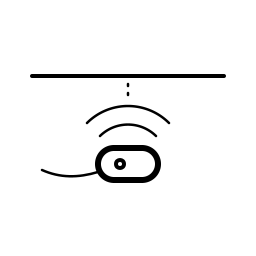
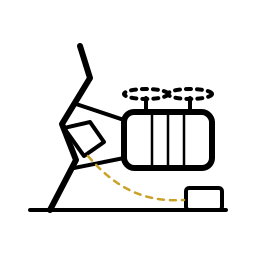
The leg is loaded before the airframe leaves the case — waypoints locked, no live edit once it's airborne — and the nose is picked for the job: Scout for a daylight look, Night Scout after dark, Listener for a quiet acoustic pass, Pathfinder when the mission is presence rather than picture. The tube is seated, and there is nothing left to configure over a link, because there is no link.
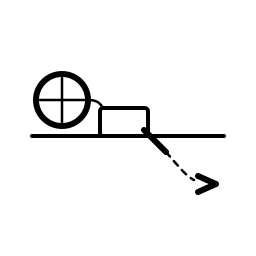
A short pulse off the shared Goose launcher family — throttled to a scout's gentle departure, not an interceptor's — clears the tube in well under a second. The wings snap open on the one mechanism that has to work every time, the prop unfolds, and the airframe climbs away on its own preset heading.
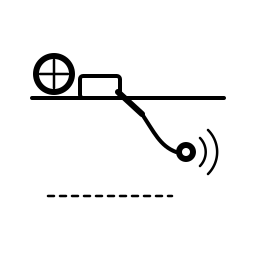
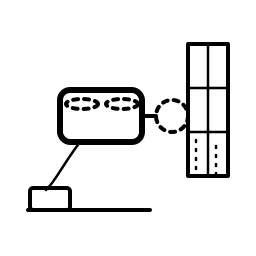
Preset waypoints or a visual-only autonomous hold — either way, nothing transmits. The nose records what it was sent to find, onboard, for the length of the leg. There is no telemetry to watch and no link to lose, because losing a link that was never opened isn't a failure mode.
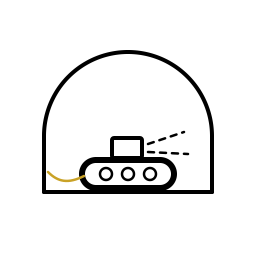
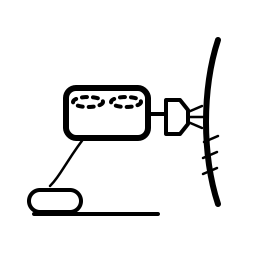
Most legs end in a belly landing wherever the battery runs out, and the record comes home with the airframe for a swap and a re-fly. Some don't come back at all. Neither outcome is chased or mourned — it was priced in before the tube was loaded, and the next airframe is already in the case.
Kestrel holds the cheap end of the Air family's scout tier. Its siblings share the launcher-and-doctrine logic — same no-radio thesis, different jobs, at prices Kestrel deliberately undercuts.
The smallest, cheapest body in the roster — flown on a preset leg, recorded, and priced to lose.
Download PDF ↓The family's anchor — the interceptor round whose launch tube Kestrel borrows, throttled down.
Download PDF ↓Works the night — orbiting a watch point in near silence, where Kestrel just passes through.
Download PDF ↓The long-legged eye — flown for hours and tens of kilometres past where Kestrel's battery gives out.
Download PDF ↓The family's deliberate radio exception — built to carry the network rather than avoid it.
Download PDF ↓If you buy, build, integrate or regulate forward scouting and disposable ISR for Canada or its allies, the Kestrel — working point and all — is on the table.