HOURS ON STATION,
HUNDREDS OF KILOMETRES OUT
The bird that flies its whole leg without asking a satellite for a name.
Long-Leg Reconnaissance · Standoff Sensing · Wide-Area Survey
A long-endurance, long-range ISR airframe built to fly its entire sortie without a satellite fix: preset legs, inertial dead reckoning, terrain-referenced and celestial navigation — all passive. No radio, no antenna, no downlink in flight; the picture comes home with the airframe.
The bird that flies its whole leg without asking a satellite for a name.
Long-Leg Reconnaissance · Standoff Sensing · Wide-Area Survey
Loon CS-150 is the Air family's answer to one question: how far can a sensor go if it never asks anything for permission along the way? The airframe is a high-aspect-ratio, battery-electric fixed wing built to trade speed and agility for hours on station — and its guidance is built to the same no-radio discipline as the rest of the fleet, carried to its logical extreme. The entire sortie flies on preset legs, inertial dead reckoning, terrain-referenced fixes and celestial fixes, with no GNSS receiver anywhere on the airframe.
Loon is one of eight Goose-family airframes, and the one measured in hours and hundreds of kilometres rather than minutes. Kestrel is the cheap, tube-launched scout priced to lose. Owl circles quietly over a perimeter after dark. Raven is the family's deliberate RF exception, carrying the network so the others don't have to. Loon carries none of that trade — it is the far-ranger, built to stand off and watch for as long as the battery and the airframe's lift-to-drag ratio allow.
It carries sensors, never effectors. The belly bay takes one common mechanical, power and data interface across four module variants — EO/IR standoff, wide-area mapping, passive acoustic and environmental/civil survey — and every one of them only receives. Nothing on the airframe stores or releases energy at a target, and nothing ever will.
Every navigation input Loon needs is loaded before the rail releases it, or sensed passively in flight — a stored terrain and imagery reference, a star, the airframe's own inertial memory. Nothing it needs to fly is broadcast at it, and nothing it carries broadcasts back.
Loon's flight plan is a set of waypoint legs loaded into the airframe before the rail releases it — headings, altitudes, timing, and the terrain and imagery reference the nav stack will need in flight. Nothing arrives afterward. Nothing needs to.
In the air, an inertial core carries the dead-reckoning solution — attitude, heading, velocity — the way it has for endurance aircraft for decades. Left alone over a multi-hour leg, that solution drifts without bound; Loon's answer is to bound it passively, from below and above. Below, a terrain- or visual-map-matching sensor checks the ground it's actually flying over against the reference it loaded before launch. Above, a celestial fix — day or night — gives an independent, sky-referenced correction. Baro and mag aiding fill the gaps between fixes. None of it transmits. None of it asks a satellite for anything.
The sensor payload records everything it sees; nothing streams. Data comes home the way the airframe does — physically, at the recovery dock, over a wired or contact link with no RF component. It is a real latency cost against a live downlink, and Loon pays it deliberately: a standoff sensor that never radiates is a standoff sensor that can't be found by anything listening for one.
The complete data card for the Loon airframe — dimensions, performance, launch, navigation, payload, construction and compliance, grouped the way a fleet buyer compares them. Figures are stated at the airframe's declared ~10 kg working point; where a value depends on the assumption set, its sweep is stated with it.
All performance figures are stated at the declared ~10 kg working point and its assumption set; endurance and range carry their sweeps in the value, and no single-point range or endurance figure is published for this airframe. Recovery method and wing-spar material are open trades.
The fleet's thesis is that the link is the vulnerability, and every Goose-family airframe proves it near its launcher, in minutes. Loon is where the thesis has to hold at range — hours out, well past the horizon of anything a jammer or a spoofer could reach it with, because there is nothing aboard to jam or spoof in the first place.
The airframe rides the same manufacturing doctrine as the rest of the fleet: moulded GF-nylon fuselage and wing shells on dies cut in Canadian Shield's own 5-axis shop, a materials tier that keeps recycled PET honestly confined to non-structural work. The one open structural question — the material for a 2.8 m endurance wing spar — may become the first structural home for the group's own PET+CF material, or a bought-in carbon tube; either way, the tooling and the decision stay Canadian.
Kestrel proves no-radio at a few kilometres and an hour's flight; Owl proves it after dark over a perimeter; Raven is the deliberate exception that makes the rule visible. Loon proves the same doctrine at hours and hundreds of kilometres — the family's furthest-reaching argument that a link you don't have can't be taken from you.
One long leg, walked end to end — illustrative of how the airframe is used, not a mission record.
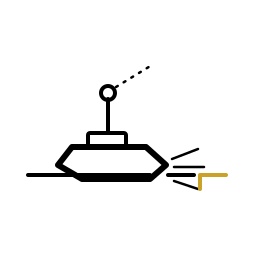
Loon arrives on its rail, or the rail arrives with it. At the ground station, the mission leg — waypoints, altitudes, timing, and the terrain and imagery reference the nav stack will match against — loads over a wired, pre-launch link. No radio check, because nothing on the airframe transmits.
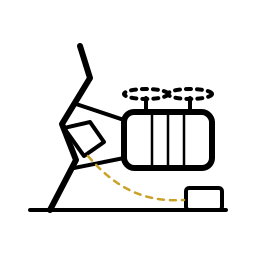
A low-energy rail throws the airframe to flying speed over a few metres — a fraction of the shock environment a tube-launched round sees, gentle enough that COTS electronics ride it without heroic qualification. The motor picks up, the wing loads up, and the leg begins exactly as loaded.
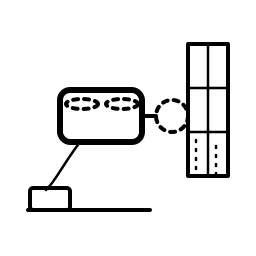
Hours of cruise on inertial, terrain-referenced and celestial fixes, recording the belly-bay sensor the whole way — standoff sensing or wide-area survey, hands off. Nothing calls home. Nothing needs to be listening for it to work.
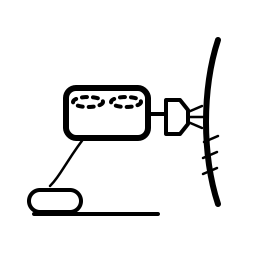
At the end of the leg, the airframe returns to a recovery point — belly landing, net or parachute, depending on the site — and the recorded product comes off at the data-offload dock: physical media or a short wired link, no RF. The picture is hours old by design; it is also un-jammable and unfindable in flight.
Loon is one of eight Goose-family airframes — the one measured in hours and hundreds of kilometres rather than minutes. Three siblings frame the trade it makes: the cheap scout, the night watcher, and the family's one deliberate RF exception.
Hours on station, hundreds of kilometres out — the whole sortie on passive navigation alone.
Download PDF ↓The cheap, tube-launched scout priced to lose — no-radio proven at a few kilometres and an hour's flight.
Download PDF ↓Circles quietly over a perimeter after dark — the family's night watcher.
Download PDF ↓The family's deliberate RF exception — carries the network so the others don't have to.
Download PDF ↓If you plan long-range ISR, standoff sensing or GPS-denied operations for Canada or its allies, Loon — working-point figures and all — is on the table.