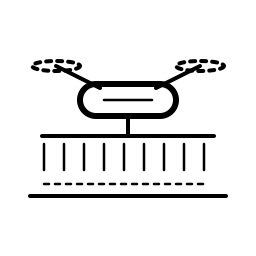
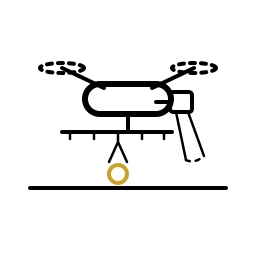
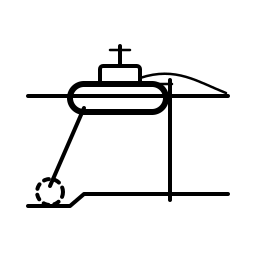
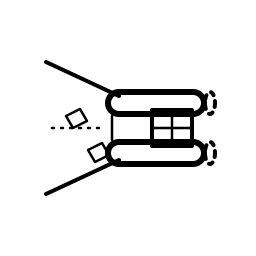
HEARD BY NO ONE.
HOME BEFORE THE LIGHT.
A big, slow propeller and an IR-biased eye — orbiting instead of hovering, unheard, unseen, unjammed.
Perimeter Watch · Route Overwatch · Night ISR · Site Surveillance
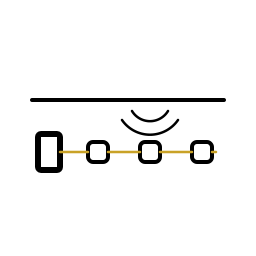
A quiet, fixed-wing electric aircraft built to orbit a route, perimeter or site through the night — a big, slow propeller, an eye biased toward infrared, and nothing aboard that transmits. It carries sensors and nothing else.
A big, slow propeller and an IR-biased eye — orbiting instead of hovering, unheard, unseen, unjammed.
Perimeter Watch · Route Overwatch · Night ISR · Site Surveillance
Owl CS-140 is a quiet, fixed-wing electric aircraft built to orbit a route, perimeter or site through the night — unseen and unheard. It is a passive-sensor carrier, not an interceptor: no warhead, no energetic payload, nothing aboard that can strike, drop or designate.
It takes its place among four other airframes on the same launcher-and-doctrine logic. Kestrel is the cheap, attritable scout; Loon is the long-endurance, long-range eye; Raven is the family's deliberate radio exception — comms relay, decoy, electronic support. Owl is the one built purely for quiet: acoustic and thermal restraint carried ahead of reach or speed. It does not perch on the target; it circles above it. The platform's own hover cross-check makes the reason arithmetic rather than opinion — a same-mass quadrotor would burn roughly five to six times more power to hover than the Owl burns to cruise, so an orbiting fixed wing beats a loitering rotor on this mission.
The doctrine goes one step past the fleet's usual carriers-not-munitions rule. Owl does not just avoid explosives — it carries no effect of any kind. It does not ram, drop, designate for, or trigger anything. It carries sensors, and only sensors. Record-and-return is the baseline data path — perfectly silent, nothing radiated — with an optional trailing fibre for a live, human-in-loop feed on missions that need one. No RF payload of any kind: emission is deliberately left to Raven, so the family's one aircraft built for radio silence never becomes its own exception.

Hover would cost five to six times cruise power on this airframe — arithmetic, not opinion. So the Owl never lands on the target; it circles above it, quietly, on a big slow propeller, until the battery says it's time to go home.
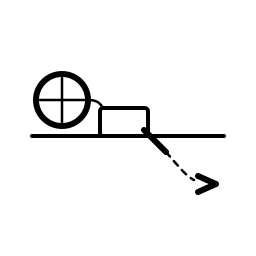
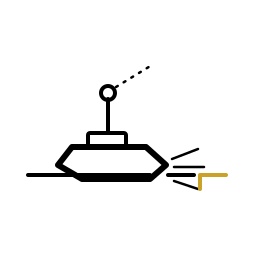
A bungee-elastic rail — about four metres, on unprepared ground — takes the Owl to stall-plus speed at a benign ~1.8 g: far gentler than the shock the fleet's tube-launched interceptors are built to survive. No pyrotechnics, no compressed-gas requirement, no shock-hardening program. That gentleness is also why COTS sensor and avionics hardware is credible on this platform at all.
Once airborne, one engineering control governs the quiet budget, and only one: propeller tip speed. A big propeller turning slowly moves the same air as a small one screaming — roughly 86 m/s at the tip, about Mach 0.25 — and classical propeller acoustics puts rotational noise near the fifth power of that number. No dB(A)-at-distance figure is published for this aircraft, for either the cruise condition or the launch transient: that number comes from a calibrated ground-acoustics measurement, not from arithmetic, and Canadian Shield does not publish arithmetic as measurement.
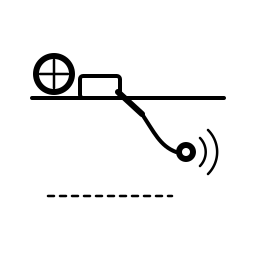
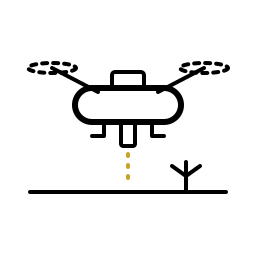
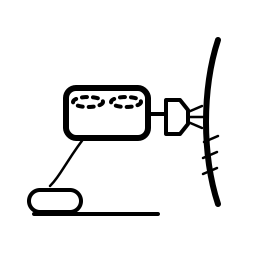
On station the nose or belly bay carries a passive EO/IR sensor biased toward infrared — the name mission is night watch off motor-and-battery contrast — and every frame is recorded onboard. There is no transmitter on this aircraft, in any configuration: the only live option is an optional trailing fibre for a human-in-loop feed. When the sortie ends, the Owl comes down on a deep-stall or belly-skid landing, on ground it never needed prepared, and the record comes home with the airframe.
The complete data card for the Owl — dimensions, performance, launch and recovery, propulsion, sensors, construction and compliance, grouped the way a fleet buyer compares them.
Endurance is stated at the 4.5 kg configuration with the lift-to-drag sweep beside it; bus power includes a 15 W avionics-and-payload allowance. No dB(A)-at-distance acoustic figure is published for either the cruise condition or the launch transient.
The fleet's no-radio rule runs all the way through the Owl: passive optical sensing only, nothing radiated, and data that comes back with the airframe — by record-and-return, or over an optional trailing fibre with a human in the loop. There is nothing aboard for a jammer to find, because nothing aboard transmits.
Owl's product is the picture, not the effect. It hands what it sees to the systems that act — a route-watch frame that cues a ground patrol, a perimeter track that hands off to the interceptor family. Goose and Gyrfalcon get their shot cued by products like the Owl's; the Owl itself never rams, drops, designates for, or triggers anything. Looking and acting stay separated by design, on two different airframes, in two different roles.
The manufacturing thesis rides along. Moulded GF-nylon fuselage and wing shells — the division's first flying wing rather than a cylinder, split into three or four segments so each mould stays small — over a single non-moulded primary structure, a COTS pultruded carbon spar tube running the full span. Recycled rPET stays honestly confined to non-structural parts: the belly skid, bay liners, the ballast/trainer article. Cut on the same Canadian 5-axis floor as the rest of the fleet.
The Owl carries sensors and nothing else — no kinetic mass, no capture chemistry, no net, no dropped store, no laser designator, no RF payload. If the fleet ever needs an aircraft that transmits, that aircraft is called Raven, not Owl.
One night watch, walked end to end — illustrative of how the aircraft is used, not a mission record.
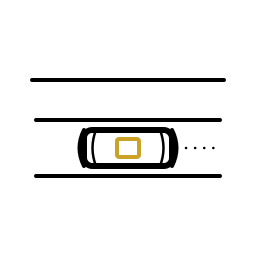
A bungee-elastic rail, roughly four metres, takes the Owl to flying speed at a benign ~1.8 g — no pyrotechnics, no compressed-gas step, no infrastructure beyond the rail and its shuttle. The sortie is preset before the rail; nothing checks in over a link, because there is no link to check.
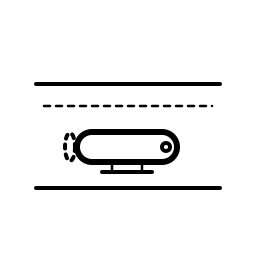
The aircraft climbs out and settles into an orbit over the route, perimeter or site, its IR-biased eye recording onboard through the night. A single airframe is good for roughly two hours on station; continuous coverage is bought by rotation — about three aircraft per watch point, one up, one turning, one in reserve — not by asking one aircraft to do more than its battery allows.
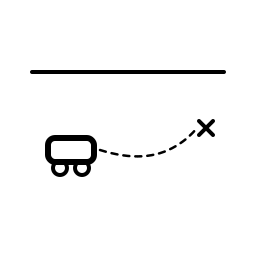
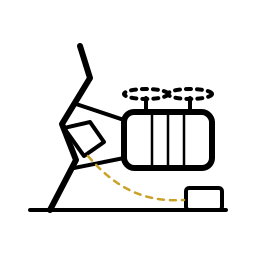
A deep-stall or belly-skid landing brings the Owl down on the same unprepared ground it left from; the replaceable rPET skid takes the wear. The battery pack swaps for the next sortie, and the sensor record comes off with the airframe — intelligence latency equal to sortie length, and nothing exposed to the air in between.
Owl is the Air family's night eye. Three siblings fly the same no-radio thesis in different registers — the cheap scout, the far-ranger, and the family's one deliberate radio exception. Same doctrine, different jobs.
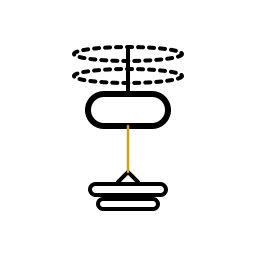
The quiet night watcher — orbits a route, perimeter or site after dark on a big, slow propeller.
Download PDF ↓The cheap, attritable scout — tube-launched, priced to lose, sent anyway.
Download PDF ↓The long-endurance, long-range eye — hours on station, hundreds of kilometres out.
Download PDF ↓The family's deliberate radio exception — comms relay, decoy and electronic support.
Download PDF ↓If you buy, build, integrate or regulate uncrewed night ISR for Canada or its allies, the Owl is on the table.