Beaver · CS-250 · Field-Engineering Carrier

IT DOESN'T OUT-MUSCLE
THE GROUND. IT OUTLASTS IT.

Tracked. Battery-electric. An anchored winch pulls roughly seven times what the tracks alone can.

Route Clearance · Berm & Trench Work · Wire & Obstacle Reduction · Anchored Recovery

600 KG
Gross vehicle mass
20 KN
Anchored winch class
~7×
Winch pull vs unanchored drawbar
0
Radio or GPS links in any tier
What It Is

The Ground Family's Field Engineer.
Grizzly-Common, Reworked to Work.


Beaver CS-250 is a tracked, battery-electric field-engineering carrier — the machine that opens the route rather than moving the load over it. Route clearance, berm shaping, wire and light-obstacle reduction, and anchored recovery are the job; a person's judgment stays on the fibre for every one of them.

It shares the ground family's chassis logic — welded frame, twin electric track drives, low-slung battery bay — but the Beaver's version is reworked at three stations to react working loads instead of just carrying them: a push/tool frame forward, a winch bed and fairlead amidships, and anchor hard-points with a rear spade that hold the hull while the winch works. A front quick-coupler swaps the mission tool — blade, winch and earth-anchor rig, wire/obstacle cutter, trencher/auger, or bridging/matting — the same way Grizzly swaps a cargo module.

The heritage is the same lineage as the family anchor: three decades of the parent group building and operating heavy mobile rigs, carried into a tracked-chassis line that has been in continuous field service since 2017. The Beaver is not a clean-sheet earthmover — it is that lineage, uprated at the stations that see the biggest forces on the vehicle.

The Claim
Grizzly carries. Beaver works.

A dozer works because it is heavy. A 600 kg robotic sapper cannot out-muscle the ground with installed power alone — so the Beaver borrows its force from the ground itself, through an anchored winch, and spends its patience on shallow, repeated passes instead of one heavy one.

  • Force from the anchor — a 20 kN winch line pulls roughly seven times what the tracks alone can.
  • Patience over mass — shallow, multi-pass cuts where a single-pass dozer can't be patient.
  • No radio, no GPS — preset routes and fibre-tethered work emit nothing.
01 How It Works · The Force System

THE FORCE COMES FROM THE ANCHOR, NOT THE MOTOR


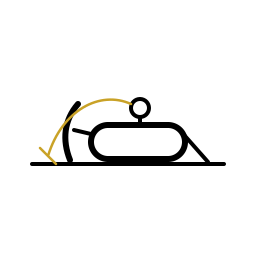
Weight is the tool in earthmoving, and a light robotic sapper can't cheat that with installed power. So the Beaver's blade does the shallow work directly, and its signature system — a 20 kN-class winch, fairlead, rear spade and a portable earth anchor set forward of the vehicle — does the heavy work by pulling against the ground itself.

The front blade lifts and angles for shallow, multi-pass cuts — grading, snow, berm shaping and light rubble, not single-pass dozing. Net drawbar on its own tracks runs roughly 2.7–5.4 kN depending on soil, worth a 5–11 cm cut per pass. Planted and anchored, the same 20 kN winch line pulls roughly seven times that — the honest number behind “a grader and a winch, not a dozer.”

Guidance runs the fleet's three no-radio ground tiers, but the work itself stays on Tier 2: fibre-tethered teleop with a human in the loop, because judgment calls at an active worksite are not an autonomy task — SLAM is scoped to transit and survey. Tool interlocks sit outside the autonomy stack entirely: no blade or auger motion without an armed, deliberate command, and a defined line-safety zone around any loaded winch line.

ANCHORED PULL GRADER FORWARD · ANCHORED WINCH AFT 15 kWh LFP 1.0 m BLADE — LIFT + ANGLE WINCH REAR SPADE REMOTE ANCHOR LOAD NET DRAWBAR (TRACKS) ≈2.7–5.4 kN soil-dependent ANCHORED WINCH 20 kN · ~7× anchor-limited CS-250 · the anchor takes the load the tracks alone can't
Full Specification Sheet

Every Number, Grouped for the Walk-Around.


The complete data card for the Beaver carrier — dimensions, performance, the force system, tools, guidance and compliance, grouped the way a fleet buyer compares them.

Beaver CS-250 · Field-Engineering Carrier Ground Family · Work Tier · Field Engineer

01Dimensions & Mass

Gross vehicle mass
600 kg
Track contact patch
0.55 m²
Nominal ground pressure
≈10.7 kPa (~1.6 psi) — light-tracked class
Mass residual
~380 kg of 600 kg gross — frame, tracks and drives

02Performance

Work speed (blading)
~0.5 m/s
Transit cruise
~2.5 m/s (9 km/h)
Net drawbar — loose soil
≈2.7 kN
Net drawbar — firm cohesive soil
≈5.4 kN
Drawbar power @ 0.5 m/s
≈1.7 kW electrical — force-limited, not power-limited

03Drive & Energy

Configuration
Tracked skid-steer · twin electric track drives — Grizzly-common platform
Energy storage
15 kWh LFP (~100 kg) — force-limited, not energy-limited

04Winch & Anchor

Winch
20 kN-class COTS · fairlead, rear spade, portable earth anchors
Winch line speed / power
0.1 m/s · 2.0 kW electrical
Anchored-winch multiplier
≈7× unanchored drawbar — anchor-limited; holding capacity is a soil-class question

05Tools & Interface

Front blade
1.0 m · lift + angle · shallow multi-pass
Blade cut depth per pass
~5 cm loose · ~11 cm firm cohesive
Front tool interface
Quick-coupler mount · electric/hydraulic tool power · data/feedback · shock-rated
Mission tools
5 — blade, winch + anchor, wire/obstacle handling, trencher/auger, bridging/matting

06Guidance & Signature

Guidance tiers
Preset waypoint · fibre-tethered teleop for work · autonomous SLAM for transit and survey
Emissions
None in any tier — no radio, no GNSS
Design environment
Muskeg · snow · freeze–thaw · to −40 °C

07Compliance

Patent status
Patent pending
Export control
Export-controlled — international transfer subject to Canadian government permits; export posture is counsel-first
Munitions classification
Carrier for mechanical engineering tools, not a munition — no warhead, fuze or energetic material in any tool or variant
Tool governance
No blade or auger motion without an armed, deliberate command — a human on the fibre for every working task
Scope
The Beaver opens the route; heavy haul over it is Grizzly CS-210 scope

Every cut-depth and drawbar figure states its soil class, and the anchored-winch multiplier is anchor-limited — holding capacity is a soil-class question, stated with the pull rather than assumed. A 600 kg sapper does not out-muscle the ground; it borrows its force from the anchor and spends patience on shallow, repeated passes.

In the Doctrine

No Radio. No GPS.
The Worksite Doesn't Get a Signal Either.


The fleet's thesis is that the link is the vulnerability — so the Beaver carries none. Preset routes and fibre-tethered work emit nothing; SLAM senses passively for transit and survey and calls home never. A parted winch line is the worst failure mode on this platform, not a jammed one, and the safety chain — hardwired e-stops, a wired stop over the fibre, a defined line-safety zone, and tool interlocks that require an armed, deliberate command before any blade or auger moves — is built for exactly that.

The manufacturing thesis sharpens here rather than softens: every ground-engaging tool — blade edge, auger flight, anchor spade, winch structure — is steel, welded and machined in the owned 5-axis shop, not moulded. Abrasion, point loads and −40°C impact are exactly where polymer fails, and earthwork finds that failure fast. Beaver is a coordinated carrier within the ground family — a support platform for engineering tasks, never a strike platform — and every one of its five tools is mechanical: no warhead, fuze or energetic material anywhere in the lineup.

Family Context
Six platforms. One chassis logic.

Grizzly anchors CS-210 through CS-260: Grizzly hauls the heavy load, Moose hauls bulk, Wolf coordinates in numbers, Lynx scouts ahead, Beaver works the ground, Wolverine carries the access tools. The anchor's deck standard, console and safety chain are engineering the family buys once — Beaver spends that budget on the three stations that let a light carrier react a heavy force.

Deployment

A Route-Clearing Leg, Walked Through.


One leg, walked end to end — illustrative of how the carrier is used, not a mission record.

01 · Arrival

By Surface, Tool On the Nose

The Beaver self-deploys on tracks, or arrives by road, rail or sling. At the worksite the blade or the winch-and-anchor rig lands on the front quick-coupler — mechanical mount, power and data in one motion — and the fibre spool is seated for the tethered leg ahead. No link check — there is no link.

02 · Work

Shallow Cuts, Anchored Pulls

On a route-clearing or berm leg, the blade takes shallow, multi-pass cuts at a steady work speed, patient where a single-pass dozer can't be. Where the job is a pull — an obstacle, a bogged load, a recovery — a remote earth anchor goes down forward of the vehicle, the rear spade sets, and the 20 kN winch takes the strain the tracks alone couldn't. A human stays on the fibre for every armed command; uncertain ground still means stop, hold, wait.

03 · Recover

Line In, Tool Swapped, Out Again

The winch line reels in, the spade lifts, and the tool swaps at the quick-coupler for the next task — the same interface whether it lands a blade, an auger or a matting rig. If a leg ends early, the vehicle is exactly where it stopped — holding, silent, waiting for a person. Recovery is a tow point, not a search.

The Ground Family · At a Glance

Six Platforms. One Chassis Logic.


Grizzly anchors CS-210 through CS-260, and the anchor's deck standard, console and safety chain are engineering the family buys once. The Beaver spends that budget on the three stations that let a light carrier react a heavy force.

This engineer CS-250 · Field engineer

Beaver

Works the ground — grades the route, shapes the berm and pulls from the anchor. The machine that opens the way.

Download PDF
CS-210 · Family anchor

Grizzly

Hauls the heavy load — the anchor whose deck standard, console and safety chain the whole family buys once.

Download PDF
CS-220 · Bulk hauler

Moose

Hauls bulk on the family's shared chassis logic.

Download PDF
CS-230 · Coordinated numbers

Wolf

Coordinates in numbers — many carriers on the same doctrine.

Download PDF
CS-240 · Fast scout

Lynx

Scouts ahead of the family's heavy movers.

Download PDF
CS-260 · Access tools

Wolverine

Carries the access tools to the work face.

Download PDF
Proof, Not Promotion

Clear the Ground.
Not the Person.

If you buy, build, integrate or regulate uncrewed field-engineering systems for Canada or its allies, the Beaver is on the table.

Full Marketing Package

The Rest of the Fleet.


Every Canadian Shield platform has a brochure like this one — same depth, same status discipline, same refusal to publish a number we cannot source. Organized by family below.

Air · 8
CS-110 · Air

Goose

No battery. No motor. No receiver. A kinetic carrier launched at ~189 m/s on shop air.

Read the brochure Download PDF
CS-111 · Air

Encapsulator

A capture-head variant on the Goose CS-110 launch line — fouls rotors and entangles the airframe instead of striking it down.

Read the brochure Download PDF
CS-112 · Air

Matrix

Aimed, direct-fire, tethered — the net that stays connected to the gun that threw it.

Read the brochure Download PDF
CS-120 · Air

Gyrfalcon

Goose's launch chain, plus the power Goose leaves out — a tail motor and bow-thruster ring for mid-flight correction.

Read the brochure Download PDF
CS-130 · Air

Raven

A moulded electric aircraft that carries the network — decoy, relay, electronic support. Non-kinetic. Recoverable.

Read the brochure Download PDF
CS-140 · Air

Owl

A big, slow propeller and an IR-biased eye — orbiting instead of hovering, unheard, unseen, unjammed.

Read the brochure Download PDF
CS-150 · Air

Loon

The bird that flies its whole leg without asking a satellite for a name.

Read the brochure Download PDF
CS-160 · Air

Kestrel

The Air family's smallest body — a tube-launched, motor-cruising scout priced to lose, not to last.

Read the brochure Download PDF
Ground · 6
CS-210 · Ground

Grizzly

Tracked. Battery-electric. 150 kg over muskeg — with nothing to jam.

Read the brochure Download PDF
CS-220 · Ground

Moose

600 kg of freight over bad ground. Payload is the product — mobility is the constraint it is bought within.

Read the brochure Download PDF
CS-230 · Ground

Wolf

Eight coordinated carriers. One fibre trunk. One operator. Nothing to jam.

Read the brochure Download PDF
CS-240 · Ground

Lynx

A wheeled route-picker with thermal eyes — and a watch mode measured in days.

Read the brochure Download PDF
This brochure CS-250 · Ground

Beaver

Tracked. Battery-electric. An anchored winch pulls roughly seven times what the tracks alone can.

Read the brochure Download PDF
CS-260 · Ground

Wolverine

A compact tracked carrier that places self-reacting tools at the work face — the force closes on the structure, not the machine.

Read the brochure Download PDF
Water · 2
CS-310 · Water

Orca

Persistent survey & carrier AUV — one moulded hull that surveys, carries and watches.

Read the brochure Download PDF
CS-320 · Water

Jellyfish

A soft pulsed-jet payload carrier — slower than the current on purpose.

Read the brochure Download PDF
Underground · 8
CS-410 · Underground

Badger

A surface plant that pushes a steerable head into ground with no line, no map, no signal.

Read the brochure Download PDF
CS-411 · Underground

Aquifer

Coiled-tubing bore, fibre-guided — conduit installed, water table mapped, nothing to jam.

Read the brochure Download PDF
CS-420 · Underground

Ferret

Recon, mapping and locating in existing tunnels and culverts — with a block-only interpose capability, always human-confirmed.

Read the brochure Download PDF
CS-430 · Underground

Mole

A passive seismic and acoustic node on long-life battery — reporting only over a buried fibre link.

Read the brochure Download PDF
CS-435 · Underground

Trembler Line

A chain of buried Mole nodes on a fibre trunk — detect, localize, cue. Nothing radiated, nothing to jam.

Read the brochure Download PDF
CS-440 · Underground

Muskrat

Hybrid swim/crawl. Zero visibility. No diver, no radio, no GPS.

Read the brochure Download PDF
CS-450 · Underground

Gopher

It maps, it marks, it parks. Cheap enough to send in numbers.

Read the brochure Download PDF
CS-460 · Underground

Farell Pig

Flow-driven, self-propelled or tethered — it rides the line, it doesn't bore one.

Read the brochure Download PDF
Industrial · 17
CS-510 · Industrial

Seeder

A pneumatic seed-pod launcher, retuned to gentleness. Pods down, evidence back.

Read the brochure Download PDF
CS-520 · Industrial

Skimmer

A small moulded surface craft — the information and marking layer of a spill response.

Read the brochure Download PDF
CS-530 · Industrial

Rock Scaler

A contact-tolerant aerial platform sets the hook. A ground-anchored winch does the pulling.

Read the brochure Download PDF
CS-540 · Industrial

Washer

A caged, umbilical-fed washing platform. Water up the line, evidence back down.

Read the brochure Download PDF
CS-550 · Industrial

Coater

An umbilical-fed applicator platform. The pressure stays on the ground; the machine flies the last few hundred millimetres.

Read the brochure Download PDF
CS-560 · Industrial

Sprayer

Full-width boom, drift-reduction nozzles, a metered rate held across the pass. The broadcast tool for the uniform job.

Read the brochure Download PDF
CS-561 · Industrial

Spot Sprayer

Machine vision finds the target; only that nozzle opens. Built to cut total product volume per acre.

Read the brochure Download PDF
CS-570 · Industrial

Dredger

A trailerable uncrewed dredger for ponds, marinas, lagoons and channels.

Read the brochure Download PDF
CS-580 · Industrial

Recovery

An uncrewed collection craft for the debris and spill material that floats.

Read the brochure Download PDF
CS-590 · Industrial

Enviro

A tracked, teleoperated manipulator platform for shoreline and land cleanup — reach, load and slope, enforced as one envelope.

Read the brochure Download PDF
CS-630 · Industrial

Litter Collector

An uncrewed multirotor built to find litter, take only litter, and prove it did.

Read the brochure Download PDF
CS-600 · Industrial

Cargo Mover

An uncrewed VTOL cargo family — four sizes of the same machine, from toolbox to bulk lift.

Read the brochure Download PDF
CS-610 · Industrial

Personnel Mover

A crew-carrying VTOL work machine. Two tiers — PM-8 single-seat, PM-12 two-seat.

Read the brochure Download PDF
CS-620 · Industrial

Heavy-Lift Logger

An uncrewed coaxial hybrid rotorcraft for long-line log extraction — turn after turn, hour after hour.

Read the brochure Download PDF
CS-700 · Industrial

Self-Charging Dock

A docking and replenishment station that lets a working fleet return, recharge and redeploy without a hand touching it.

Read the brochure Download PDF
CS-710 · Industrial

Relay Chain

A deployable chain of relay nodes — command, telemetry and position augmentation for civil fleets working past the edge of the network.

Read the brochure Download PDF
CS-C001 · Industrial

Fibre Spool Line

Guidance-fibre consumable cassettes — a physical tether option, alongside or instead of radio.

Read the brochure Download PDF
Defence · 1
CS-901 · Defence

Shield Pod

A canopy-retarded delivery pod: land on a crumple zone, right itself, open, release the carrier system.

Read the brochure Download PDF