Underground Systems · CS-4xx Badger line mark — opens the interactive 3D deployment and simulation (portal access required) ▶ Interactive 3D · portal access

Badger CS-4xx family

Send the robot down the hole, not the soldier. Seven platforms and one system for the domain where GPS dies and radio dies — boring, tunnel recon, buried sensing, wet-tunnel work and pipeline riding, on thirty years of directional-drilling heritage. Effects are recon, mapping, sensing, emplacement and physical interposition only.

years of build history — a proven line HDD heritage — existing trade proprietary design — patent pending
SURFACE · 0 M BADGER CS-410 — COILED-TUBING MICRO-BORE SURFACE PLANT COIL REEL → STRAIGHTENER → CLAMP-AND-PUSH DRIVE → ENTRY GUIDE TOPSOIL SUBSOIL / SAND CLAY · GLACIAL TILL BEDROCK — CANADIAN SHIELD NO RADIO · NO GPS — ENFORCED BY PHYSICS COILED TUBING — FIBRE (GUIDANCE · COMMS) · LUBE · PAYLOAD — AND THE CONDUIT PRODUCT LEFT IN THE BORE STEERABLE COMPACTION HEAD — DISPLACEMENT BORE · NO SPOIL RETURN HDD-TYPE BIT — TRICONE / PDC MOLE CS-430 — SEISMIC / ACOUSTIC LISTENER FERRET CS-420 — EXISTING-TUNNEL RECON

Cross-section, indicative — a design sketch, not an engineering drawing. Badger is a surface plant: nothing enters the ground except the tubing and the head. Depths, geometries and platform names are working candidates.

Full Marketing Package

The Full Fleet.


Every Canadian Shield platform has a brochure like this one — same depth, same status discipline, same refusal to publish a number we cannot source. Organized by family below.

Air · 8
CS-110 · Air

Goose

No battery. No motor. No receiver. A kinetic carrier launched at ~189 m/s on shop air.

Read the brochure Download PDF
CS-111 · Air

Encapsulator

A capture-head variant on the Goose CS-110 launch line — fouls rotors and entangles the airframe instead of striking it down.

Read the brochure Download PDF
CS-112 · Air

Matrix

Aimed, direct-fire, tethered — the net that stays connected to the gun that threw it.

Read the brochure Download PDF
CS-120 · Air

Gyrfalcon

Goose's launch chain, plus the power Goose leaves out — a tail motor and bow-thruster ring for mid-flight correction.

Read the brochure Download PDF
CS-130 · Air

Raven

A moulded electric aircraft that carries the network — decoy, relay, electronic support. Non-kinetic. Recoverable.

Read the brochure Download PDF
CS-140 · Air

Owl

A big, slow propeller and an IR-biased eye — orbiting instead of hovering, unheard, unseen, unjammed.

Read the brochure Download PDF
CS-150 · Air

Loon

The bird that flies its whole leg without asking a satellite for a name.

Read the brochure Download PDF
CS-160 · Air

Kestrel

The Air family's smallest body — a tube-launched, motor-cruising scout priced to lose, not to last.

Read the brochure Download PDF
Ground · 6
CS-210 · Ground

Grizzly

Tracked. Battery-electric. 150 kg over muskeg — with nothing to jam.

Read the brochure Download PDF
CS-220 · Ground

Moose

600 kg of freight over bad ground. Payload is the product — mobility is the constraint it is bought within.

Read the brochure Download PDF
CS-230 · Ground

Wolf

Eight coordinated carriers. One fibre trunk. One operator. Nothing to jam.

Read the brochure Download PDF
CS-240 · Ground

Lynx

A wheeled route-picker with thermal eyes — and a watch mode measured in days.

Read the brochure Download PDF
CS-250 · Ground

Beaver

Tracked. Battery-electric. An anchored winch pulls roughly seven times what the tracks alone can.

Read the brochure Download PDF
CS-260 · Ground

Wolverine

A compact tracked carrier that places self-reacting tools at the work face — the force closes on the structure, not the machine.

Read the brochure Download PDF
Water · 2
CS-310 · Water

Orca

Persistent survey & carrier AUV — one moulded hull that surveys, carries and watches.

Read the brochure Download PDF
CS-320 · Water

Jellyfish

A soft pulsed-jet payload carrier — slower than the current on purpose.

Read the brochure Download PDF
Underground · 8
CS-410 · Underground

Badger

A surface plant that pushes a steerable head into ground with no line, no map, no signal.

Read the brochure Download PDF
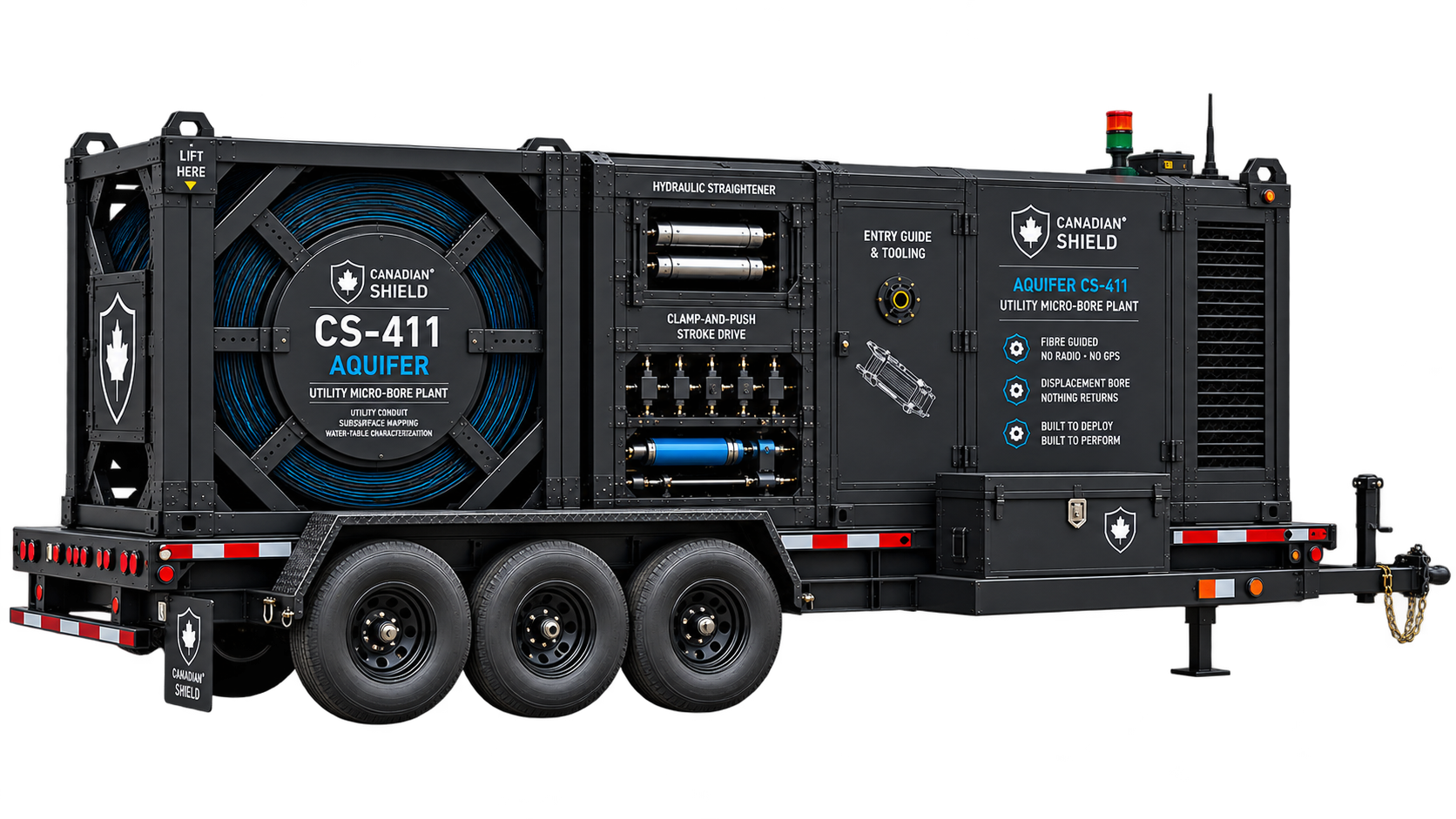
CS-411 · Underground

Aquifer

Coiled-tubing bore, fibre-guided — conduit installed, water table mapped, nothing to jam.

Read the brochure Download PDF
CS-420 · Underground

Ferret

Recon, mapping and locating in existing tunnels and culverts — with a block-only interpose capability, always human-confirmed.

Read the brochure Download PDF
CS-430 · Underground

Mole

A passive seismic and acoustic node on long-life battery — reporting only over a buried fibre link.

Read the brochure Download PDF
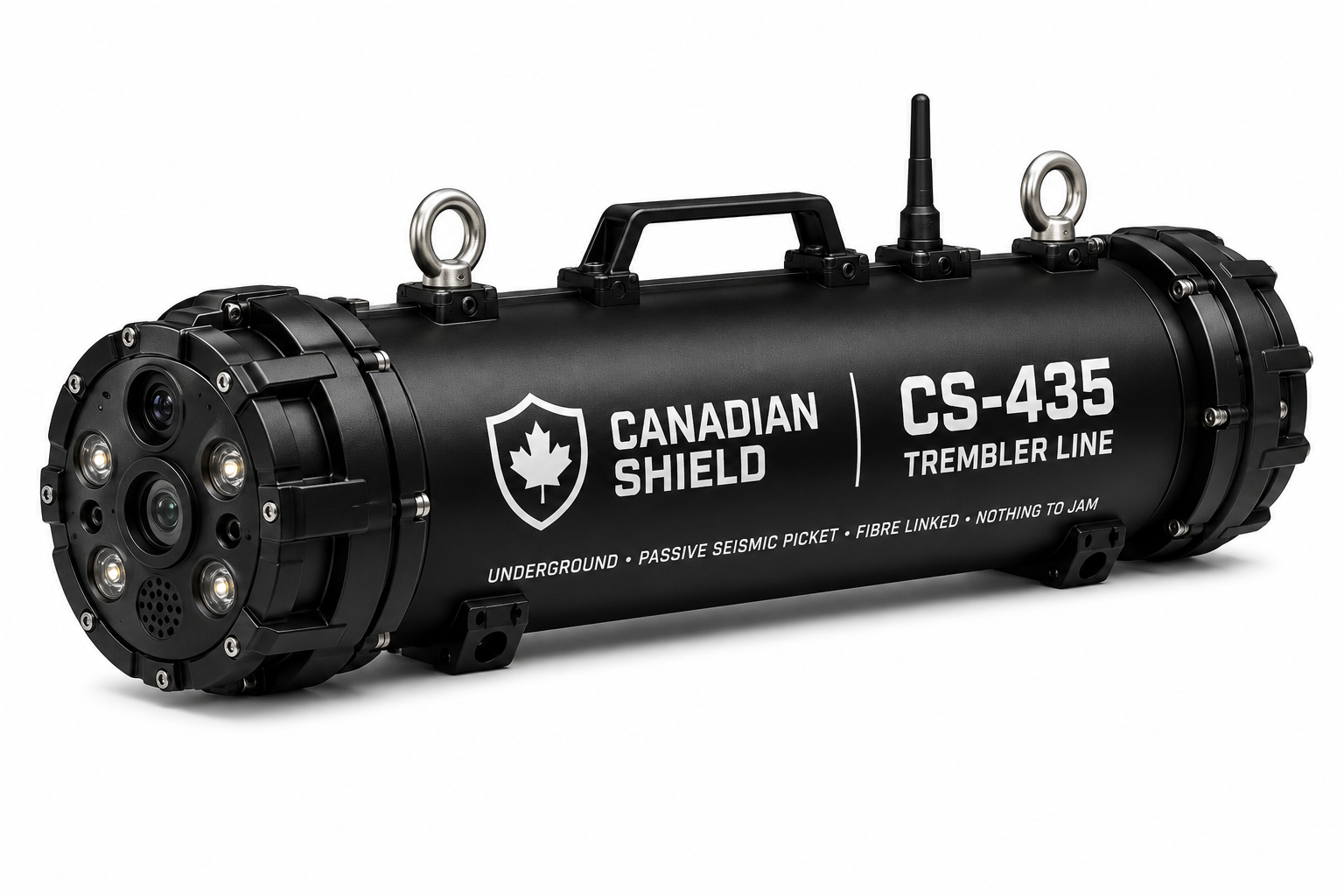
CS-435 · Underground

Trembler Line

A chain of buried Mole nodes on a fibre trunk — detect, localize, cue. Nothing radiated, nothing to jam.

Read the brochure Download PDF
CS-440 · Underground

Muskrat

Hybrid swim/crawl. Zero visibility. No diver, no radio, no GPS.

Read the brochure Download PDF
CS-450 · Underground

Gopher

It maps, it marks, it parks. Cheap enough to send in numbers.

Read the brochure Download PDF
CS-460 · Underground

Farell Pig

Flow-driven, self-propelled or tethered — it rides the line, it doesn't bore one.

Read the brochure Download PDF
Industrial · 17
CS-510 · Industrial

Seeder

A pneumatic seed-pod launcher, retuned to gentleness. Pods down, evidence back.

Read the brochure Download PDF
CS-520 · Industrial

Skimmer

A small moulded surface craft — the information and marking layer of a spill response.

Read the brochure Download PDF
CS-530 · Industrial

Rock Scaler

A contact-tolerant aerial platform sets the hook. A ground-anchored winch does the pulling.

Read the brochure Download PDF
CS-540 · Industrial

Washer

A caged, umbilical-fed washing platform. Water up the line, evidence back down.

Read the brochure Download PDF
CS-550 · Industrial

Coater

An umbilical-fed applicator platform. The pressure stays on the ground; the machine flies the last few hundred millimetres.

Read the brochure Download PDF
CS-560 · Industrial

Sprayer

Full-width boom, drift-reduction nozzles, a metered rate held across the pass. The broadcast tool for the uniform job.

Read the brochure Download PDF
CS-561 · Industrial

Spot Sprayer

Machine vision finds the target; only that nozzle opens. Built to cut total product volume per acre.

Read the brochure Download PDF
CS-570 · Industrial

Dredger

A trailerable uncrewed dredger for ponds, marinas, lagoons and channels.

Read the brochure Download PDF
CS-580 · Industrial

Recovery

An uncrewed collection craft for the debris and spill material that floats.

Read the brochure Download PDF
CS-590 · Industrial

Enviro

A tracked, teleoperated manipulator platform for shoreline and land cleanup — reach, load and slope, enforced as one envelope.

Read the brochure Download PDF
CS-630 · Industrial

Litter Collector

An uncrewed multirotor built to find litter, take only litter, and prove it did.

Read the brochure Download PDF
CS-600 · Industrial

Cargo Mover

An uncrewed VTOL cargo family — four sizes of the same machine, from toolbox to bulk lift.

Read the brochure Download PDF
CS-610 · Industrial

Personnel Mover

A crew-carrying VTOL work machine. Two tiers — PM-8 single-seat, PM-12 two-seat.

Read the brochure Download PDF
CS-620 · Industrial

Heavy-Lift Logger

An uncrewed coaxial hybrid rotorcraft for long-line log extraction — turn after turn, hour after hour.

Read the brochure Download PDF
CS-700 · Industrial

Self-Charging Dock

A docking and replenishment station that lets a working fleet return, recharge and redeploy without a hand touching it.

Read the brochure Download PDF
CS-710 · Industrial

Relay Chain

A deployable chain of relay nodes — command, telemetry and position augmentation for civil fleets working past the edge of the network.

Read the brochure Download PDF
CS-C001 · Industrial

Fibre Spool Line

Guidance-fibre consumable cassettes — a physical tether option, alongside or instead of radio.

Read the brochure Download PDF
Defence · 1
CS-901 · Defence

Shield Pod

A canopy-retarded delivery pod: land on a crumple zone, right itself, open, release the carrier system.

Read the brochure Download PDF
01 · The Doctrine

The Underground Moat.


Steering a tool through the ground blind — walkover locating, wireline steering, bore-path planning — is the directional-drilling trade. Canadian Shield sits on it through the SIG group's own directional-drilling companies — thirty years of it — plus the owned 5-axis mould shop. Airframes iterate in months; drilling competence is learned in the ground, over years. That is the moat.

THE CLAIM

Heritage Is the Entry Ticket

Every underground vehicle must solve the problem HDD solved decades ago: know where the head is, steer it where it must go, and talk to it — all without RF. We are not inventing the method; we are re-housing a trade the group already practises.

“An underground moat you cannot buy from a catalogue.”
THE TRICK

One Fibre, Five Jobs

The unifying idea across the family: a trailing optical fibre that is the guidance, the comms, the continuous power feed for the deep series, the breadcrumb back out — and, for Badger, the conduit product left behind in the bore. One line, everything on it, nothing to jam.

“There is nothing to jam.”
THE SPLIT

Make the Hole · Work the Hole

Two jobs, split clean. Badger and Aquifer make the hole. Ferret, Mole, Muskrat, Gopher and the Farell Pig work holes and passages that already exist — they enter, listen in, swim, crawl or ride. Every platform has a civil twin, and the civil work funds the defence line.

“Send the robot down the hole, not the soldier.”
The Radio Boundary — Stated Plainly

No Radio, Both Halves

No radio and no GPS in any defence, underground or tethered design — ever. Underground, the rule is enforced by physics: rock and soil kill RF outright. Radio and GNSS are permitted on the civil Industrial line only — it is the surface exception, and we say so explicitly. Guidance tiers down here: preset for one-way Gopher runs, fibre-guided human-in-the-loop as the default, and mapping autonomy only — never engagement autonomy — as the Ferret growth path.

01B · The Heritage Behind the Push

A Problem the Group Already Solved Once.


Pushing a long, thin tube through the ground for hundreds of metres has one enemy: friction building up along the string until the drive can't push any further. Inside SIG's own horizontal-directional-drilling practice, a downhole tool developed for exactly this problem — vibration applied along the drill string during pull-back — measurably reduces that friction while it works. It is real, fielded heritage, not a Badger invention: the underlying method has been field-proven across roughly two thousand kilometres of installed bore since the mid-2000s.

THE PRINCIPLE

Vibration Eases the Pull

A small vibration element carried in the drill string reduces the force needed to advance and retrieve it — the same physics that lets a vibrating stake sink into ground a static one resists. It is field heritage, not a Badger-specific design: the same friction problem shows up on Badger's own coil-tube run, and the same principle is the design inspiration for addressing it there.

THE DISCIPLINE

Three Failures, Three Fixes

The heritage tool's design history is a short list of hard lessons, each one closed with a design rule still carried forward: an early unit ran too long and broke downhole from accumulated friction — shortened. A later unit let fluid pressure build up and fractured the surrounding material — the flow path was redesigned. A battery failed under sustained vibration loading — replaced with a solid, vibration-rated cell as a standing requirement. Nothing here is theoretical; every rule on this list was paid for once in the field.

Stated Plainly

Heritage, Not Yet a Proven Result at Badger's Scale

The friction-reduction principle is field-proven at pipeline-installation scale, on equipment much larger than Badger's own coil-tube drive. Whether — and how much — it carries over to Badger's smaller tube, different soils, and different power budget is a real engineering question, not yet answered. We say so here rather than assume it.

friction-reduction principle — field heritage, existing trade
02 · Family Anchor

Badger CS-410
A Plant, Not a Crawler.


Badger is not a machine that rides into the hole. It is a coiled-tubing micro-bore surface plant: coil reel, hydraulic straightener, clamp-and-push stroke drive and entry guide, pushing a steerable compaction head downhole. Displacement method — no spoil return. Nothing enters the ground except tubing and head, and the delivered product can be the conduit itself. The only platform in the family with a mission and deployment model of its own. The line carries years of build history.

Guidance: Fibre Only

Tier 2, per the doctrine — downhole attitude sensing over the fibre, HDD walkover and wireline locating heritage, and stroke-count odometry from the drive. A human holds the loop; the fibre is the loop. No radio and no GPS exist anywhere in the design.

Superseded

The Old Crawler Is Retired

Earlier design material used auger-crawler terminology that didn't match the actual drive architecture; that description has been corrected to the surface plant described here. The heritage behind it is not affected: Canadian Shield's parent group has run mobile horizontal-directional-drilling rigs in commercial service for three decades, and that trade — surveying, locating and steering a tool underground without radio — stands regardless of which architectural description was used to explain the mechanism. Badger itself is engineered and patent-pending, in prototype and testing.

architecture per current drawing package
The Civil Twin — Aquifer CS-411

The Export-Light Line That Funds the Rest

Aquifer is the civil long-horizontal-bore variant: same plant, same fibre guidance, same surface-powered deep series — pointed at conduit and utility installation and subsurface and water-table mapping, sold through SIG's existing trenchless and pipeline relationships. Size, bore length and rate are unmodelled; the export-light framing is a counsel question, not a settled fact.

roadmap
02B · The Fleet Layer

Strategic Agents. Learn From Every Run.


Every run a Badger unit completes is a data point. A software layer above the platform — shared across the Depth Series fleet, not bespoke to any one job — turns that accumulating record into three concrete predictions the crew can act on before the next push, not after it fails.

Stated Plainly

A Software Layer, Not a Shipped Product

Strategic Agents is fleet-scale software sitting above the Depth Series hardware, not a feature any single unit carries today. It gets more useful the more the fleet runs — which also means it starts as a thin layer and earns its predictions over time, not on day one.

03 · The Roster

Seven Platforms.
One System. One Job Each.


Designations per the program canon, verified collision-free; platform names are working candidates. Only Badger and Aquifer bore — the other six were verified as having no bore-head dependency at all. They enter, listen in, swim, crawl or ride passages that already exist. And nothing in this family is launched — every unit is emplaced: surveyed first with the same pre-job discipline an HDD crew runs today, positioned and anchored, deployed with a human in the loop over fibre, then recovered on its breadcrumb or left in place as a designed, logged abandonment.

PlatformRole in one lineSeries · powerStatus
Badger CS-410 Surface coiled-tubing plant — pushes a steerable head where there is no hole; the tubing stays behind as fibre conduit. Family anchor, the moat. Deep · tether-fed in development
Aquifer CS-411 Civil long-horizontal-bore twin — the export-light line that funds the defence side. Deep · tether-fed roadmap
Ferret CS-420 Enters existing tunnels; recon, map, locate; interposes on a Trembler Line cue — blocks, never strikes. Shallow · battery roadmap
Mole CS-430 Buries itself and goes still — passive seismic/acoustic node for persistent watch. Long-life battery roadmap
Trembler Line CS-435 A system, not a platform: strung Mole nodes that detect, localize and cue a Ferret. Human decides. Fibre node-to-node advancing system design
Muskrat CS-440 Flooded culverts and storm sewers — the wet-tunnel specialist that bridges to Orca. Shallow · battery roadmap
Gopher CS-450 Expendable mapper/marker for one-way missions — the attritable tier; parks as the terminal marker by design. Shallow · battery roadmap
Farell Pig CS-460 Doesn't dig — rides existing pipelines, culverts and conduits as a payload carrier. Designation registration is owed. Flow / self / tether in development

Cross-reference: the Shield Pod (CS-901) is the fleet's cross-cutting air-deployment pod; its highest-value case is air-delivering a Badger plant, and the same pod has a humanitarian twin — lifeline delivery to sites nothing else can reach, same pod, same ethic. It lives with the support layer, not this family.

04 · Work the Hole

The Six That Don't Bore.


Six roles, one shared coiled-tubing platform — full designations and roles in the roster below.

05 · The Picket

Trembler Line CS-435
Detect. Localize. Cue.


A system, not a platform: Mole nodes strung on a dark-fibre trunk to a monitored head-end. The line hears digging, tunnelling, footsteps and vehicles, localizes the source from the pattern across the nodes, and cues a Ferret to interpose. Response is human-in-the-loop before any physical engagement — the system detects, localizes and cues. It never strikes.

INTRUSION — HEADING WEST DIGGING / FOOTSTEPS / VEHICLE MOLE NODES — FIBRE-LINKED · NODE-TO-NODE · NO EMISSIONS FIRST ARRIVAL — LOUDEST NODE BLOCK POSITION — INTERPOSE, NOT STRIKE FERRET — CUED AHEAD OF THE PATH · HUMAN CONFIRMS FIRST TREMBLER LINE — PASSIVE SEISMIC PICKET · NOTHING TO JAM DETECT → LOCALIZE → CUE → HUMAN CONFIRM

Sequence, indicative. No strike authority exists anywhere in the loop — the end state is a machine parked in the way, on a human's confirmation.

Straight Talk

What We're Proving Out

Whether seismic localization can hand a Ferret a position and vector tight enough to block on is the leading question the advancing design work must answer. Telling a digger from a deer from a foot patrol — false-positive discrimination — is open. False alarms are the historic failure mode of every seismic picket, and we say so before a customer discovers it. Civil twin: geotechnical and infrastructure monitoring.

Proof, Not Promotion

The Domain Nobody Can Buy
From a Catalogue.

If you own pipelines, utilities, perimeters or the problems under them — or you buy, build or regulate uncrewed systems for Canada and its allies — the underground line is where our heritage runs deepest.