SEND THE ROBOT DOWN
THE HOLE, NOT THE SOLDIER
A surface plant that pushes a steerable head into ground with no line, no map, no signal.
Boring · Conduit Emplacement · Denied-Ground Access
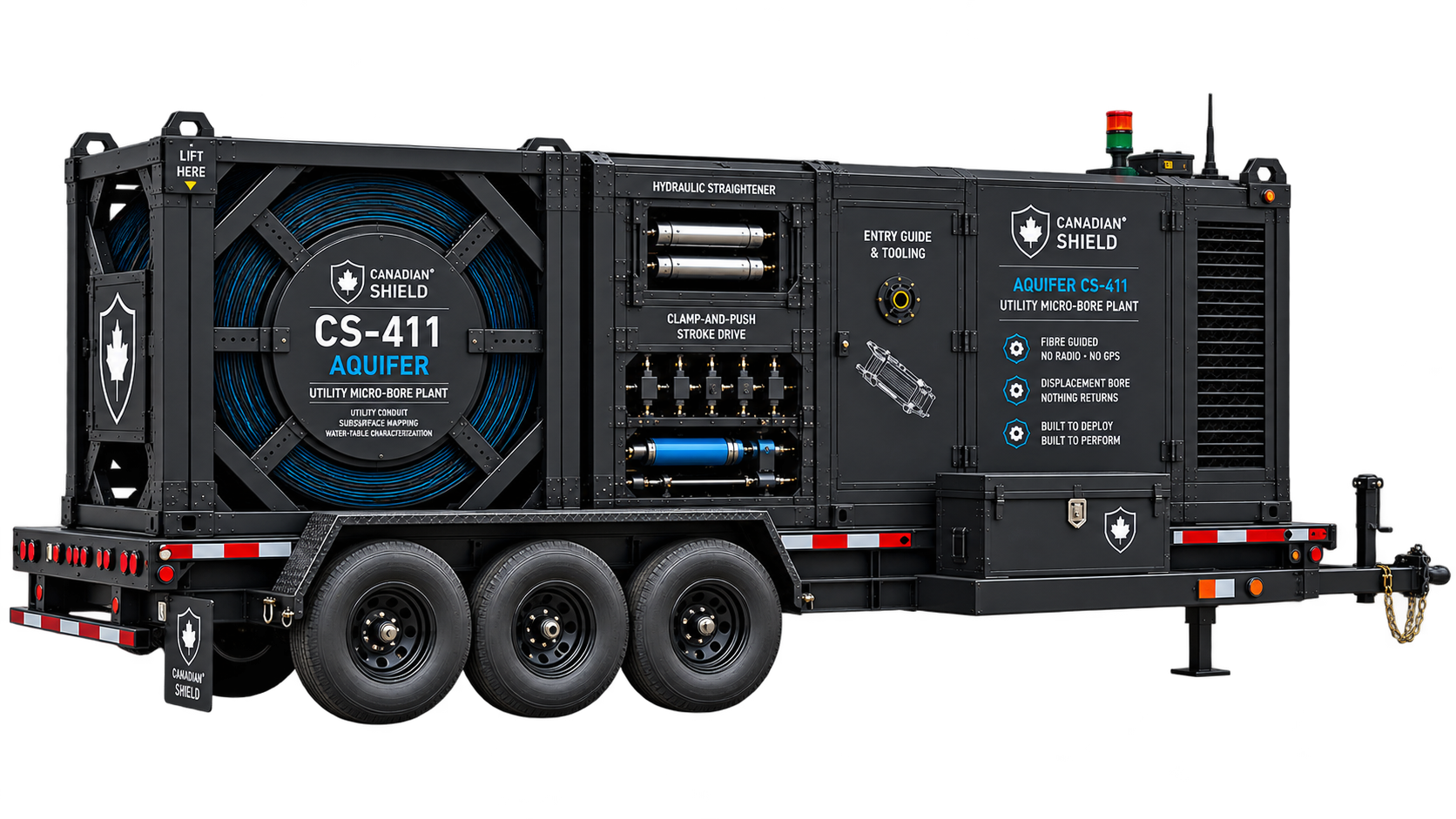
A reel, a straightener, a clamp-and-push drive and an entry guide — pushing a steerable head into ground with no line, no map and no signal, on fibre alone. Nothing enters the ground but the tubing and the head. No radio, no GPS: nothing to jam.
A surface plant that pushes a steerable head into ground with no line, no map, no signal.
Boring · Conduit Emplacement · Denied-Ground Access
Badger CS-410 is not a machine that rides into the hole — it is a coiled-tubing micro-bore surface plant. A coil reel feeds tubing through a hydraulic straightener into a clamp-and-push stroke drive, which advances the string through an entry guide and into the ground. Nothing else enters the ground.
The method is displacement boring: no spoil return, no cuttings to manage, no trench. The drive pushes a steerable compaction head downhole, and the tubing that follows it in can be the delivered product itself — the conduit left behind in the bore. Badger is the only platform in the seven-platform underground family with a mission and deployment model of its own; every other underground platform works a hole that already exists.
The heritage behind the push is real. Canadian Shield's parent group carries three decades of horizontal-directional-drilling heritage in-house — mobile HDD rigs to 1,000,000 lb pull, a trade practised on real ground, not a clean-sheet guess. Badger re-houses that trade in a smaller, steerable, fibre-guided package — built on that lineage, not a substitute for it.
This is the doctrine's most literal expression. A steerable head goes into denied or inaccessible ground instead of a person — no line-of-sight, no line to lay, no one standing over a live bore. The plant stays on the surface; the risk stays out of the ground.
The coil reel pays out tubing under controlled tension into a hydraulic straightener, which takes the reel-set curvature out of the string before it reaches the drive. The clamp-and-push stroke drive is the plant's heart: a clamp grips the tubing, a hydraulic stroke advances it a fixed increment, the clamp releases and resets, and the cycle repeats — the same clamp-and-push cadence that moves any coiled-tubing string, applied at bore scale.
At the working end, the entry guide sets the initial heading and the string transitions from surface handling to bore. Downhole, a steerable compaction head — carrying an HDD-type bit face, tricone or PDC depending on formation — displaces the ground ahead of it. No spoil return: the bore doesn't need mucking out, because nothing is cut loose and carried back.
Guidance is fibre-only — Tier 2 of the fleet's no-radio doctrine. Downhole attitude sensing rides the fibre back to the operator; stroke-count odometry from the drive gives distance-along-bore without a single emission; and the method leans on HDD walkover and wireline-locating heritage the group already practises from the surface. A human holds the loop the entire run — the fibre is the loop.
The complete data card for the Badger plant — rig, spool and tubing, drive and power, tooling, guidance and compliance, grouped the way a fleet buyer compares them.
Ranges are stated as classes; any rate states its formation and any force states its class. The plant draws on three decades of horizontal-directional-drilling practice in-house — mobile HDD rigs to 1,000,000 lb pull — and stays on the surface: nothing enters the ground but the tubing and the head.
Every Canadian Shield platform is built no-radio, no-GPS by design. Underground, that doctrine stops being a design choice and becomes a physical fact: rock and soil kill RF outright. There is nothing to jam, because there was never a link to begin with. Badger's single guidance fibre carries attitude sensing, comms, lube and payload feed downhole, and doubles as the breadcrumb back out — and for Badger specifically, it is also the conduit product left behind in the bore.
The heritage claim is real, not marketing. Canadian Shield's parent group carries three decades of horizontal-directional-drilling heritage in-house, including mobile HDD rigs to 1,000,000 lb pull — Badger is built on that heritage. The civil twin, Aquifer CS-411, shares the same plant architecture — same reel, same drive, same fibre guidance — and is the export-light line that helps fund the defence side; sharing the architecture is not the same as being exempt from export control, and Aquifer's own export posture is a separate, counsel-first question.
And the family rule stands wherever Badger is sold: it carries tubing, sensors and conduit — never a warhead, never a fuze, never an energetic material, in any variant.
Badger and Aquifer make the hole. Ferret, Mole, Muskrat, Gopher and the Farell Pig work holes and passages that already exist — they enter, listen in, swim, crawl or ride. Badger's plant architecture, deck-standard fibre and safety chain are the engineering the rest of the family builds on — that is why it comes first.
One bore, walked end to end — illustrative of how the plant is used, not a mission record.
The plant mobilizes on a single trailer or skid and runs the same walkover and pre-job survey discipline an HDD crew runs today. The rig positions on the entry line and anchors for reaction load; the coil reel seats, the straightener aligns, and the guidance fibre threads through to the head before the first stroke. No link check — there is no link.
The drive clamps the tubing, strokes it forward an increment, releases and resets — stroke by stroke, downhole. The operator steers the head off downhole attitude sensing carried over the fibre, with stroke-count odometry giving distance-along-bore. A human holds the loop for the entire run; uncertain ground or a lost attitude read and the drive stops and holds.
At breakthrough or target depth, the tubing either retracts back through the drive for reel recovery, or stays exactly where it is — the designed conduit product, left in the bore. Either way the plant demobilizes on the same trailer it arrived on. If a run ever stops early, the string is exactly where it stopped: holding, silent, waiting for a person.
Badger anchors the underground family: it and its civil twin make the hole, and the rest of the family works holes and passages that already exist. Badger's plant architecture, deck-standard fibre and safety chain are the engineering the others build on.
The coiled-tubing surface plant that makes the hole — reel, straightener, clamp-and-push drive, entry guide.
Download PDF ↓The same plant architecture — same reel, same drive, same fibre guidance — pointed at civil and utility ground; the export-light line that helps fund the defence side.
Download PDF ↓Works holes and passages that already exist — it enters where Badger bores, on the plant architecture, fibre and safety chain Badger sets.
Download PDF ↓If you own pipelines, utilities, perimeters or the ground beneath them — or you buy, build or regulate uncrewed underground systems for Canada or its allies — the Badger is on the table.