SOVEREIGN UNCREWED
SYSTEMS.
BUILT IN CANADA.
Canadian Shield — the defence and industrial drone company, backed by SIG · Sustainable Infrastructure Group.
Division · Heritage · Contact
Canadian Shield — the defence and industrial drone company, backed by SIG · Sustainable Infrastructure Group.
Division · Heritage · Contact
Canadian Shield is a defence and industrial drone company, backed by SIG · Sustainable Infrastructure Group, building a four-domain fleet — air, ground, water, underground — of uncrewed systems designed for the one condition every other maker treats as an exception: the radio is jammed and GPS is gone. Where incumbents bolt jam-resistance onto RF-dependent platforms, we rule radio out by design. Where they win on exquisite single-shot systems, we win on unit cost and salvo depth, on an owned 5-axis shop that cuts its own moulds. Sovereign, made in Canada, and allied-ready.
Shield — defence. Canadian — sovereign heritage, never a market ceiling. And the Canadian Shield is the country's bedrock, tying the mission to the underground family no startup can copy.
Goose · Grizzly · Orca · Badger — 29 named platforms and one system, presented as roadmap, not as simultaneous products. See the fleet →
"Jam-proof autonomy in denied environments — air, ground, water, underground." Fought in a jammed RF world, won on unit cost and salvo depth.
The CS-5xx civil line — work-horse platforms built on the same shop floor, and the fleet's one explicit radio exception: radio and GNSS are permitted on the surface civil line only. See the line →
Canadian Shield is Canadian in heritage and Canadian in manufacture — and it is not, and never intends to be, a Canada-only company. “Canadian” here works the way “Swiss-made” works everywhere: a trust and origin signal, not a market restriction.
The sequence is deliberate. Canada is the anchor customer and the proof point, and every allied conversation waits behind a Canadian reference. That is not a limitation; it is the reference sale. Sovereignty is told here as a manufacturing story, not a flag on a brochure.
The threat picture our doctrine answers — jammed spectrum, drone saturation, denied environments — is not uniquely Canadian, and neither is the answer. What follows is a doctrine fit, not a target list: these are working hypotheses, no contact has been made, and no relationship with any foreign government, military or company is claimed or implied.
Doctrine-fit map — not a customer map
Allies who share Canada's intelligence picture share its threat picture: the same jammed, drone-saturated airspace assumptions the no-radio doctrine was built for.
Allied nations closest to active drone-saturated threat environments face the cost-exchange problem at its sharpest — the fight non-explosive carriers were designed for.
Allies operating in cold, remote, infrastructure-poor terrain face conditions that parallel the Alberta environment this fleet is being designed around.
The far end of the doctrine-fit map — a long-horizon hypothesis, listed for completeness and weighted accordingly. Nothing nearer than the phases above allow.
Preliminary legal review indicates no anticipated impediment to exporting Canadian Shield's platforms to NATO member states; a formal export-control classification has not yet been completed. As with every Canadian defence exporter, individual shipments require classification and a permit under the Export and Import Permits Act, assessed against Canada's Export Control List and administered by Global Affairs Canada — a per-shipment, counsel-first step that cannot be pre-committed ahead of a specific order.
Canada proves the system; the origin travels with it. No foreign relationship, deal or program is claimed anywhere on this site — the map above is a doctrine map, not a customer map.
The capability underneath Canadian Shield is older than the company. Thirty years of horizontal-directional-drilling engineering built it — a trade whose whole discipline was steering tooling through rock and soil with no line of sight: walkover locating from the surface, wireline steering to close the loop, reaching what nothing else could. That history left more than experience. It left a working 5-axis CNC machine shop that once cut drilling tooling and now cuts the division's own injection moulds. It left the tracked-chassis heritage that underlies the Grizzly ground family. And it left an engineering drawing estate running to thousands of sheets — decades of real work, on paper. None of it was built for defence. All of it transfers.
The transfer rests on one observation. Steering equipment blind underground — no GPS, no line of sight, no radio signal that survives rock — is the same problem as autonomous navigation in a jammed, GPS-denied battlespace. The drilling industry has worked that problem for two generations. Engineers who spent careers answering "how do you steer something you cannot see and cannot talk to" do not start from zero when the radio is jammed and the satellites are gone. That observation is why the division exists.
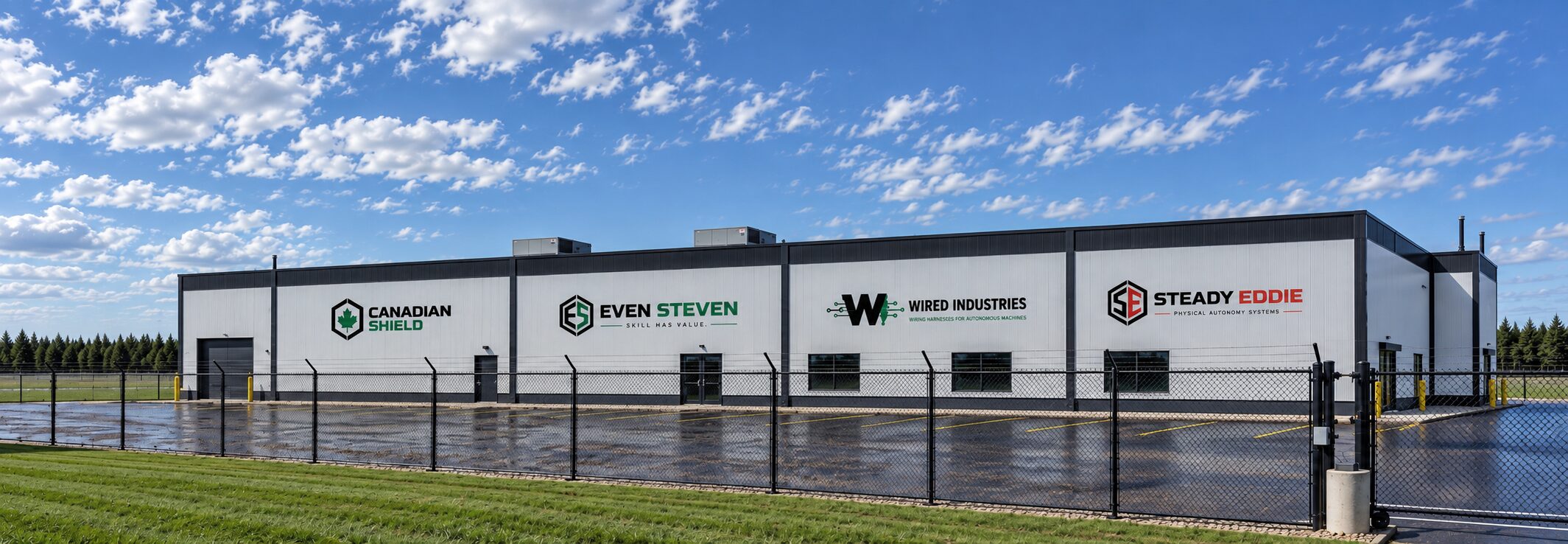
It also dictates how the division builds. Platforms operate without radio dependence because the heritage never had radio to depend on. The tooling that builds them is cut in-house, on machines the group owns, on a shop floor that stands in steel and concrete rather than in a rendering — a manufacturing base that never waits on an outside vendor to iterate.
The structure on top of that iron is deliberately clean. Canadian Shield stood up in 2026 as a current operating division of the Sustainable Infrastructure Group — not a revived old company, not a shell, not a startup drawing its first sheets. Its four platform families — Goose in the air, Grizzly on the ground, Orca on the water, Badger underground — are prototyped and advancing through active development, presented as a roadmap rather than a finished catalogue. Platform designs across the fleet are held as proprietary know-how and trade secret; two related patent applications are pending — a coil-tube drive system and a polymer foam system. The heritage is Canadian, the manufacturing is sovereign, and the ambition is not confined to Canada. The division states its maturity plainly and builds from there.
5-axis CNC machining (Haas) · mould and fixture craft · a PET recycling and injection line · forty years of directional-drilling doctrine · tracked-chassis heritage · an Alberta industrial workforce and supplier network.
A current SIG division with its own charter, the Canadian Shield brand, and a four-domain fleet presented as roadmap — operating today, platforms in active development.
Every era of the shop has been the same trade: precision metal cut for hard environments — downhole, underground, and now airborne.
The division works from a real footprint, not a rendering: a 143-acre site with Class G uncontrolled airspace overhead, where low-altitude flight and launch trials are flown; a 60,000 sq ft manufacturing facility on industrial lands — formerly a licensed cannabis production site, inheriting its perimeter security, access control and monitoring; and a full machine shop, headlined by a 5-axis Haas machining center and backed by a PET recycling and injection line, carrying a full manufacturing history and ABSA and CSA quality-control certification.
Headlined by a 5-axis Haas machining center and a PET recycling and injection line — not limited to the mould story alone, but a full machine shop with a full manufacturing history behind it.
Launch, recovery and flight-trial infrastructure sits on the 143-acre site, with Class G uncontrolled airspace overhead — the fleet is proven within sight of where it is built.
The division ramps from prototype to full production in 90 to 120 days — the floor space, quality system and workforce are already in place.
The platform family shares a single electrical and mechanical seam — and the wiring that carries it is built in-house, not bought in.
Wired Industries, an in-house SIG manufacturing division, builds the UAV wiring harnesses — the physical build side of the common interface standard, kept on the group's own floor.
A common wiring and mounting interface standard runs across the platform family, adapted from established MIL-STD practice — so payloads and subsystems move between platforms instead of being re-engineered for each one.
Adaptation and integration engineering is a standing capability of the division: partner payloads, sensors and cueing interfaces are brought onto the fleet against the common standard, on our side of the seam.
Canadian Shield is manufacturing and developing hardware today. Goose is built and in test. Grizzly and Badger carry years of build history. Orca advances behind them in active development. Platform designs are held as proprietary know-how and trade secret; two related patent applications are pending. And response time is a design requirement, not a slogan — the fleet is built to be quickest-to-answer in its class, on a supply chain that starts with material available anywhere, not a single sourced input.
For procurement bodies, partners and press. This page is informational — a conversation with us starts with a message, not a claim.
Alberta, Canada.
General enquiries:
[email protected]
Sales enquiries:
[email protected]