BADGER'S PLANT, POINTED AT
UTILITY GROUND
Coiled-tubing bore, fibre-guided — conduit installed, water table mapped, nothing to jam.
Utility Conduit · Subsurface Mapping · Water-Table Characterization
The same coiled-tubing surface plant, the same fibre guidance, the same no-radio posture as Badger CS-410 — pointed at conduit and utility installation and subsurface water-table mapping, sold through the group's existing trenchless and pipeline relationships. No radio, no GPS, nothing to jam.
Coiled-tubing bore, fibre-guided — conduit installed, water table mapped, nothing to jam.
Utility Conduit · Subsurface Mapping · Water-Table Characterization
Aquifer CS-411 is the civil long-horizontal-bore variant of the Badger CS-410 surface plant: the same coiled-tubing architecture, the same fibre guidance, the same surface-powered deep series — pointed at civil and utility work instead of a defence objective.
Where Badger’s job is defence emplacement, Aquifer’s job is two things a trenchless crew already sells: pushing conduit and utility product along a planned alignment, and mapping the ground it passes through — water table, moisture, strata — as it advances. It is built to be sold through the group’s existing trenchless and pipeline-industry relationships, not invented from a clean sheet of paper.
Aquifer’s framing as the “export-light” line is a counsel question, not a settled fact — and it carries the same no-radio, fibre-only, export-controlled posture as every other CS-4xx platform. Nothing about Aquifer’s civil end-use changes that.
Every metre of conduit Aquifer pushes underground is a metre a crew didn’t have to open trench for. The family’s doctrine — send the robot down the hole, not the soldier — holds just as well on a utility corridor as it does on a defence objective: put the plant in the ground, keep the people out of it.
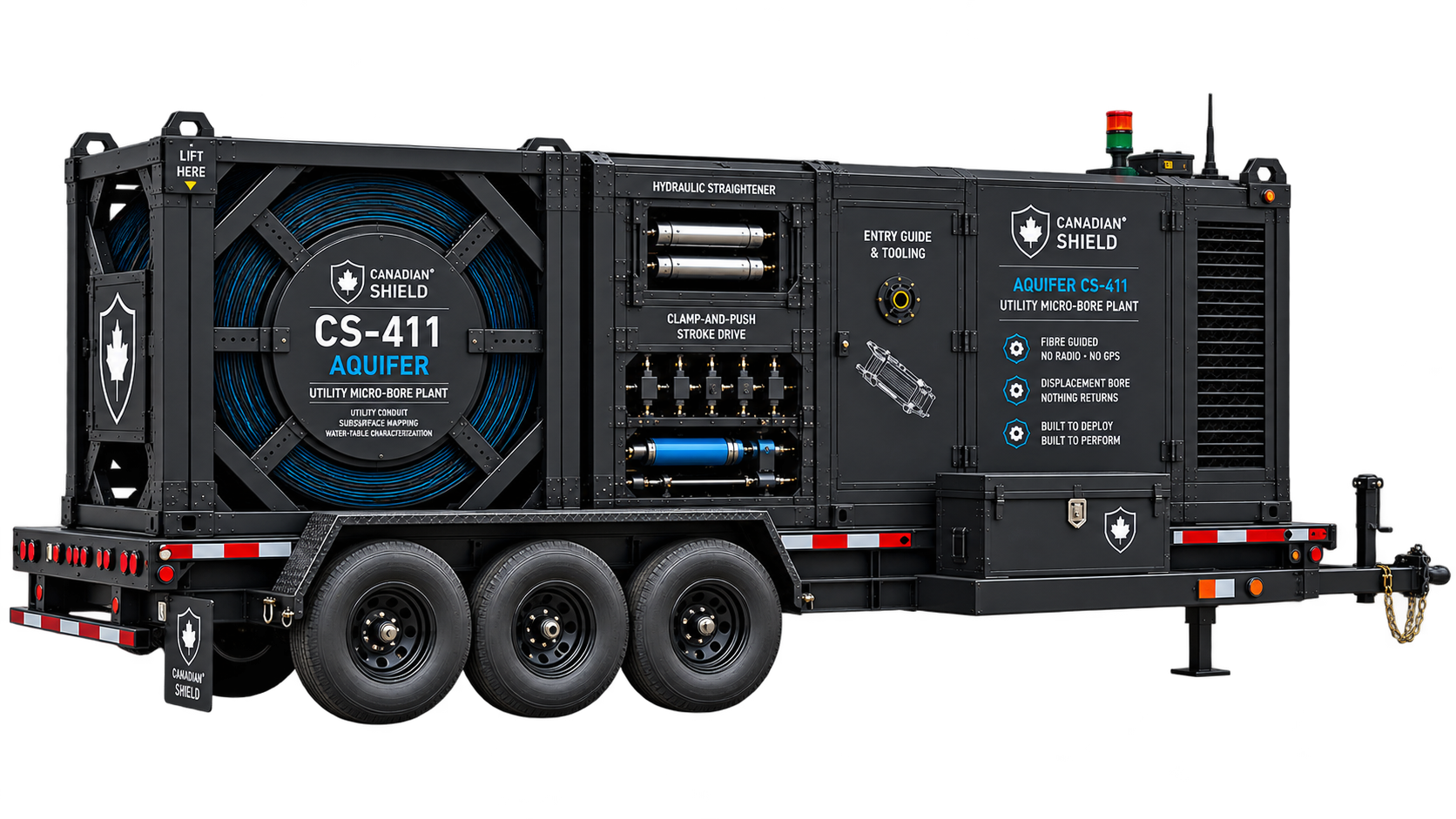
Aquifer is not a machine that rides into the ground — like Badger, it stays on the surface. Coil reel, hydraulic straightener, clamp-and-push stroke drive and entry guide push a steerable head downhole on coiled tubing. Displacement method, no spoil return: nothing enters the ground except the tubing and the head, and the tubing itself can be the delivered conduit product.
The civil tuning is in the reel and the head. Aquifer’s reel and drive are sized for longer horizontal reach than the defence configuration. The head carries the same steering sensing as Badger’s, plus a water-table and geotechnical sensing package — conductivity, moisture, strata identification — logging the ground as the bore advances.
Guidance is fibre-only, human-in-the-loop, exactly as it is on Badger: downhole attitude sensing over the fibre, HDD walkover and wireline-locating heritage, and stroke-count odometry from the drive. No radio and no GPS exist anywhere in the design — the civil end-use does not change the guidance architecture.
The complete data card for the Aquifer plant — rig, bore and tubing, drive, sensing, guidance and compliance, grouped the way a fleet buyer compares them.
Ranges are stated as classes. Aquifer’s figures are stated at the plant-architecture level it shares with Badger CS-410 — same reel, same drive, same fibre guidance; horizontal reach is stated only relative to the defence configuration, and no penetration-rate figure is published for this configuration. The plant draws on three decades of horizontal-directional-drilling practice in-house — mobile HDD rigs to 1,000,000 lb pull — and stays on the surface: nothing enters the ground but the tubing and the head.
Aquifer is framed internally as the “export-light” line — the civil-facing product intended to help fund the defence side of the underground family through revenue the trenchless and pipeline industries already understand. That framing is a counsel question, not a settled legal fact, and it is stated here exactly that plainly.
Aquifer is a CS-4xx underground defence-family platform, not a CS-5xx/6xx/700 civil-line product. It has not been granted, and does not claim, any export exemption or classification. It carries the same no-radio, fibre-only guidance and the same export-controlled posture as Badger, Ferret, Mole and every other platform in the family — civil end-use changes the customer, not the compliance rules.
The heritage underneath both twins is real: three decades of horizontal-directional-drilling practice in-house, mobile rigs built and operated to 1,000,000 lb, and a plant architecture the group already knows how to build and run. Aquifer is not a clean-sheet product; it is the same plant logic, sold to a market that already buys directional drilling.
Badger and Aquifer make the hole; Ferret, Mole, Muskrat, Gopher and the Farell Pig work holes and passages that already exist. One fibre carries the guidance, the comms, the payload feed and the breadcrumb back out — nothing to jam, on either half of the split. Send the plant, not the crew, into the trench line.
One bore, walked end to end — illustrative of how the plant is used, not a project record.
The plant mobilizes to a utility or infrastructure site by road, the same way an HDD crew’s rig arrives today. The planned alignment is surveyed, the entry pit is opened, and the reel, straightener and drive are positioned and anchored at the entry point. The fibre spool is seated. No link check — there is no link.
The drive strokes the coiled tubing along the planned conduit alignment while a human steers the head over the fibre, guided by downhole attitude sensing and stroke-count odometry. The water-table and geotechnical sensing package logs conductivity, moisture and strata as the bore advances — data the utility or civil client can use directly.
At the far end, the tubing itself can be left in place as the installed conduit product, or the head is retracted back along the bore. The plant demobilizes from the entry pit — no recovery of anything left downhole, because nothing downhole needs recovering that wasn’t designed to stay.
Aquifer and its defence twin make the hole; the rest of the family works holes and passages that already exist. Same plant architecture, same fibre, same no-radio thesis — different customers.
The civil long-horizontal-bore plant — utility conduit installed and the water table mapped as the bore advances.
Download PDF ↓The defence twin — the same reel, drive and fibre guidance, pointed at defence emplacement in denied ground.
Download PDF ↓Works holes and passages that already exist — it enters where the twins bore, on the plant architecture, fibre and safety chain they set.
Download PDF ↓If you build, install or specify utility conduit, or map ground ahead of civil works, the Aquifer is on the table alongside its defence twin, Badger.