THE ONLY WAY INTO
FLOODED GROUND NOBODY WALKS INTO
Hybrid swim/crawl. Zero visibility. No diver, no radio, no GPS.
Recon · Mapping · Inspection — Culverts, Storm Sewers, Inundated Tunnel
A hybrid swim/crawl platform for flooded culverts, storm sewers and inundated tunnel sections — too tight and too dark for a diver, too small a space for Orca. Fibre-tethered or preset and logged. No radio, no GPS, nothing to jam and nothing to send a person into.
Hybrid swim/crawl. Zero visibility. No diver, no radio, no GPS.
Recon · Mapping · Inspection — Culverts, Storm Sewers, Inundated Tunnel
Muskrat CS-440 is a small hybrid swim/crawl platform built for flooded culverts, storm sewers and inundated tunnel sections — ground where no other Underground platform can operate, and where the Water family's Orca AUV is simply oversized for the space. It exists because a person should never have to wade or dive into a dark, current-bearing pipe to find out what is in it.
It is explicitly the joint between two families. Muskrat carries the same no-radio doctrine and the same fibre-or-logged guidance philosophy as Orca, adapted for a tight, dark, debris-choked confined-water environment instead of open water — the same thesis, a different pressure class and a much smaller turning circle.
Family heritage runs underneath it. Canadian Shield's parent group carries three decades of horizontal-directional-drilling heritage in-house — the trade of steering a tool blind through the ground and knowing exactly where it is without a radio link. That trade did not stop at the water's edge; Muskrat is where it meets the flood.
Here the hole is flooded — a storm sewer, a culvert, an inundated tunnel section — and the alternative it replaces is a diver working blind or a person wading a dark pipe by feel. Muskrat goes first, sees in the dark by sonar, and reports back over a line nothing can jam.
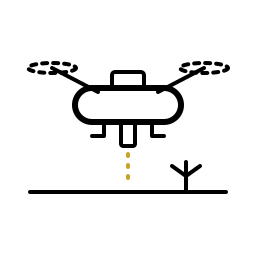
Propulsion is a hybrid: twin ducted thrusters for the flooded reaches, and a tracked/wheeled crawl skid that folds out for the shallow or dry sections the same run often has — a culvert rarely stays one depth end to end.
The water it works in is almost always opaque, so optical cameras are treated as situational, not primary. Forward-looking sonar is the default eye for the flooded run; LIDAR is carried for the above-waterline and dry sections of the same passage where optics can actually see. A water-quality probe rides along where the mission calls for it — contamination and flow-condition sensing is a natural extension of a platform already built to go where the water is worst.
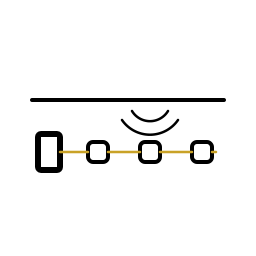
Guidance never argues with the water. A fibre tether carries commands and telemetry in real time, with a human in the loop, for close work and short runs — the workhorse tier. For longer culvert runs where a tether is impractical to pay out or recover, Muskrat runs a preset, logged profile and reports the data on retrieval — Orca's own survey-mission philosophy, carried into a pipe. No radio, ever. No acoustic modem standing in for one. GPS would not reach the water anyway, so the design never asks it to.
The complete data card for the Muskrat platform — dimensions, performance, drive, sensors, sealing, guidance and compliance, grouped the way a fleet buyer compares them.
Every speed and endurance figure states its mode (swim or crawl); the depth figure states its class — a confined-water platform, not a deep-ocean one. That is house policy, not fine print.
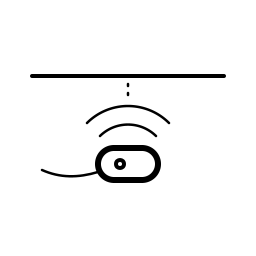
The house thesis is that the link is the vulnerability — Muskrat carries none. A fibre tether cannot be jammed because there is no spectrum in the loop; a preset/logged run emits nothing at all and reports only after it surfaces. No acoustic modem is dressed up as a wireless substitute. That boundary holds in a flooded pipe exactly as it holds in dry rock.
Muskrat is the platform where two family doctrines meet without contradiction. The Underground family's rule — send the robot down the hole, not the soldier — was written for dry bores and existing tunnels. Muskrat proves it also holds when the hole is flooded: the alternative it replaces is a diver working blind or a person wading a storm sewer by feel, and the doctrine rules that alternative out.
And it is a carrier, never a munition. No warhead, no fuze, no energetic material anywhere in the design, in any cartridge or variant. Muskrat senses, maps and inspects — it does not strike, and it never will.
Badger and Aquifer make the hole. Ferret, Mole, the Trembler Line, Muskrat, Gopher and the Farell Pig work holes and passages that already exist — they enter, listen in, swim, crawl or ride. Muskrat's job is the one none of the others can do: go where the passage is flooded, and come back with the picture. See the Orca brochure for the open-water half of the same thesis.
One flooded run, walked end to end — illustrative of how the platform is used, not a mission record.
Muskrat inserts at a maintenance hole, a culvert mouth, or a storm-sewer access point — wherever a crew can reach without entering the water itself. For a real-time run the tether is seated and paid out from the surface reel; for a long culvert leg, the mission profile loads and the vehicle goes in untethered. No link check on the untethered leg — there is no link to check.
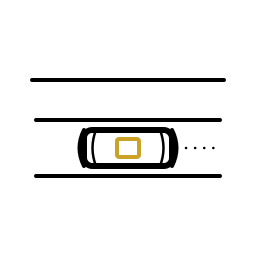
Muskrat swims the flooded reaches and crawls the shallow or dry ones on the same run, sonar sweeping ahead in water no camera could use. On the fibre, a human sees what the sonar sees, in real time. Off the fibre, the run logs continuously and reports nothing until it is out.
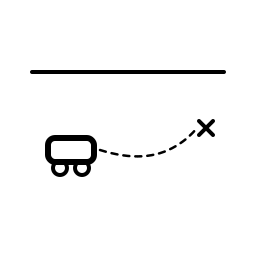
A tethered run is retrieved by pulling the tether back through the maintenance hole. An untethered run reverses its own logged route and returns to the entry point on a preset reciprocal path, where the data offloads at the surface. Either way, the hull and the picture come home — never a diver, never a person in the water.
Badger and Aquifer make the hole; Ferret, Mole, the Trembler Line, Muskrat, Gopher and the Farell Pig work holes and passages that already exist. Muskrat's job is the one none of the others can do — and Orca carries the open-water half of the same thesis.
The job none of the others can do: go where the passage is flooded, and come back with the picture.
Download PDF ↓With Aquifer, Badger makes the hole — the start of the underground moat the rest of the family works.
Download PDF ↓The second of the two hole-makers; the other six platforms work holes and passages that already exist.
Download PDF ↓Like Mole, Gopher and the Farell Pig, Ferret works passages that already exist — enter, listen in, crawl or ride.
Download PDF ↓The open-water half of the same thesis — the same no-radio, fibre-or-logged philosophy, in a hull too big for the pipe.
Download PDF ↓If you own culverts, storm sewers, flooded infrastructure or the passages under them — or you buy, build or regulate uncrewed underground and underwater systems for Canada and its allies — Muskrat is the platform for the water nobody else can reach.