THE LINE THAT LISTENS
SO NO ONE HAS TO WALK THE WIRE
A chain of buried Mole nodes on a fibre trunk — detect, localize, cue. Nothing radiated, nothing to jam.
Detect · Localize · Cue · Human-Confirmed Interpose
A chain of buried Mole sensor nodes strung on a dark-fibre trunk to a monitored head-end. The line hears digging, tunnelling, footsteps and vehicles, localizes the source across the chain, and cues a Ferret to interpose — on a human's confirmation. No radio, no GPS. Nothing to jam.
A chain of buried Mole nodes on a fibre trunk — detect, localize, cue. Nothing radiated, nothing to jam.
Detect · Localize · Cue · Human-Confirmed Interpose
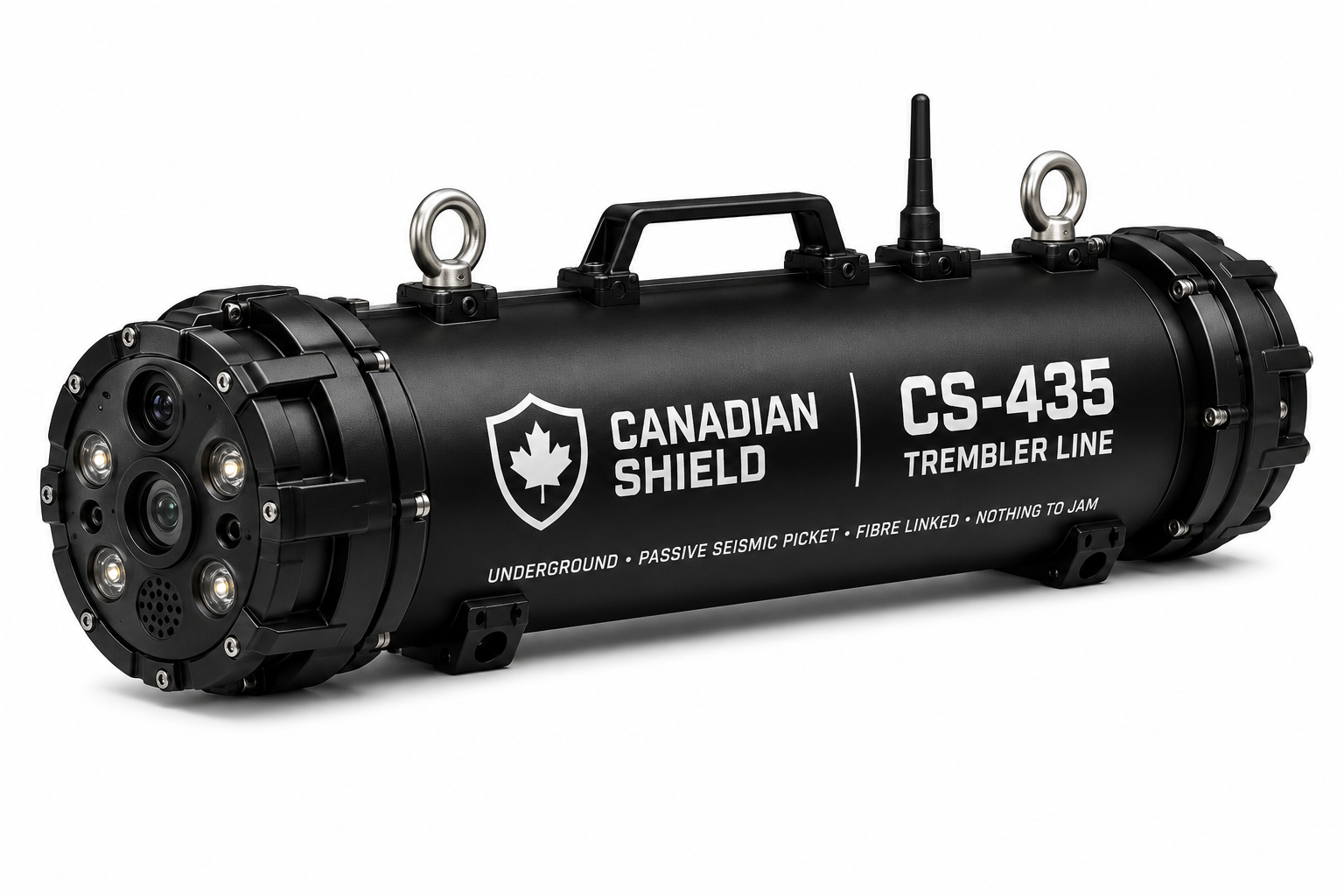
Trembler Line CS-435 is not a vehicle — it is a system. Mole CS-430 sensor nodes, buried at intervals along a perimeter or a likely approach, listen passively and report over a dark-fibre trunk to a monitored head-end console. Nothing in the chain transmits outward; the fibre carries everything.
The line hears digging, tunnelling, footsteps and vehicles. It localizes the source from the arrival-time pattern across the chain — the node nearest the disturbance registers first, its neighbours a beat later, and the pattern places a rough position and bearing. A confirmed detection cues a Ferret CS-420 already staged nearby to move to an interpose position ahead of the intrusion path. Trembler Line is explicitly a detection-and-cueing system, not a weapon: it never strikes, and no part of it carries the authority to order one.
Node emplacement borrows the same discipline the group already practises. Three decades of horizontal-directional-drilling heritage in-house means surveying, locating and placing a tool in the ground blind is not new work for Canadian Shield — it is the trade a Mole node's emplacement survey draws directly from.
The most exposed minute of a standing post is the walk to relieve it. Trembler Line stands the watch instead — buried, silent, always on — so the only moment that still needs a person is the one that actually matters: the confirmation before anything moves.
Mole nodes bury at survey-set intervals along the watched line, each one a passive seismic/acoustic listener with nothing broadcasting outward — the same physics-enforced no-radio, no-GPS rule that governs every underground platform in the family.
When something disturbs the ground — a dig, a tunnel advance, footsteps, a vehicle — the vibration reaches the nearest node first and its neighbours a beat later. The pattern of arrival times across the chain is the whole trick: it lets the head-end place the source's rough position and bearing without a single emission ever leaving the ground. This is time-of-arrival localization stated plainly, not a proprietary black box.
A localized detection becomes a cue pulse that travels the fibre trunk to the head-end console — never a decision on its own. A human reviews the cue; if it is confirmed, that human tasks a Ferret already staged nearby to move to an interpose position ahead of the intrusion path. The Ferret blocks. It does not strike. No warhead, fuze or energetic material exists anywhere in Trembler Line, at any point in the chain.
The complete data card for the Trembler Line system — configuration, performance, network, payload, construction, signature and compliance, grouped the way a fleet buyer compares them. This is a system built from two existing family members: Mole CS-430 supplies the ear; Ferret CS-420 supplies the legs.
Localization accuracy and false-positive discrimination are stated as open engineering questions, not numbers dressed up to look settled — that is house policy, not fine print.
The fleet's thesis is that the link is the vulnerability — so Trembler Line carries none. Every byte the system moves rides the buried fibre trunk, node to node, to one monitored head-end. There is no spectrum in the loop to jam, because there is no spectrum in the loop at all.
Trembler Line is built entirely from two existing family members — it adds no new sensor and no new mobility. Mole CS-430 supplies the buried ear; Ferret CS-420 supplies the legs that move on a cue. The system's own engineering is the fibre network and the localization logic that ties the two together, and the discipline to keep a human deciding at every step. It slots directly into the family's "make the hole, work the hole" split: Badger and Aquifer make the hole, and Trembler Line is a passive perimeter watch that substitutes for a person walking a standing post over ground that already has one.
Mole listens, Ferret moves — Trembler Line is the fibre and the logic that chains them into a persistent watch. No warhead, fuze or energetic material anywhere in the system; the end state of the whole loop is a Ferret unit parked in the way, on a human's confirmation, always.
Telling a digger from a deer from a foot patrol — false-positive discrimination — is an open engineering question, not a solved one. False alarms are the historic failure mode of every seismic picket ever fielded, anywhere, and Trembler Line does not get a pass just because it is new. Whether seismic localization can hand a Ferret a position and vector tight enough to block on with confidence is the leading question the design work must still answer.
We say this before a customer discovers it. The system reports a cue with a confidence level, never a certainty, and the human-confirmation gate at the head-end does not move as the discrimination work matures — it stays in place regardless of how good the localization logic gets.
A system-level walkthrough, illustrative of design intent, not a mission record. Trembler Line is a persistent system, not a single-run mission.
The perimeter or approach is surveyed first — the same pre-job discipline an HDD crew runs before any bore, applied here to node placement instead. Mole nodes are emplaced at survey-set intervals and left still; the fibre trunk is spliced node to node and run back to a monitored head-end console. No node broadcasts anything to confirm it is alive — the head-end confirms it over the wire.
Once live, the line runs unattended — passive listening, no patrol interval, no gap in coverage. Most of its life is quiet: nothing happens, nothing is sent, nothing is jammed because nothing is transmitted. On a disturbance the nodes register in sequence and the head-end localizes the source from the pattern across the chain.
A cue reaches a person at the head-end — never an actuator. If the cue is confirmed, that person tasks a Ferret already staged near the line to move to an interpose position ahead of the intrusion path. The Ferret blocks the way. It does not strike, and nothing upstream of it has the authority to order one either.
Trembler Line is built from two existing family members: Mole supplies the buried ear, Ferret supplies the legs that respond on a human-confirmed cue.
A chain of buried Mole nodes on a fibre trunk — detect, localize, cue.
Download PDF ↓The legs — staged nearby, moves to a block position on a confirmed cue.
Download PDF ↓The family anchor — bores the passages the rest of the family then works.
Download PDF ↓If you own perimeters, approaches or the ground under them — or you buy, build or regulate uncrewed detection systems for Canada or its allies — the Trembler Line conversation starts here.