What It Is
A Tool Carrier. Not a Ram.
The Access Specialist of the Ground Family.
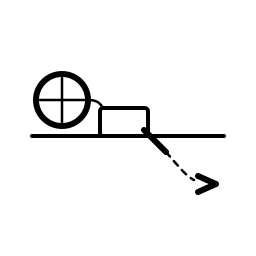
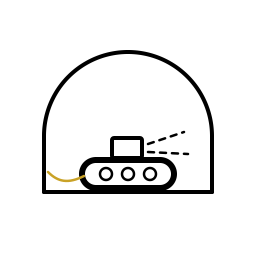
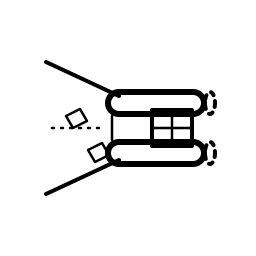
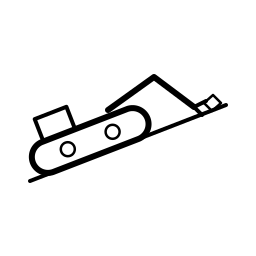
Wolverine CS-260 is a compact, tracked, battery-electric carrier built to
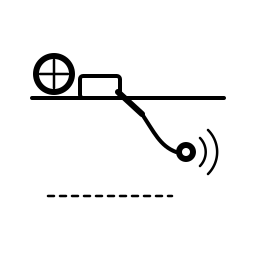
place mechanical-access tools — spreaders, cutters, winches, recce probes — exactly where
an entry team needs them, then get out of the way. It does not strike anything. It
positions.
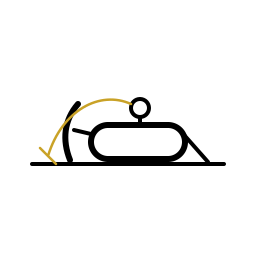
The physics rules out the other picture. At 250 kg gross, a compact tracked carrier
cannot out-muscle its own mass: friction alone caps a straight push at roughly the low
kilonewtons — well under the 5–20 kN class of a forced-entry door. So Wolverine does
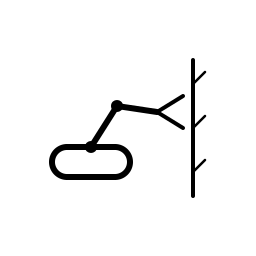
not ram. It carries self-reacting tools whose hydraulic force loop closes across
the jamb, bar or gap it is working — the target structure reacts the force, not the
vehicle. This is a deliberate design distinction, not a marketing softening: Wolverine is
a carrier, never a strike platform, and no growth path to an energetic or ramming
capability is designed, reserved or implied anywhere in its scope.
It is the sixth and smallest serious tracked platform in the ground family, sized to
pass where a person passes — corridors, gates, stairs. Grizzly hauls the heavy load,
Moose the bulk cargo, Wolf works in coordinated numbers, Lynx scouts ahead, Beaver works
the ground itself — and Wolverine carries the tools an entry team needs at the work face,
never the impact.
The Claim
Carry the tool. Not the blow.
Wolverine’s job is positioning, not force. The tool does the work and reacts
against the structure it is opening — the vehicle only ever carries, aims and holds.
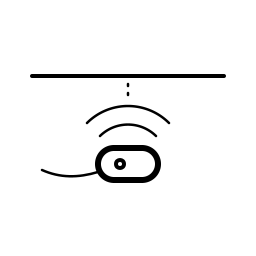
Quietly, electrically, and without a tool moving until a person on the tether says
so.
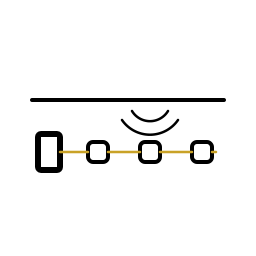
- No radio, no GPS — nothing emitted in any guidance tier; nothing for anyone to find or jam.
- Self-reacting tools — the force loop closes on the target structure, not the chassis.
- Hardware tether interlock — no arm or tool motion without a human holding the enable.