Washer · CS-540 · Industrial Series

WASH THE TOWER
CREW ON THE GROUND

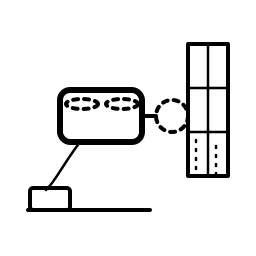
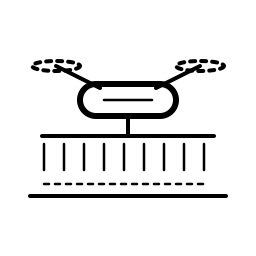
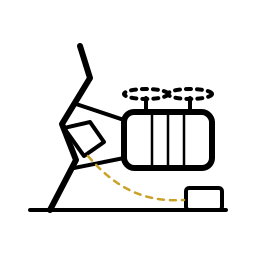
A caged, umbilical-fed washing platform. Water up the line, evidence back down.

Treat · Pump · Deliver · Agitate · Rinse

20 kgreferenceAll-up weight, working class 18–25 kg
≈20 mpracticalWorking height, ground-fed (39 m theoretical)
0carriedLitres of mission water carried aloft
0energeticsWarheads, fuzes or energetic material anywhere in the system
What It Is

The One Aircraft in the Estate
Built to Lean on the Building.


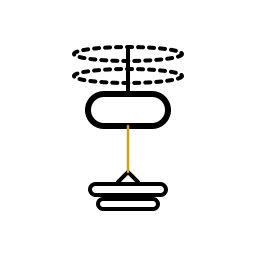
The Washer is an uncrewed façade- and surface-washing platform: a caged multirotor that works close against glazing, curtain wall and industrial structure, fed by a single managed umbilical — water, power and comms in one bundle — from a ground station that treats, pressurizes and pays out the line.

The architecture starts from one blunt piece of arithmetic: a litre of water is a kilogram, and an aircraft that carries its wash water spends its lift budget hauling ballast. So the Washer does not carry its water. The umbilical delivers it continuously, power rides the same bundle for effectively unlimited on-station endurance, and the only water aloft is a small buffer for transitions and head purge. Every other choice — the perimeter cage, the sacrificial panels, the standoff wheels that touch the surface first, the strain-relieved hard point at the center of gravity — follows from living soaking wet at working standoff from someone else's expensive glass.

And the reason to build it is standing on the swing stage. Façade washing today means suspended access: bosun's chairs, rope access, davits and stages — people hanging in front of buildings in wind, for hours, to move a brush. Every hour this machine spends against the glass is an hour a person does not spend suspended in front of it. The operator runs the job from the ground, beside the station, with the umbilical as a physical, inspectable connection to the machine.

The Inversion

Every other aerial platform avoids the surface. This one works against it.

The fleet's airframes are built to keep clear of obstacles; the Washer's whole mission happens at arm's length from one. Wheels touch first and define the gap, the cage protects rotors and glass from each other, and the expensive failure the design guards hardest against is the client's façade — not the machine.

1Umbilical — water, power and comms in one managed bundle; endurance is a ground-station property, not a battery property
0Mission water carried aloft — the onboard tank is a transitions-and-purge buffer, never a reservoir
0Energetic materials anywhere in the system — pressure is bounded to cleaning duty, permanently
How It Works

Five Stages — Only One of Them Flies.


01 The Signature Mechanism · The Umbilical

FIVE STAGES — ONLY ONE OF THEM FLIES

The Washer is a water-handling chain that happens to include an aircraft. Treat, pressurize, deliver, agitate, rinse — and only the fourth stage is airborne. Most of the system's value sits on the ground, on the treat-pump-reel station.

The ground station filters and polishes the supply to spot-free de-ionised water — DI drying is what makes an unattended finish viable on glass — then a regulated pump sends it up the umbilical: a 12 mm-bore hose, power conductors and hard-line comms in one managed jacket on a tensioning reel. The reel keeps the catenary loaded without ever pulling on the aircraft, and line tension is continuously sensed — the primary instrument for detecting a snag before it matters.

The umbilical is also the honest limit, and we publish the physics rather than hide it: the line's own weight, not its flow, caps how high a ground-fed Washer works — a six-to-eight-storey machine on the reference line. Full tower height is an open design fork: a roof- or davit-supported supply configuration, stated here rather than promised. At the hard point, strain relief decouples hose tension from the fluid coupling — a snag never becomes a burst — and a mechanical fuse releases below platform break strength, leaving the aircraft flyable and land-able on its reserve battery with the umbilical gone.

shared fluid-handling module — one canon with Sprayer & Coater
FIVE-STAGE CHAIN — ONLY STAGE 4 IS AIRBORNE 1 TREAT RO / DI POLISH SPOT-FREE 2 PUMP REGULATED — NOT RAW PRESSURE 3 DELIVER REEL + TENSION — THE DESIGN DRIVER 4 APPLY & AGITATE THE ONLY AIRBORNE STAGE 5 RINSE · SHED · CAPTURE PURE-WATER RUN-OFF — OPERATIONAL REGULATED EFFLUENT — CAPTURED UMBILICAL SECTION — ENLARGED HOSE 12 mm ID PWR + / PWR − HARD-LINE COMMS ~0.26 kg/m — THE NUMBER THAT RULES THE MACHINE 39 m THEO ≈20 m PRACT GROUND-FED = A 6-TO-8-STOREY MACHINE · FULL TOWER HEIGHT = ROOF-SUPPORTED SUPPLY — DESIGN FORK, STATED OPENLY CS-540 · the wash chain — the umbilical is the design driver
SERPENTINE PASSES · WHEELS TOUCH FIRST · SINGLE-DIGIT bar MULLION / SEALANT — BRUSH KEEPS OFF IT BRUSH BAR 0.6 m ACROSS THE FACE · TRAVERSE 0.15 m/s · STANDOFF 0.3–0.8 m AGITATION DOES THE WORK, NOT PRESSURE · DI RINSE DRIES SPOT-FREE — NO SQUEEGEE PASS NEEDED REACTION AT THE GLAZING POINT: ~2.3 N — ~1% OF MACHINE WEIGHT · HIGHER-PRESSURE DUTY IS FLIGHT-CONTROL-BOUNDED CS-540 · the anchor head — flow-through brush + DI rinse
02 The Work Face · Head & Interface

ONE FRAME, ONE INTERFACE, MANY HEADS

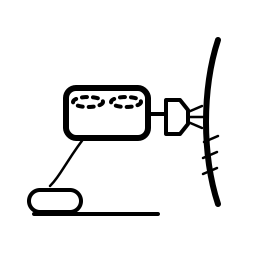
The anchor head is a pure-water brush: soft flow-through bristles and rinse jets at single-digit bar. Agitation does the cleaning; de-ionised water does the finish — it dries spot-free without a squeegee pass, which is what makes an uncrewed job viable.

The head mounts through one defined interface — mechanical mount, dry-break fluid coupling, power and telemetry at a single station — so a new surface is a head change or a media change, never a platform change. The family behind the brush maps the line's reach: a rinse-only pre-soak head, an industrial washdown lance for steel and concrete, a reaction-balanced rotary whose opposed jets cancel their own thrust, a wide low-pressure bar for solar arrays, and a camera-and-lighting inspection head that carries no fluid at all. The machine is de-energized before any head change — ordinary wet-industrial practice, applied without exception.

At the surface, the standoff wheels touch first and define the gap. They are soft, non-marking and grit-shedding — a surface-protection component before a structural one, because the expensive failure on this machine is the client's glazing, not the airframe. Brush passes keep off mullions and sealant beads by rule, and the pressure envelope is bounded to cleaning duty permanently: no abrasive entrainment, no cutting-class heads, ever. Wash chemistry, where a client specifies it, belongs to the client and the regulator — with effluent captured on regulated jobs.

interface doctrine — shared with the fleet's payload mounts no abrasive, no cutting duty — a permanent boundary (D19)

CS-540 · WASHER Industrial Series
Capabilities & Specifications

The Numbers, Stated the Way
We State Everything.


Figures below are drawn from the Washer engineering drawing package (CSH-DWG-WASHER-001).

01Dimensions & Mass
Designation
CS-540 · Washer
Configuration
Caged multirotor · perimeter cage · forward work frame
All-up weight
18–25 kg working class · 20 kg reference
Structure
Glass-filled-nylon load path · recycled-PET sacrificial cage panels
02Performance
Working height, ground-fed
≈20 m practical (~6 storeys) · 39 m theoretical — hose weight, not flow, sets the limit
High-rise route
Roof- / davit-supported supply — an open design fork, stated, not promised
Reserve battery
Repositioning hops + controlled descent on umbilical disconnect — flyable and land-able, line gone
03Network & Power
Architecture
Umbilical-fed — the platform does not carry its water; onboard volume is a transitions-and-purge buffer only, by rule
Umbilical
Water + power + comms, one managed bundle on a tensioning reel · 12 mm ID hose · ~0.26 kg/m
Umbilical load budget
≈100 N sustained, set against thrust margin on the reference weight
Control & comms
Hard-line comms in the umbilical · commercial RF C2 · GNSS — radio & GNSS permitted on this surface civil line, stated as a feature
04Payload & Effect
Delivery flow
≈2.8 L/min at the reference coverage point — flow is never the constraint
Ground pump
15 bar class (glazing mission) — regulation, not raw pressure, is the requirement
Anchor head
Pure-water flow-through brush + rinse jets · single-digit bar · 6 bar / ~4 L/min reference point — agitation does the work
Head bar · traverse
0.6 m · 0.15 m/s
Working standoff
0.3–0.8 m brush · 0.5–2.0 m jet heads — wheels touch first and define the gap
Nozzle reaction
~2.3 N at the glazing point (~1% of weight) — higher-pressure washdown is bounded as a flight-control limit
Head family
Brush · rinse-only · washdown lance · reaction-balanced rotary · flat-array · inspection — one work frame, one interface, a head change never a platform change
05Materials & Construction
Wetted path
DI-compatible, low-leach engineered assembly
Design rule FH-1
No recycled-PET part touches process fluid — wet-service resin selection continues within this rule
06Signature & Power
Safety
Strain relief + mechanical fuse at the CG hard point · de-energized head changes · ground-fault protection at the station · closed work zone below — wet-industrial practice, pervasive from the first unit
07Compliance
Excluded, permanently
Abrasive entrainment · cutting-class heads · any energetic content — pressure envelope bounded to cleaning duty (D19)
Scope
Wash chemistry, where specified, belongs to the client and the regulator — never to Canadian Shield
Coverage & Water Use — the Governing Rule

We do not publish a headline square-metres-per-day or litres-per-job figure, because on this machine those numbers are not properties of the machine. They are governed by variables that change building to building — and a productivity claim without them attached is meaningless, so we decline to make one. What we will state is the shape of the answer: on a ground-fed job, rigging and repositioning cadence set the pace, not flow.

Façade geometry & access rigging Working-time efficiency on the face Water application rate per m² Head & media selection Wind at working height Effluent-capture rules by jurisdiction Ground-fed vs roof-supported supply

Coverage and water use depend on the governing variables stated above — no headline figure is published without them. Wash chemistry, where specified, belongs to the client and the regulator, never to Canadian Shield.

In the Doctrine

One Shop Floor.
Two Pay-Cheques.


Canadian Shield's thesis is that manufacturing is the decisive capability. The Washer is that thesis earning a civil living: the same sovereign Canadian production base, pointed at the side of a building instead of the sky over one.

The overlap is physical, not rhetorical. The 5-axis shop that cuts moulds for the defence fleet cuts the Washer's structural moulds. Its fluid-handling module — tank, pump and metering grammar, the wetted-path rule, the hard-point rule — is one shared design canon with the Sprayer and Coater lines, drawn once and instanced three ways. Its cage and braced-stance control heritage comes straight from the Rock Scaler, the estate's other contact-tolerant airframe. Civil revenue and defence readiness draw on the same tooling, the same materials rules and the same machines — which is exactly the point.

And up here, the estate's radio boundary runs the other way. The no-radio rule governs the defence, underground and tethered platforms without exception — but the Industrial line is the surface civil exception where radio and GNSS are permitted, and the Washer uses both openly: commercial RF and GNSS for command, navigation and the work record, with hard-line comms in the umbilical besides, because a wire beside the hose beats any RF link downtown. A city street is not a jammed battlefield, and we do not price it like one.

radio & GNSS permitted — this line only, never underground shared fluid module, cage heritage & mould shop with the fleet
The Safety Case

The machine hangs off the building — so nobody else has to.

Suspended access — swing stages, bosun's chairs, rope work — is the hazard this machine exists to displace. The operator stands on the ground beside the station; the umbilical is a physical, inspectable link; and a snag resolves as sensed tension and a mechanical fuse, not as a person on a rope in the wind. That is a safety argument a building owner can audit.

1Fluid-handling design canon across Washer, Sprayer and Coater — drawn once, instanced per platform
5-axisThe owned mould shop behind both lines — existing capability, running today
2Markets carried by one engineering base — the shop floor pays for itself twice
On the Building

Dirty Glass In.
A Spot-Free Face Out.


A Washer job is a ground operation with an airborne stage: the station sets up at the base, the machine climbs the face on its line, and the crew never leaves the pavement. Here is the day, end to end.

1 · Arrive

The Station Sets, the Zone Closes

The crew arrives by truck: aircraft, treat-pump-reel station, umbilical on its reel, heads in their cases. The work zone beneath the face is closed and coned, the station plumbs to site water and power, and the RO/DI train polishes the supply to spot-free before the first rotor turns.

  • The survey pass: the inspection head flies the face first — condition mapped before a drop of water moves.
  • The boundary: ground-fault protection at the station; effluent capture rigged where the jurisdiction requires it.
2 · Work

Wheels Touch, the Face Gets Worked

The platform rises on the paying-out line, wheels touch first to set the standoff, and the brush works serpentine passes at single-digit bar — agitation doing the cleaning, DI rinse sheeting behind it to dry spot-free. Reel tension holds the catenary; sensed line tension watches for snags the whole time.

  • Operator's job: run the plan from the ground, watch the machine, own the exceptions.
  • Machine's job: hold standoff, keep off the mullions, and finish the pane it started.
3 · Recover

Purge, Reel In, Roll Away

At the end of the face the head purges from the onboard buffer, the platform descends with the reel taking up line, and the umbilical — a wear item with a defined retirement life — is inspected as it winds. Captured effluent leaves in its module on regulated jobs; pure-water run-off has already dried off the glass.

  • What leaves: the machine, the station, the line and every drop of regulated effluent.
  • What remains: a spot-free façade — and nobody ever hung in front of it.

Scenario illustrates the design intent of the operating loop. Cleaning performance across glazing types, coatings and soil loads — and flight authorization for close-proximity urban work — are exactly what the bench and flight program exists to establish, jurisdiction by jurisdiction.

One Canon, Three Fluid Machines

The Washer's Nearest Relations.


The fluid-handling module — tank, pump and metering grammar, the wetted-path rule, the hard-point rule — is drawn once and instanced across three platforms. The cage and braced-stance control heritage comes from a fourth.

This system CS-540 · Industrial

Washer

A caged, umbilical-fed washing platform. Water up the line, evidence back down.

Download PDF
CS-560 · Industrial

Sprayer

Full-width boom, drift-reduction nozzles, a metered rate held across the pass. The broadcast tool for the uniform job.

Download PDF
CS-550 · Industrial

Coater

An umbilical-fed applicator platform. The pressure stays on the ground; the machine flies the last few hundred millimetres.

Download PDF
CS-530 · Industrial

Rock Scaler

A contact-tolerant aerial platform sets the hook. A ground-anchored winch does the pulling.

Download PDF
The Work Face

The Building Gets Washed.
Nobody Hangs Off It.

If you own a glass face, a tank farm or a solar field — and a suspended-access bill with a risk register attached — the conversation starts with your building, and with the machine built to lean on it so your people never have to.

Full Marketing Package

The Rest of the Fleet.


Every Canadian Shield platform has a brochure like this one — same depth, same status discipline, same refusal to publish a number we cannot source. Organized by family below.

Air · 8
CS-110 · Air

Goose

No battery. No motor. No receiver. A kinetic carrier launched at ~189 m/s on shop air.

Read the brochure Download PDF
CS-111 · Air

Encapsulator

A capture-head variant on the Goose CS-110 launch line — fouls rotors and entangles the airframe instead of striking it down.

Read the brochure Download PDF
CS-112 · Air

Matrix

Aimed, direct-fire, tethered — the net that stays connected to the gun that threw it.

Read the brochure Download PDF
CS-120 · Air

Gyrfalcon

Goose's launch chain, plus the power Goose leaves out — a tail motor and bow-thruster ring for mid-flight correction.

Read the brochure Download PDF
CS-130 · Air

Raven

A moulded electric aircraft that carries the network — decoy, relay, electronic support. Non-kinetic. Recoverable.

Read the brochure Download PDF
CS-140 · Air

Owl

A big, slow propeller and an IR-biased eye — orbiting instead of hovering, unheard, unseen, unjammed.

Read the brochure Download PDF
CS-150 · Air

Loon

The bird that flies its whole leg without asking a satellite for a name.

Read the brochure Download PDF
CS-160 · Air

Kestrel

The Air family's smallest body — a tube-launched, motor-cruising scout priced to lose, not to last.

Read the brochure Download PDF
Ground · 6
CS-210 · Ground

Grizzly

Tracked. Battery-electric. 150 kg over muskeg — with nothing to jam.

Read the brochure Download PDF
CS-220 · Ground

Moose

600 kg of freight over bad ground. Payload is the product — mobility is the constraint it is bought within.

Read the brochure Download PDF
CS-230 · Ground

Wolf

Eight coordinated carriers. One fibre trunk. One operator. Nothing to jam.

Read the brochure Download PDF
CS-240 · Ground

Lynx

A wheeled route-picker with thermal eyes — and a watch mode measured in days.

Read the brochure Download PDF
CS-250 · Ground

Beaver

Tracked. Battery-electric. An anchored winch pulls roughly seven times what the tracks alone can.

Read the brochure Download PDF
CS-260 · Ground

Wolverine

A compact tracked carrier that places self-reacting tools at the work face — the force closes on the structure, not the machine.

Read the brochure Download PDF
Water · 2
CS-310 · Water

Orca

Persistent survey & carrier AUV — one moulded hull that surveys, carries and watches.

Read the brochure Download PDF
CS-320 · Water

Jellyfish

A soft pulsed-jet payload carrier — slower than the current on purpose.

Read the brochure Download PDF
Underground · 8
CS-410 · Underground

Badger

A surface plant that pushes a steerable head into ground with no line, no map, no signal.

Read the brochure Download PDF
CS-411 · Underground

Aquifer

Coiled-tubing bore, fibre-guided — conduit installed, water table mapped, nothing to jam.

Read the brochure Download PDF
CS-420 · Underground

Ferret

Recon, mapping and locating in existing tunnels and culverts — with a block-only interpose capability, always human-confirmed.

Read the brochure Download PDF
CS-430 · Underground

Mole

A passive seismic and acoustic node on long-life battery — reporting only over a buried fibre link.

Read the brochure Download PDF
CS-435 · Underground

Trembler Line

A chain of buried Mole nodes on a fibre trunk — detect, localize, cue. Nothing radiated, nothing to jam.

Read the brochure Download PDF
CS-440 · Underground

Muskrat

Hybrid swim/crawl. Zero visibility. No diver, no radio, no GPS.

Read the brochure Download PDF
CS-450 · Underground

Gopher

It maps, it marks, it parks. Cheap enough to send in numbers.

Read the brochure Download PDF
CS-460 · Underground

Farell Pig

Flow-driven, self-propelled or tethered — it rides the line, it doesn't bore one.

Read the brochure Download PDF
Industrial · 17
CS-510 · Industrial

Seeder

A pneumatic seed-pod launcher, retuned to gentleness. Pods down, evidence back.

Read the brochure Download PDF
CS-520 · Industrial

Skimmer

A small moulded surface craft — the information and marking layer of a spill response.

Read the brochure Download PDF
CS-530 · Industrial

Rock Scaler

A contact-tolerant aerial platform sets the hook. A ground-anchored winch does the pulling.

Read the brochure Download PDF
This brochure CS-540 · Industrial

Washer

A caged, umbilical-fed washing platform. Water up the line, evidence back down.

Read the brochure Download PDF
CS-550 · Industrial

Coater

An umbilical-fed applicator platform. The pressure stays on the ground; the machine flies the last few hundred millimetres.

Read the brochure Download PDF
CS-560 · Industrial

Sprayer

Full-width boom, drift-reduction nozzles, a metered rate held across the pass. The broadcast tool for the uniform job.

Read the brochure Download PDF
CS-561 · Industrial

Spot Sprayer

Machine vision finds the target; only that nozzle opens. Built to cut total product volume per acre.

Read the brochure Download PDF
CS-570 · Industrial

Dredger

A trailerable uncrewed dredger for ponds, marinas, lagoons and channels.

Read the brochure Download PDF
CS-580 · Industrial

Recovery

An uncrewed collection craft for the debris and spill material that floats.

Read the brochure Download PDF
CS-590 · Industrial

Enviro

A tracked, teleoperated manipulator platform for shoreline and land cleanup — reach, load and slope, enforced as one envelope.

Read the brochure Download PDF
CS-630 · Industrial

Litter Collector

An uncrewed multirotor built to find litter, take only litter, and prove it did.

Read the brochure Download PDF
CS-600 · Industrial

Cargo Mover

An uncrewed VTOL cargo family — four sizes of the same machine, from toolbox to bulk lift.

Read the brochure Download PDF
CS-610 · Industrial

Personnel Mover

A crew-carrying VTOL work machine. Two tiers — PM-8 single-seat, PM-12 two-seat.

Read the brochure Download PDF
CS-620 · Industrial

Heavy-Lift Logger

An uncrewed coaxial hybrid rotorcraft for long-line log extraction — turn after turn, hour after hour.

Read the brochure Download PDF
CS-700 · Industrial

Self-Charging Dock

A docking and replenishment station that lets a working fleet return, recharge and redeploy without a hand touching it.

Read the brochure Download PDF
CS-710 · Industrial

Relay Chain

A deployable chain of relay nodes — command, telemetry and position augmentation for civil fleets working past the edge of the network.

Read the brochure Download PDF
CS-C001 · Industrial

Fibre Spool Line

Guidance-fibre consumable cassettes — a physical tether option, alongside or instead of radio.

Read the brochure Download PDF
Defence · 1
CS-901 · Defence

Shield Pod

A canopy-retarded delivery pod: land on a crumple zone, right itself, open, release the carrier system.

Read the brochure Download PDF