LAND GENTLE —
THEN LET IT WALK OUT
A canopy-retarded delivery pod: land on a crumple zone, right itself, open, release the carrier system.
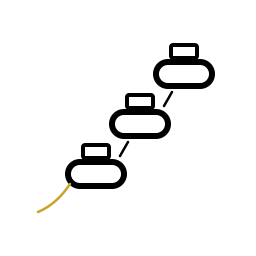
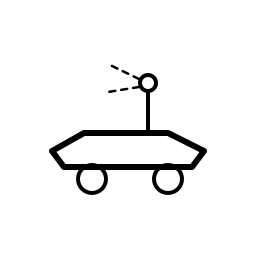
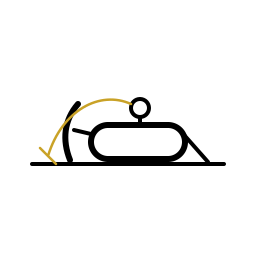
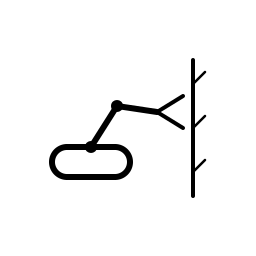
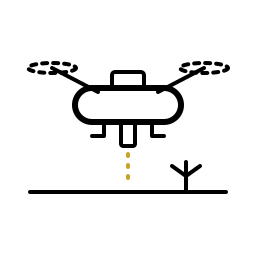
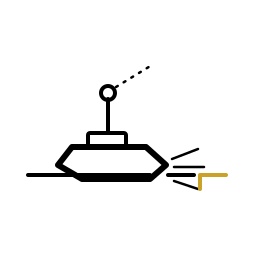
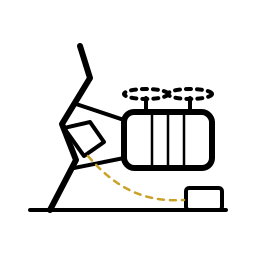
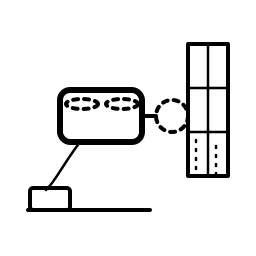
Release · Descend · Land · Right & Open · Egress
Canadian Shield's cross-fleet air-deployment pod: a canopy-retarded delivery container that carries a carrier system down, lands on a sacrificial crush stage, self-rights on any attitude and opens its petal doors so the carrier can walk, roll or drive out — at a site a road can't reach, or a crew shouldn't stand under. A delivery container, not a weapon.
A canopy-retarded delivery pod: land on a crumple zone, right itself, open, release the carrier system.

Release · Descend · Land · Right & Open · Egress
The Shield Pod is an air-deployment container: a moulded shell over an internal load frame, a canopy-retarded descent train, a sacrificial crush stage at the base, and four petal doors that double as self-righting levers and egress ramps. It carries a carrier system — a Badger boring plant, a Grizzly, a Goose launcher fit, an Orca-exploratory package, or a humanitarian air/water/comms cache — through the drop, the landing, and out onto the ground, without a crew standing under it.
It is a defence platform, not an Industrial one, because of where and what it delivers: the cradle-interface catalogue is built around the fleet's own carriers first — Badger, Grizzly and the Goose launcher fit are named integration cases alongside the civil/humanitarian loads. Get a working carrier into a site a road can't reach or a crew can't be standing under, set it down gently enough that it still works when the doors open, and let it go. One pod envelope, one descent train, one release-logic state machine; the only thing that changes system to system is a swappable cradle insert, so a new carrier is a tooling change to the cradle, not a redesign of the pod.
The engineering headline is not the fall — it is the arithmetic underneath it. A budgeted landing at a 6–8 m/s sink rate onto a 10–15 cm crush stroke works out to ~12–33 g of average deceleration — well inside the shock tolerance of the mechanical and electronic systems this line already ships. What actually drives the design is reliable egress at any landing attitude, a cold-worthy release-logic chain, and the opening-shock case at the top of the canopy train — the case that sizes the internal frame.
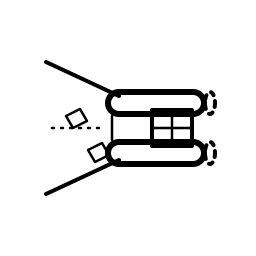
Four elements, four jobs: the outer shell sheds weather and handling loads; the internal frame carries the landing, cradle and canopy-opening cases; the sacrificial crush stage takes the impact so nothing else has to; the petal doors right the pod and then become the ramp the payload leaves on.
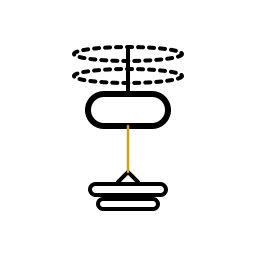
Release fires an extraction stage that stabilises the pod and stages a main canopy — round for the baseline, steerable ram-air for the guided variant — at a controlled airspeed. The canopy converts a wide range of release altitudes into one known, repeatable impact velocity: everything downstream, from crush stroke to pad area, keys off that single number.
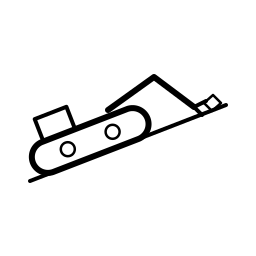
At touchdown the pod lands on its base, on purpose: a sacrificial crush stage absorbs the impact so the shell and cradle never have to. Passive geometry — a low center of mass and a shell with no stable rest attitude except base-down — does most of the righting work; if the pod comes to rest off-base, the petal doors open in sequence and lever it upright. Once the pod is base-down and stationary, the same doors swing out as an egress ramp and the cradle unlocks — never before both conditions are proven true.
The release-logic chain is deliberately conservative: it fails locked in the air — nothing opens on the way down, ever — and fails open-able on the ground by simple mechanical backup, so a sensor fault can never strand the payload inside a closed pod. A mechanical g-latch and a no-motion window back up the electronics at the one point where the two failure postures meet: impact detection.
The complete data card for the Shield Pod — mass, descent, landing, cradle, construction and compliance, grouped the way a fleet buyer compares them.
Landing deceleration is stated as an ideal-crush average over the crush stroke; peak values run higher. The 250 kg gross mass is a worked case for the descent and impact budget, with sensitivity checked from 100 to 500 kg.
Canadian Shield's thesis is that manufacturing is the decisive capability. The Shield Pod carries that thesis to the last mile: the same moulded-shell and machined-frame discipline built on this manufacturing base, packaged into a container that gets a fleet carrier onto ground nothing else can reach — a site a road can't reach, or a crew shouldn't be standing under during release.
The overlap is physical, not rhetorical. The 5-axis shop that cuts moulds elsewhere in the group cuts the pod's shell and petal tooling; the internal frame is a machine-shop part, not a specialty one; the crush cartridges are moulded from the same materials rulebook as the rest of the fleet. One engineering canon, one materials rulebook, one cradle-interface logic — reused across every carrier the fleet ships, defence or civil.
And because its primary job is putting Badger, Grizzly and Goose-launcher fits into the ground, the pod carries the same no-radio posture the rest of the defence fleet does: descent guidance is inertial and barometric by design, not radio-dependent, and it does not assume a permissive spectrum the way a civil work platform can. The pod itself is non-kinetic — no warhead, no fuze, no energetic material — but international transfer is subject to Canadian government permits, counsel-first, the same as every other defence platform in the fleet.
The pod's economics live in the cradle interface — specified once, so a new carrier system is a swappable insert rather than a new descent train. One envelope, one descent train and one release-logic chain across every carrier fit the fleet ships.
A Shield Pod job is a delivery, not a mission of its own: the carrier system inside is the point, and the pod's whole job is getting it there intact. One drop, walked end to end — illustrative of the operating sequence, not a mission record.
The carrier system is seated in its cradle insert and the pod is rigged at the carriage interface. The release point, landing box and no-go boundaries are planned and geofenced before the pod ever leaves the ground — a per-system fit that is a tooling change, not a redesign.
Release stages the canopy to a known impact speed; the crush stage absorbs the landing; passive geometry and petal-sequence righting set the pod base-down; the doors open and the cradle unlocks. The whole sequence runs with no crew standing underneath it — the interlock chain is the only thing present at touchdown, and it fails locked in the air, open-able on the ground.
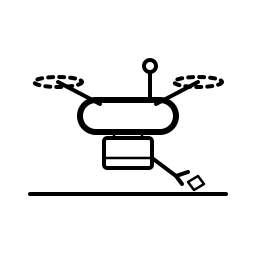
Once the pod is open and proven stationary, the carrier system egresses down the petal ramp under its own power and goes to work. The pod's job ends when the doors open: what the carrier does from there belongs to that carrier's own brochure, not this one.
The Shield Pod is the fleet's cross-fleet delivery layer: its cradle-interface catalogue names carriers from every family, and each one rides the same pod envelope on its own swappable insert.
The cross-fleet air-deployment pod — one envelope, one descent train, one cradle interface.
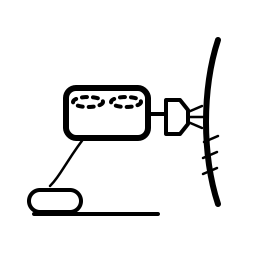
Download PDF ↓The Underground boring plant — delivered by pod to ground a road can't reach.
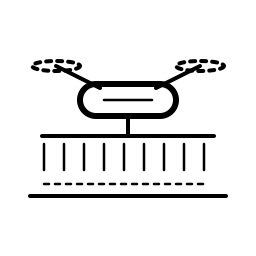
Download PDF ↓The Ground family's lead carrier — a named cradle-insert fit in the pod's interface catalogue.
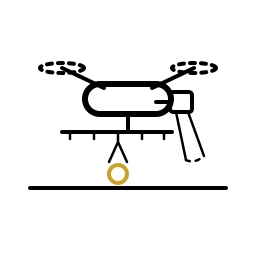
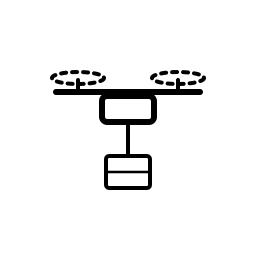
Download PDF ↓The Air family's launcher, podded as a launcher fit — a magazine delivered to site.
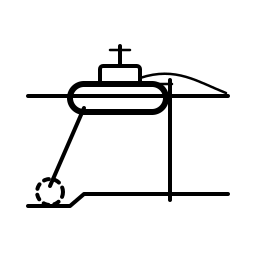
Download PDF ↓The Water family's carrier, named as an Orca-exploratory package alongside the humanitarian cache loads.
Download PDF ↓If you need a working carrier system on ground a truck can't reach — a contested site, a remote survey grid, a location cut off by flood or fire — the conversation starts with the carrier you need delivered, and the pod built to get it there intact.