Self-Charging Dock · CS-700 · Industrial Series Ground Infrastructure

TURNAROUND TO ZERO

A docking and replenishment station that lets a working fleet return, recharge and redeploy without a hand touching it.

Approach · Capture · Swap/Charge · Refill · Launch

U→1
Utilisation approaches one as turnaround approaches zero
1
Generic dock interface, reused across the whole Industrial line
3
Stated energy-replenishment options under trade — no winner declared
0
Munitions, warheads or terminal-effect content handled, ever (D19)
What It Is

The Hinge That Makes
an Autonomous Fleet Actually Autonomous.


The Self-Charging Dock is Industrial-line ground infrastructure — not a vehicle, not an airframe, a fixed station a working platform returns to. A machine approaches, is captured and seated, has its battery and payload replenished, and launches again — largely unattended, cycle after cycle, for most of an operator's working day.

It exists because of one arithmetic fact stated plainly by the line's own engineering: a working machine's day is fly, return, refill, fly again — and when working sorties are short, as heavy-payload sorties usually are, the machine spends its day on the ground unless the ground is fast. Utilisation is flight time divided by flight time plus turnaround; as turnaround falls toward zero, utilisation rises toward one, regardless of how long any single sortie runs. That is the number the dock is built to move, and it is why Canadian Shield calls the dock the Industrial line's commercial hinge rather than one more platform on the roster.

It does not fly, spray, seed or lift. It is the piece of infrastructure that lets everything on the roster that does those things do them for an entire shift instead of a few sorties — serving the Seeder, the Sprayer and Spot Sprayer, the Cargo Mover ladder, and the rest of the Industrial series as each platform's own dock interface matures.

The Governing Insight
Turnaround, not flight time, caps the day.

Ten more minutes of flight is the wrong lever if the machine then sits on a tailgate for twenty. The dock is the answer to the actual bottleneck: it does not make any airframe fly longer — it makes the ground stop being the slow part.

01 How It Works · Capture & Replenishment

APPROACH GETS YOU CLOSE. THE FUNNEL FINISHES THE JOB.


Finding and seating a machine on the dock, repeatably, in Canadian weather, is a layered problem. Approach guidance — RTK GNSS or an optical fiducial marker on the pad — gets a descending machine close. From there, a mechanical self-centring funnel does the last centimetres: passive, powerless, and — deliberately — the committed authority for final capture. A cone sized for the smallest platform on the line does not seat the largest, so funnel geometry is scaled to the biggest served tier, not the average one.

Once seated, a retention latch fires — an interlock input, not a convenience, because nothing else on the dock is permitted to move until it reads true. From there the machine is serviced through one generic station interface: mechanical index, power, data and, where fitted, a fluid or granular manifold. Energy replenishment is where the design deliberately keeps three doors open at once — the dock does not force a winner between hot-swap, fast-charge and contact/inductive charging, because the discriminator is a duty-cycle model, not a preference.
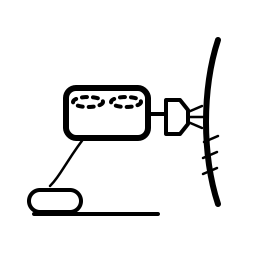
Everything downstream of the latch — manipulator motion, fluid lines, chemistry fills — is guarded and hardwired: motion is enabled only when the machine is seated, latched, and the exclusion zone reads clear, independent of whatever is running the day's schedule.

DOCK CYCLE DOCK STATION — SECTION ON THE CAPTURE AXIS RAISED, SELF-DRAINING PAD RTK / FIDUCIAL — GETS IT CLOSE SELF-CENTRING FUNNEL — MECHANICAL, LAST CENTIMETRES SEAT DATUM + RETENTION LATCH STATION INTERFACE — ENERGY FORK, OPEN 1 · HOT-SWAP MANIPULATOR EXCHANGES PACK 2 · FAST-CHARGE IN SITU — CHARGE-RATE BOUND 3 · INDUCTIVE CONTACT PLATES — LOSSY, TOLERANT STATED OPTIONS — NO BRANCH SELECTED PLATFORM-SPECIFIC END-EFFECTOR — FLUID / GRANULAR / CARGO MODULE LAUNCH — CYCLE LOGGED EXCLUSION ZONE — OCCUPANCY-INTERLOCKED; MOTION ENABLED ONLY ON SEATED + LATCHED + ZONE-CLEAR CS-700 · dock station — approach · capture · swap/charge · refill · launch
1 · ApproachRTK GNSS or an optical fiducial guides the machine close.
2 · CaptureThe self-centring funnel absorbs the remaining error and seats it.
3 · Swap/ChargeThe open energy fork — hot-swap, fast-charge or inductive.
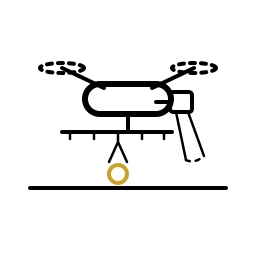
4 · RefillA platform-specific end-effector tops battery and payload alike.
5 · LaunchThe latch releases; the cycle is logged; the pad clears for the next.
The Central Open Fork
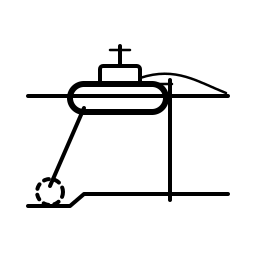
Three Ways to Put Energy Back In.
No Winner Declared.


The drawing package is explicit: the energy-replenishment method is the package's central trade, and no branch is selected. All three are stated as the design's options, each with a real cost the others do not carry.

1 · Robotic Hot-Swap

Turnaround Bound by Mechanics

A guarded manipulator exchanges a depleted pack for a charged one from a heated magazine. Turnaround is bounded by mechanics, not chemistry — but it only works if every Industrial airframe carries the same pack interface: mechanical envelope and latch, electrical connector, one fleet-wide standard, not a part.

2 · Fast-Charge In Situ

Turnaround Bound by Chemistry

The seated machine charges where it sits — no manipulator, no swap mechanism. Turnaround is bounded by charge rate and thermally limited, and fast-charge demands short, high power peaks that a rural single-phase site service may not have on tap.

3 · Contact / Inductive

Tolerant, But Still Charge-Bound

Contact plates or inductive coupling forgive the residual misalignment the funnel would otherwise need to correct for. Inductive transfer is lossy — efficiency is still to be characterised, and the waste heat is real — and the branch remains charge-rate-bound like fast-charge.

A mixed fleet is on the table too — hot-swap at flagship docks, fast-charge at lighter satellite pads — but that is a trade study, not a decision made on this page. Selection follows the duty-cycle model in Specifications below, not a preference stated here.

Capabilities & Specifications

The Numbers, Stated the Way
We State Everything.


Figures below are drawn from the dock engineering drawing package (CSH-DWG-DOCK-001) — the design's first engineering organization. Several dimensions are sizing outputs rather than fixed inputs, and are stated that way rather than guessed at.

Self-Charging Dock CS-700 · Turnaround-to-Zero Ground Infrastructure Industrial Family · Ground Infrastructure

01Designation & Role

Designation
CS-700 · Self-Charging Dock
Role
Turnaround-to-zero ground station — self-charging & self-loading dock
Served platforms
Seeder (CS-510) · Sprayer / Spot Sprayer (CS-560/561) · Cargo Mover (CS-600, all tiers) · rest of the line as each platform's own dock interface matures

02Capture & Alignment

Approach guidance
RTK GNSS or optical fiducial marker — gets a machine close
Final capture
Mechanical self-centring funnel — passive, powerless, the committed last-centimetres authority
Funnel sizing
Scaled to the largest served tier, not the average one
Retention
Latch fires on seat; reads as an interlock input — nothing else on the dock moves until it's true

03Energy Replenishment

Method
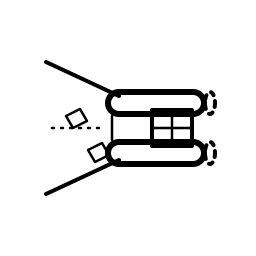
Stated open fork: (1) robotic battery hot-swap (2) fast-charge in situ (3) contact-plate / inductive charging
Discriminator
The duty-cycle model in the drawing package — no branch is selected on this page
Common pack standard
A fleet-wide battery-pack interface — mechanical envelope, latch, electrical connector — is the prerequisite for the hot-swap branch

04Payload & Service Interface

Interface
One generic station interface — mechanical index, power, data, and fluid/granular where fitted
End-effectors
Platform-specific: liquid skid for Sprayer/Spot Sprayer, granular hopper/chute for Seeder, cargo-module shuttle for Cargo Mover off its own keel-plate standard
Design rule
A new platform family means a new end-effector, never a new dock
Cross-contamination control
Dedicated fill circuits per chemistry class, or a validated rinse/purge cycle between fills; a per-fill chemistry log is kept on every branch

05Site & Structure

Pad footprint
Raised, self-draining pad sized to the largest served tier plus manipulator reach — a sizing output, not a published figure
Exclusion zone
Occupancy-interlocked perimeter sized to failure-drift cases, not rotor radius alone; detection means (fence / scanner / mat) under evaluation
Weather & cold-soak
Heated battery magazine for cold-soak; pad-heating and funnel-liner strategy for snow, ice and mud under evaluation; enclosure format (open pad / canopy / full shelter) an open fork
Site power
Grid, generator, or solar-plus-storage — open per site; peak-demand shape differs by which energy-fork branch is selected

06Control & Data

Interlock
Hardwired safety chain, independent of the scheduling computer — perimeter e-stop pillars plus remote e-stop; motion enabled only on seated + latched + zone-clear
Data & command
Every dock cycle logged — charge curves, pack serials, fill records
Human-in-the-loop
A Strategic Agent may advise scheduling; a person ratifies every irreversible action
Comms
Radio command-and-control and GNSS approach guidance

07Compliance

Patent status
Patent pending
Civil line
Ground infrastructure on the surface civil Industrial line — radio and GNSS permitted and used openly
Cargo scope
Services working carriers only — never stores, handles or loads any warhead, fuzing, energetic or terminal-effect content, in any variant, ever (D19)
Standing
Nothing on this page is a specification, offer, commitment or price

Source: drawing package CSH-DWG-DOCK-001 R0.2 · dimensions publish when the sizing model closes.

Turnaround — the Governing Arithmetic
U = tfly ÷ (tfly + tturn)

We do not publish a minutes-to-turnaround figure, because on this dock that number is not a property of the dock alone — it is the output of a duty-cycle model whose inputs are still being gathered, sortie by sortie, branch by branch. What we will state is the shape of the answer: as turnaround approaches zero, utilisation approaches one, for any flight time at all. As turnaround grows past flight time, utilisation falls below one-half and keeps falling — and at that point, adding aircraft rather than speeding the dock becomes the only fix, at real fleet capital cost.

In the Doctrine

The Line's Commercial Hinge,
Built on the Same Shop Floor.


Canadian Shield's house thesis is that manufacturing is the decisive capability, and that a fleet is bought for daily output, not for any single machine's spec sheet. The dock is where that thesis becomes an economic argument: precision capture plus energy and payload replenishment, pushing fleet utilisation toward one.

The overlap with the rest of the line is structural, not incidental. The guarded manipulator, the hardwired interlock chain and the control cabinet draw on the same machinery-safety engineering as the rest of the estate's ground and industrial equipment; the generic station interface is deliberately one standard reused across every served platform, so a new Industrial-line member costs a new end-effector, never a new dock. And the dock is the reason a common battery-pack standard across the families is a design driver rather than an afterthought — the hot-swap branch cannot exist without it.

Up here, the estate's radio boundary runs the permissive way. The no-radio rule governs the defence, underground and tethered platforms without exception — but the Industrial line is the surface civil exception, and the dock uses both radio and GNSS openly: commercial RF for command and telemetry, and RTK GNSS as one layer of the approach-guidance stack that gets a returning machine close enough for the funnel to finish the job. A farm yard is not a jammed battlefield, and the dock is not priced or engineered like one.

Family Context
The fleet is the razor. The dock is the pit stop.

A Seeder, a Sprayer or a Cargo Mover earns its keep in the air, not parked on a tailgate. The dock is the piece of infrastructure that turns a platform's flight-hour economics into a day-rate economics — one generic interface, reused across the whole roster, so utilisation compounds across the fleet instead of resetting per machine.

On Site

Set the Pad.
Let the Fleet Do the Rest.


The dock is infrastructure, not a mission profile — its day is a repeated loop, not a sortie. Here is what that loop looks like end to end, from the first pad set to the deliberate moment a person is allowed to walk up to it.

01 · Install

Pad, Power, Proven Interlocks

The dock is sited on a levelled, self-draining pad and commissioned against the site's chosen power branch — grid, generator, or solar-plus-storage. The weather mast goes up, the hardwired interlock chain is proven independently of the scheduling computer, and no aircraft is cleared to approach until the exclusion zone reads clear on demand, every time.

02 · Turnaround Cycle

Approach, Capture, Refill, Launch — On Loop

The day's real work happens here, on repeat: a machine on approach guidance is captured by the funnel, seated and latched, its battery and payload replenished through the station interface, then released to launch. Queued machines hold at the fleet's hold points outside the exclusion zone until the pad clears — largely unattended, cycle after cycle.

03 · Maintain

The Deliberate-Entry Case

Scheduled service and wear-liner replacement enter through a declared safe state, not a shortcut: rotors stopped, manipulator parked, packs de-energised, fluid lines depressurised — a lockout/tagout analogue the dock presents before a person crosses the zone. Magazine and fluid or granular stores are restocked on the same visit.

Scenario illustrates the design intent of the operating loop. Turnaround times, swap and charge rates, and queue behavior are exactly what the test program exists to measure — and the duty-cycle model, not this page, sets those numbers when they are ready to publish.

The Industrial Line · Ground Infrastructure & Served Platforms

One Dock. The Whole Roster.


The dock is one of two pieces of Industrial-line ground infrastructure, and it exists to serve the working platforms above it.

This system CS-700 · Ground infrastructure

Self-Charging Dock

Turnaround-to-zero docking and replenishment — the Industrial line's commercial hinge.

Download PDF
CS-710 · Ground infrastructure

Relay Chain

Packable comms-relay nodes — the line's other piece of ground infrastructure.

Download PDF
CS-C001 · Consumable

Fibre Spool Line

Guidance-fibre cassettes — the wired backup when radio can be denied.

Download PDF
CS-510 · Served platform

Seeder

One of the working platforms the dock's generic interface is built to serve.

Download PDF
CS-560 · Served platform

Sprayer

Liquid-skid end-effector platform on the dock's served roster.

Download PDF
CS-600 · Served platform

Cargo Mover

The mover ladder — served off the dock's cargo-module shuttle interface.

Download PDF
The Commercial Hinge

The Fleet Does the Work.
The Dock Makes It a Day-Rate.

If turnaround, not flight time, is what's capping your working fleet's output, the conversation starts with the pad — and with the ground infrastructure built to keep it clear.

Full Marketing Package

The Rest of the Fleet.


Every Canadian Shield platform has a brochure like this one — same depth, same status discipline, same refusal to publish a number we cannot source. Organized by family below.

Air · 8
CS-110 · Air

Goose

No battery. No motor. No receiver. A kinetic carrier launched at ~189 m/s on shop air.

Read the brochure Download PDF
CS-111 · Air

Encapsulator

A capture-head variant on the Goose CS-110 launch line — fouls rotors and entangles the airframe instead of striking it down.

Read the brochure Download PDF
CS-112 · Air

Matrix

Aimed, direct-fire, tethered — the net that stays connected to the gun that threw it.

Read the brochure Download PDF
CS-120 · Air

Gyrfalcon

Goose's launch chain, plus the power Goose leaves out — a tail motor and bow-thruster ring for mid-flight correction.

Read the brochure Download PDF
CS-130 · Air

Raven

A moulded electric aircraft that carries the network — decoy, relay, electronic support. Non-kinetic. Recoverable.

Read the brochure Download PDF
CS-140 · Air

Owl

A big, slow propeller and an IR-biased eye — orbiting instead of hovering, unheard, unseen, unjammed.

Read the brochure Download PDF
CS-150 · Air

Loon

The bird that flies its whole leg without asking a satellite for a name.

Read the brochure Download PDF
CS-160 · Air

Kestrel

The Air family's smallest body — a tube-launched, motor-cruising scout priced to lose, not to last.

Read the brochure Download PDF
Ground · 6
CS-210 · Ground

Grizzly

Tracked. Battery-electric. 150 kg over muskeg — with nothing to jam.

Read the brochure Download PDF
CS-220 · Ground

Moose

600 kg of freight over bad ground. Payload is the product — mobility is the constraint it is bought within.

Read the brochure Download PDF
CS-230 · Ground

Wolf

Eight coordinated carriers. One fibre trunk. One operator. Nothing to jam.

Read the brochure Download PDF
CS-240 · Ground

Lynx

A wheeled route-picker with thermal eyes — and a watch mode measured in days.

Read the brochure Download PDF
CS-250 · Ground

Beaver

Tracked. Battery-electric. An anchored winch pulls roughly seven times what the tracks alone can.

Read the brochure Download PDF
CS-260 · Ground

Wolverine

A compact tracked carrier that places self-reacting tools at the work face — the force closes on the structure, not the machine.

Read the brochure Download PDF
Water · 2
CS-310 · Water

Orca

Persistent survey & carrier AUV — one moulded hull that surveys, carries and watches.

Read the brochure Download PDF
CS-320 · Water

Jellyfish

A soft pulsed-jet payload carrier — slower than the current on purpose.

Read the brochure Download PDF
Underground · 8
CS-410 · Underground

Badger

A surface plant that pushes a steerable head into ground with no line, no map, no signal.

Read the brochure Download PDF
CS-411 · Underground

Aquifer

Coiled-tubing bore, fibre-guided — conduit installed, water table mapped, nothing to jam.

Read the brochure Download PDF
CS-420 · Underground

Ferret

Recon, mapping and locating in existing tunnels and culverts — with a block-only interpose capability, always human-confirmed.

Read the brochure Download PDF
CS-430 · Underground

Mole

A passive seismic and acoustic node on long-life battery — reporting only over a buried fibre link.

Read the brochure Download PDF
CS-435 · Underground

Trembler Line

A chain of buried Mole nodes on a fibre trunk — detect, localize, cue. Nothing radiated, nothing to jam.

Read the brochure Download PDF
CS-440 · Underground

Muskrat

Hybrid swim/crawl. Zero visibility. No diver, no radio, no GPS.

Read the brochure Download PDF
CS-450 · Underground

Gopher

It maps, it marks, it parks. Cheap enough to send in numbers.

Read the brochure Download PDF
CS-460 · Underground

Farell Pig

Flow-driven, self-propelled or tethered — it rides the line, it doesn't bore one.

Read the brochure Download PDF
Industrial · 17
CS-510 · Industrial

Seeder

A pneumatic seed-pod launcher, retuned to gentleness. Pods down, evidence back.

Read the brochure Download PDF
CS-520 · Industrial

Skimmer

A small moulded surface craft — the information and marking layer of a spill response.

Read the brochure Download PDF
CS-530 · Industrial

Rock Scaler

A contact-tolerant aerial platform sets the hook. A ground-anchored winch does the pulling.

Read the brochure Download PDF
CS-540 · Industrial

Washer

A caged, umbilical-fed washing platform. Water up the line, evidence back down.

Read the brochure Download PDF
CS-550 · Industrial

Coater

An umbilical-fed applicator platform. The pressure stays on the ground; the machine flies the last few hundred millimetres.

Read the brochure Download PDF
CS-560 · Industrial

Sprayer

Full-width boom, drift-reduction nozzles, a metered rate held across the pass. The broadcast tool for the uniform job.

Read the brochure Download PDF
CS-561 · Industrial

Spot Sprayer

Machine vision finds the target; only that nozzle opens. Built to cut total product volume per acre.

Read the brochure Download PDF
CS-570 · Industrial

Dredger

A trailerable uncrewed dredger for ponds, marinas, lagoons and channels.

Read the brochure Download PDF
CS-580 · Industrial

Recovery

An uncrewed collection craft for the debris and spill material that floats.

Read the brochure Download PDF
CS-590 · Industrial

Enviro

A tracked, teleoperated manipulator platform for shoreline and land cleanup — reach, load and slope, enforced as one envelope.

Read the brochure Download PDF
CS-630 · Industrial

Litter Collector

An uncrewed multirotor built to find litter, take only litter, and prove it did.

Read the brochure Download PDF
CS-600 · Industrial

Cargo Mover

An uncrewed VTOL cargo family — four sizes of the same machine, from toolbox to bulk lift.

Read the brochure Download PDF
CS-610 · Industrial

Personnel Mover

A crew-carrying VTOL work machine. Two tiers — PM-8 single-seat, PM-12 two-seat.

Read the brochure Download PDF
CS-620 · Industrial

Heavy-Lift Logger

An uncrewed coaxial hybrid rotorcraft for long-line log extraction — turn after turn, hour after hour.

Read the brochure Download PDF
This brochure CS-700 · Industrial

Self-Charging Dock

A docking and replenishment station that lets a working fleet return, recharge and redeploy without a hand touching it.

Read the brochure Download PDF
CS-710 · Industrial

Relay Chain

A deployable chain of relay nodes — command, telemetry and position augmentation for civil fleets working past the edge of the network.

Read the brochure Download PDF
CS-C001 · Industrial

Fibre Spool Line

Guidance-fibre consumable cassettes — a physical tether option, alongside or instead of radio.

Read the brochure Download PDF
Defence · 1
CS-901 · Defence

Shield Pod

A canopy-retarded delivery pod: land on a crumple zone, right itself, open, release the carrier system.

Read the brochure Download PDF