REPLANT THE BURN —
FROM THE AIR
A pneumatic seed-pod launcher, retuned to gentleness. Pods down, evidence back.
Index · Seat · Charge · Fire · Reset
The Industrial line's anchor: an aerial reforestation platform built around a low-pressure pneumatic pod launcher — the fleet's launch physics retuned down to roughly one-fortieth of the pressure, firing biodegradable seed pods into burned ground and logging every shot it takes. A work machine, not a weapon.
A pneumatic seed-pod launcher, retuned to gentleness. Pods down, evidence back.
Index · Seat · Charge · Fire · Reset
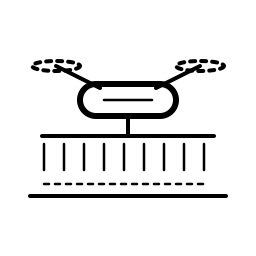
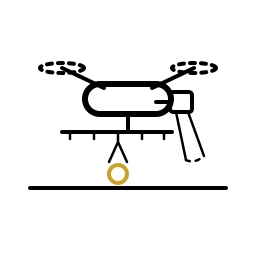
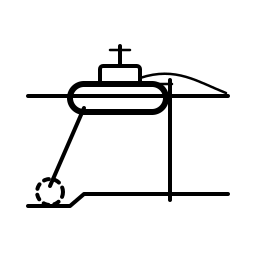
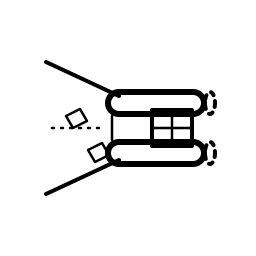
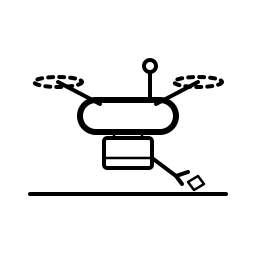
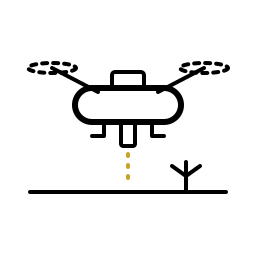
The Seeder is an uncrewed aerial reforestation platform: a moulded-polymer multirotor carrying a gravity-fed magazine of biodegradable seed pods and a downward-firing pneumatic barrel. It flies a compiled block plan over burned or cleared ground, fires pods to embedment velocity, and logs every shot.
It anchors the Industrial line because it is the clearest possible statement of what the line is: the same pneumatic launch engineering that drives the defence fleet, run at roughly one-fortieth of the pressure — closer to agricultural pneumatics than to any weapon. The design driver is inverted top to bottom. The defence question is whether electronics survive a launch; the Seeder's question is whether a living seed and a friable shell do. The launcher is engineered to be gentle, because gentleness is the requirement.
The machine's real product is not the flight — it is the record. Every pod fired is logged with GNSS position and measured muzzle velocity, building an auditable as-seeded map of the block: proof, pod by pod, that the prescription was executed. Species and seed prescriptions stay where they belong — with the client's forester and the provincial standard, never with us.
A defence round is built to take punishment; a seed pod is built to take root. Same barrel discipline, same shot-to-shot consistency obsession, opposite requirement — the acceleration ceiling is set by seed viability, and the launcher is designed down to it.
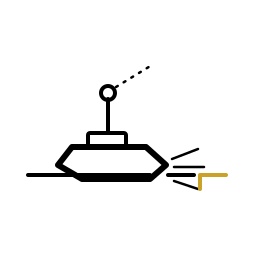
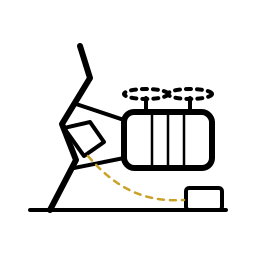
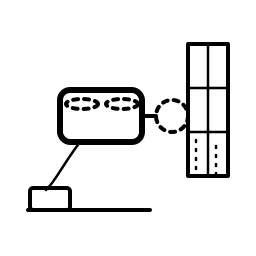
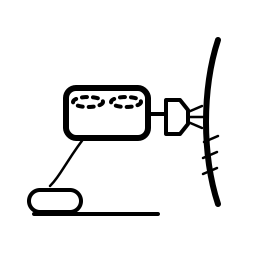
A cassette of pods sits directly over the barrel axis. Each cycle, the index gate releases one pod into the breech, a fast low-pressure valve admits a sub-1-bar charge behind it, and the pod accelerates down the barrel to embedment velocity — straight down. The breech vents, the gate re-arms; the whole cycle takes about half a second.
The magazine is gravity-fed and mounted on the vehicle centreline, so its mass drains toward the center of gravity shot by shot instead of away from it. Downward firing means each shot's small recoil adds momentarily to lift demand rather than tipping the aircraft. The launcher fires on the compiled block plan, not on an operator's trigger: the operator flies the plan, and the plan fires the pods. A barrel-safe interlock tied to flight state and a no-fire geofence are designed in from the first unit — a work machine earns trust the same way any machine on a job site does.
The governing figure of merit is not power — at these pressures the launcher's whole sortie energy budget is a rounding error next to flight power. It is shot-to-shot repeatability: every pod leaving the muzzle at the same velocity, thousands of times, in cold, in vibration, on a machine that shakes twice a second.
The pod is a ping-pong-ball-class sphere: a soil-degradable shell around seed and growth medium. Define the envelope once — diameter, mass band, crush strength, finish, moisture limits — and a new mission becomes a consumable change, not a machine change.
The material boundary is deliberate and absolute. The pod shell is formed from soil-degradable media — starch, cellulose, compressed-fibre class — and is explicitly never a recycled-PET part, because a reforestation machine that leaves polymer shells in a burn scar would invert its own purpose. The recycled-PET line serves where it should: the reusable logistics articles around the pod — cassettes, transport trays, ground-station cases — swapped at resupply and used for years.
The fill family maps the line's future without touching the airframe: conifer restock is the founding mission; deciduous and urban-canopy mixes, erosion-control blends for cut slopes and rights-of-way, and partner-formulated inoculated fills follow as prescriptions demand. A seed-free inert trainer pod — a ballistic match for bench characterisation and demonstrations — is the one variant that never enters soil for keeps.
The complete data card for the Seeder — dimensions, launch performance, navigation, payload, construction and compliance, grouped the way a working fleet buyer compares them.
Muzzle velocity is embedment-class: duff, mineral soil and clay embed differently, and the working floor is measured on the block, not assumed. No headline hectares-per-day figure is published — daily coverage is governed by oversow factor, cassette resupply cadence, airframe configuration, wind at working height, terrain and soil across the block, and the flight rules for long autonomous lines; resupply cadence, not fire rate, sets the pace.
Canadian Shield's thesis is that manufacturing is the decisive capability. The Seeder is that thesis earning a civil living: the same sovereign Canadian production base, pointed at reforestation instead of defence.
The overlap is physical, not rhetorical. The 5-axis shop that cuts moulds for the defence fleet cuts the Seeder's body moulds. The moulded glass-filled-nylon structural grammar, the recycled-PET rules for non-structural articles, the shared payload-mount discipline, the pneumatic-launch engineering — all of it is one engineering canon amortised across both lines. Civil revenue and defence readiness draw on the same tooling, the same materials rules and the same machines, which is exactly the point.
And up here, the estate's radio boundary runs the other way. The no-radio rule governs the defence, underground and tethered platforms without exception — but the Industrial line is the surface civil exception where radio and GNSS are permitted, and the Seeder uses both openly: commercial RF for command and telemetry, GNSS for waypoint flight and for the as-seeded record that is the product. A farm block is not a jammed battlefield, and we do not price it like one.
A Seeder flies for years; pods are consumed by the thousand per hectare. The platform's economics live in the consumable stream — pods, cassettes and the resupply loop — which is why the pod envelope is specified once and the fill family grows underneath it. Commercial structure is design intent, stated plainly: no unit has been priced, offered or sold.
A Seeder job is a loop, not a flight: the forester's prescription compiles into a block plan, the machine executes it pod by pod, and what comes home is evidence. Here is the day, end to end — illustrative of how the machine works a block, not a job record.
The crew arrives by truck: aircraft, ground station, charged cassettes in their transport trays, pods kept cold and dry. The client's prescription — species, density, zones to hit and zones to leave — compiles into a block plan with the no-fire geofence drawn in. Species and density are the forester's call and the provincial standard, never ours; crew lanes and standoffs are set before the first rotor turns.
The Seeder flies terrain-following lines over the burn at working height, firing on the compiled plan — one pod per cycle, straight down, each shot logged with position and measured muzzle velocity. Empty cassette, home, swap, relaunch: the resupply loop is the day's real tempo. The operator flies the plan, watches the machine and owns the exceptions; the machine puts the pod where the plan says, and proves it did.
At day's end the reusable articles leave with the crew — cassettes, trays, cases, back for the next block. The pods stay, already breaking down into the soil. The client gets the as-seeded record: an auditable, pod-by-pod map of exactly what was executed, ready for their own verification survey. What leaves is the machine and every reusable article; what remains is seed, medium and a shell built to disappear.
The Seeder anchors the surface civil line — the one part of the estate where radio and GNSS are permitted and used openly. Its siblings ride the same engineering canon: moulded glass-filled-nylon structure, recycled-PET logistics articles, one shop floor behind every machine. Same canon, different jobs.
Aerial reforestation — a pneumatic pod launcher retuned to gentleness. Pods down, evidence back.
Download PDF ↓The next machine on the line — same moulded-structure grammar and materials canon, pointed at a different job.
Download PDF ↓Aerial application on the same surface civil line, where radio and GNSS are permitted and used openly.
Download PDF ↓Precision aerial application — and the same refusal to publish a coverage number without its governing variables.
Download PDF ↓If you manage post-wildfire restock, reclamation ground or a replanting obligation with an audit attached, the conversation starts with your prescription — and with the machine built to execute it pod by pod.