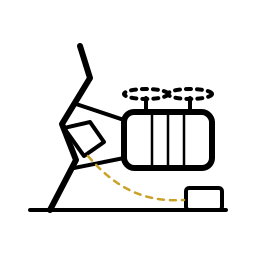
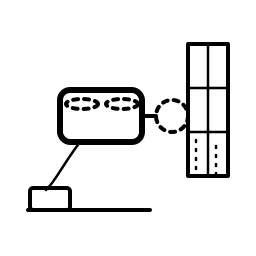
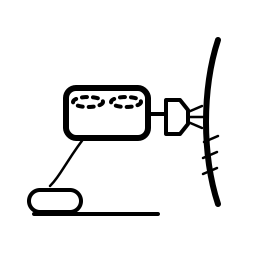
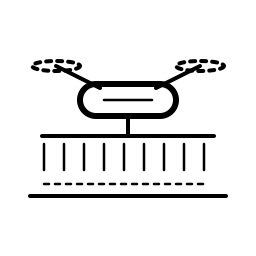
LIFT IT OUT.
LOG IT HOME.
An uncrewed collection craft for the debris and spill material that floats.
Sense · Mark · Collect · Offload
An uncrewed catamaran work boat for bulk debris and spill-material collection: funnel booms concentrate what floats, a between-hulls channel delivers it, and a swappable basket-cassette dewaters it — then leaves the craft as a sealed, logged custody unit. The execution layer that pairs with a Skimmer survey. A work machine, not a weapon.
An uncrewed collection craft for the debris and spill material that floats.
Sense · Mark · Collect · Offload
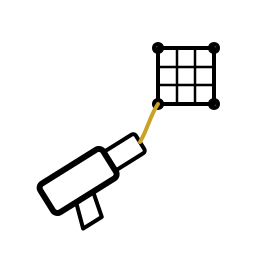
Spill response and post-storm cleanup have an information layer and an execution layer. Canadian Shield split them on purpose: the Skimmer CS-520 surveys and marks; the Recovery CS-580 collects, carries and hands over — with a custody log attached to every load.
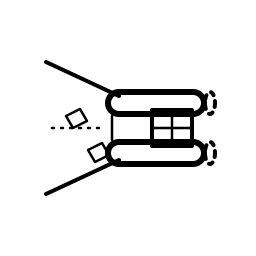
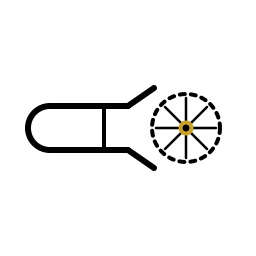
The craft is a twin-hull catamaran in the 2.4 m class, booms folded to road-trailer width for transit. Deployed, its funnel booms concentrate a 1.5 m collection front into the between-hulls channel; the craft's own motion is the collection energy, and a mesh basket-cassette in the channel is the reservoir — water passes through, solids stay. When the cassette reports full, the craft runs home, the cassette lifts out as one unit, an empty one drops in, and the loop continues. The channel is the machine, and the whole path is passive on the base craft: fewer moving parts in the dirtiest part of the job.
The cassette bay — seat, latches, lift points, load sensing, one data line — is defined once, so a new collection medium is a tooling change, not a redesign. Three fits ride the same bay: an open solid-debris mesh for municipal litter, post-storm debris and weed mats; a sealed, non-draining cassette for oily solids, where the cassette itself is the regulated-waste transfer unit; and a towed collection bag astern in the ~300 kg class that roughly doubles collection in transit-dominated work — a droppable fit that leaves the base craft unchanged.
A snagged boom or clogged mesh stops collection, not the craft. And no mode — including fault modes — can dump at sea: a fouled cassette is carried home, never jettisoned. The design's two promises are that it keeps working and that everything it takes is accounted for.

Mouth → channel → cassette is the entire collection path — and it is passive. The craft sweeps at walking pace, 0.75 m/s; geometry does the concentrating; the mesh does the separating.
The funnel booms shed load before the hull does — snag-release is a requirement, not an accident. The mouth's replaceable wear lip rides 0.15 m below the waterline, and freeboard is drawn against the loaded waterline from the start: at full cassette the craft sinks about 4.5 cm and the lip is still at working depth. Two shrouded thrusters give debris-tolerant differential steering with no rudder to foul; a paddle fallback above the waterline covers the day the water is worse than the survey said. The drives are sized by mouth drag, not cruise — the honest load case.
What makes the CS-580 a professional tool rather than a gadget is what happens at the dock: the cassette lifts out as one sealed unit, and custody transfers to the licensed chain — logged, positioned, time-stamped.
Operators never handle loose collected material; on the oily-solids fit the sealed cassette itself is the regulated-waste transfer unit, and logging is on by construction. The swap dwell is engineered to be short — cassette out, cassette in, battery exchanged in the same pause, about five minutes at the shore station — because cycle arithmetic says the reservoir and the offload trip set throughput, not the sweep speed. Wash-down is designed in, and the design treats even wash effluent as what it legally is: regulated waste.
The complete data card for the Recovery — dimensions, working performance, drive, cassette fits, construction and compliance, grouped the way a working fleet buyer compares them.
Freeboard is drawn against the loaded waterline: at a full cassette the craft sinks about 4.5 cm and the mouth lip stays at working depth. Dense-field cycle figures are working values — the reservoir and the offload trip set throughput, not the sweep speed. Collection, carriage and transfer of spill material — especially oiled solids — vary by jurisdiction; permits and waste-handling approvals belong to each operation and are never implied by this page.
The Industrial line is the civil sibling of the defence fleet — same autonomy stack, same moulded manufacturing, same owned Canadian shop floor — and the CS-580 is where that stack meets the least glamorous, most regulated work on the water.
The doctrine's civil half applies in full: radio and GNSS are permitted on this line — a harbour cleanup is not a jammed battlespace — and the boundary is published in both directions so no buyer has to guess. The manufacturing thesis shows up as the blades: mesh cassettes and liners are moulded consumables off the group's own line, which means every working CS-580 keeps buying from the Canadian floor that built it. And the fleet's sovereignty argument lands here as auditability — a collection machine whose every load is logged is a machine a municipality, an insurer and a regulator can all sign off on.
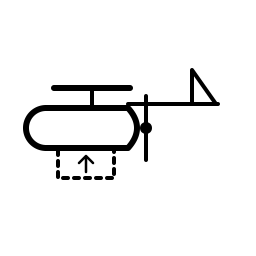
Three craft on one shared shallow-draft hull and station-keeping library: the CS-520 is the information layer, the CS-580 the collection layer, and the CS-570 the excavation layer. One incident, one family, one custody chain — from the spill edge to the licensed transfer.
One trailer, one shore station, a loop that closes on the cassette — illustrative of how the craft is used, not a job record.
The craft splashes at the ramp with booms folded and takes its tasking from the information layer: the Skimmer's survey marks where the material is, and the Recovery goes where it is sent. The funnel deploys to its 1.5 m front, the shore station stands up beside the ramp, and the craft works in high-vis posture — lights, reflector and a civil paint scheme. A work boat that wants to be seen.
The craft runs slow lanes through the debris field, and the channel does the work — mouth to channel to cassette, water through, solids stay. Snags shed at the boom, clogs stop collection but never the craft, and nothing ever goes back overboard. Load and level sensing under the seat closes the loop on capacity, not on a timer: full is the trigger.
The cycle ends at the custody boundary and starts again about five minutes later. The sealed cassette comes out as one lift and enters the licensed chain, logged end to end; an empty cassette and a fresh battery go in on the same dwell. Wash-down stays honest — decon effluent is treated as the regulated waste it is.
The Recovery is the collection layer of the water trio — three craft on one shared shallow-draft hull and station-keeping library, splitting one incident into information, collection and excavation. Same canon, different jobs.
Funnel booms, a between-hulls channel and a swappable cassette — lifts out what floats and logs every load.
Download PDF ↓The survey craft — it finds and marks the material, and its survey is the Recovery's tasking.
Download PDF ↓The excavation craft on the same hull library — it cuts what sits below the surface the Recovery sweeps.
Download PDF ↓If you answer for a harbour, a reservoir, a shoreline or a spill plan, the conversation worth having is about collection, custody and proof. It starts with the Industrial line.