THE SEA JAMS EVERYONE.
WE PLANNED ON IT.
Persistent survey & carrier AUV — one moulded hull that surveys, carries and watches.
Survey · Carry · Watch — no radio, no GPS, by physics
The Water family's anchor: a moulded, low-signature survey-and-carrier AUV built for the one domain that jams every radio on earth. A pressure hull sized by physics, a wet bay sized for tools, and a no-radio doctrine the sea itself enforces.
Persistent survey & carrier AUV — one moulded hull that surveys, carries and watches.
Survey · Carry · Watch — no radio, no GPS, by physics
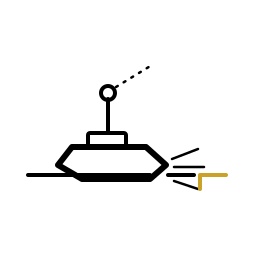
Orca CS-310 is the anchor of Canadian Shield's Water family: a ~100 kg-class autonomous underwater vehicle built around a buckling-governed pressure hull, a free-flooded moulded fairing and a 20 kg / 20 L wet payload bay at its center of buoyancy.
The design thesis is the family thesis: an all-plastic vehicle is cheap and quiet. No steel hull means no magnetic anomaly and only a weak sonar return — the manufacturing story and the low-signature story are the same story. Build for cost, and you build for stealth. Only the inner cylinder is a pressure vessel; everything the water touches first is moulded polymer on the fleet's own tooling.
Where the Goose is a round and the Grizzly is a mule, the Orca is a workboat: route survey, seabed awareness and coastal watchkeeping on long legs — and a carrier bus for the tools that do the close work, including its family-mate, the Jellyfish CS-320 creeper. A new payload cartridge is tooling, not redesign.
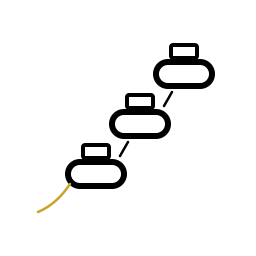
The Water family is deliberately small: Orca does the tens-of-kilometres transit on its screw; Jellyfish does the last, quietest kilometre on pulse and drift. Orca trades acoustic signature for range — a screw is audible, and we accept that for the survey role. That trade is stated, not hidden.
The inner Ø250 mm cylinder is the only dry space aboard — sized against external-pressure buckling, the failure mode that actually governs a plastic hull, not hoop stress.
Around it, the moulded nose, mid and tail fairings flood freely and feel no pressure differential at all — which is why they can be light, cheap and quietly shaped. Inside, the 2 kWh battery rides a lead-screw trim tray: pitch trim by moving mass, not by thrashing control surfaces. A pumped variable-ballast system worth ±3–5 kg handles the fresh-to-salt swing and fine depth-keeping, and at the 100 m design depth the wall works out to ~15 mm — set by buckling, not hoop stress.
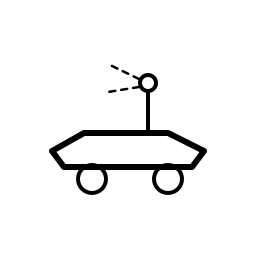
Propulsion is a shrouded, low-RPM, low-blade-loading screw behind cruciform stern planes — deliberate, unhurried thrust for long survey legs.
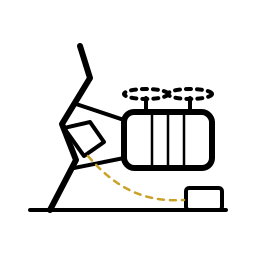
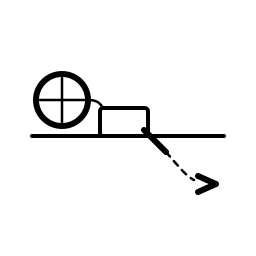
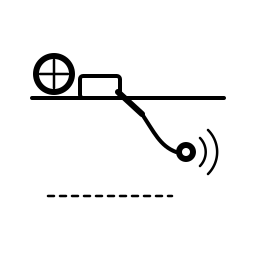
Guidance runs the family's three tiers, and none of them is a radio. Tier 1 is preset dead-reckoning for simple legs. Tier 2 — the workhorse — is fibre: a payout spool of guidance fibre with a human on the far end, unjammable because there is nothing in the water to jam. Tier 3 adds an inertial navigator with Doppler velocity log for precision work, and is export-gated accordingly. An acoustic modem exists as a sparse check-in link — never a control channel — and silent-running segments are part of the mission grammar, not an afterthought.
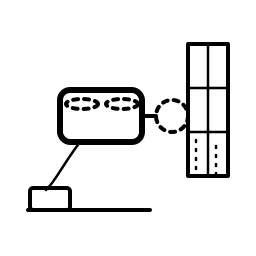
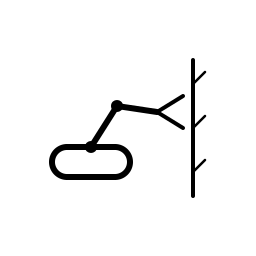
The flooded wet bay sits at the center of buoyancy and swallows one ~20 kg / ~20 L cartridge — sensor node, relay, sampler, inspection package, or a carried vehicle. Non-kinetic cartridges only. That rule is binding.
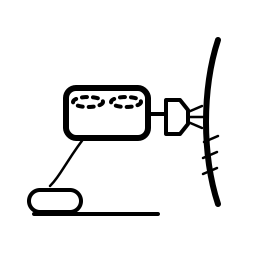
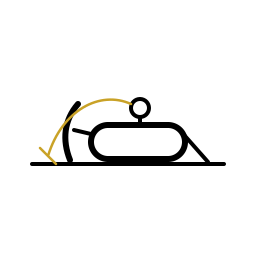
A define-once interface contract — mount rails, wet-mate connector, retention and release, buoyancy bookkeeping — means a new cartridge is tooling, not redesign. And when anything goes wrong, the one must-work device aboard is also the simplest: a cast-lead drop weight on a preloaded spring. On command, on timer lapse, or on power loss, the weight goes and the vehicle rises. A fault surfaces the Orca — it does not strand a battery on a lakebed.
The complete data card for the Orca — dimensions, performance, drive, guidance, payload, construction and compliance, grouped the way a fleet buyer compares them.
Endurance is stated at the cruise speeds shown — the cube-law trade between speed and range applies. No low-signature figure is claimed on this page; the screw is audible and that trade is accepted for the survey role. Close-in creep work belongs to Jellyfish CS-320, carried in this wet bay.
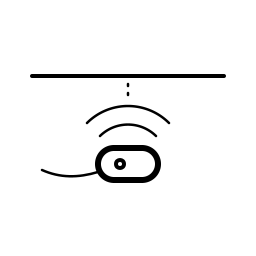
Every Canadian Shield platform is built no-radio, no-GPS — jam-proof because there is nothing to jam. In the water, that doctrine isn't even a choice: seawater conductivity kills RF outright, a few metres down.
The Orca is what happens when a fleet doctrine finds its most natural home. Fibre is the workhorse guidance tier — a physical thread with a human on the end, immune to jamming by construction. Bounded autonomy covers the long legs. There is no ballistic tier at sea, and no radio anywhere in the loop, because the ocean already made that decision for everyone. Adversary jammers spend power on a vehicle that was never listening.
And it is a carrier, not a munition. The wet bay takes sensor, relay, sampler and inspection cartridges — never a warhead, never a fuze, never an energetic material. That boundary is binding across the fleet, in every variant, for every customer.
A moulded polymer vehicle from the fleet's own die shop is inexpensive enough to buy in numbers — and non-magnetic, acoustically dull and sovereign-made by the same act. Salvo depth at sea is hulls in the water; the manufacturing floor is what puts them there.
A harbour-approach survey, walked end to end — illustrative of how the vehicle is used, not a mission record.
The ~100 kg-class hull is a two-person carry from truck bed or small boat — no crane, no davit; handling points are sized for a shore crew. The cartridge clicks into the wet bay on the define-once interface, ballast trim is set for local water — the fresh-to-salt swing absorbed by the pumped tank — and the mission plan and abort criteria load at the shore station, pre-dive.
On fibre for the close work and bounded autonomy for the transit, the Orca runs its survey lines at cruise — hours of seabed awareness on one charge, with silent-running segments where the mission calls for them. Route survey and watchkeeping are the anchor mission set; cartridge work — emplacing a sensor node, carrying a sampler, delivering a creeper to its start point — rides along on the same hull.
Nominal recovery is a planned rendezvous at the surface. Off-nominal recovery is the drop weight: command, timer lapse or power loss releases the lead and the vehicle rises — the abort is mechanical, spring-driven and dumb by intent. Either way the hull, the battery and the data come home; then recharge, re-cartridge, relaunch.
The Water family is deliberately small: Orca does the tens-of-kilometres transit on its screw; Jellyfish does the last, quietest kilometre on pulse and drift. Same no-radio doctrine — the sea enforces it — different jobs.
The survey-and-carrier mothership — one moulded hull that surveys, carries the tools and does the long transit.
Download PDF ↓The mothership-carried creeper — rides the Orca's wet bay as a cartridge, then does the last, quietest kilometre on pulse and drift.
Download PDF ↓If you plan harbour security, seabed awareness or sovereign underwater capability, the conversation starts with the hull that carries everything else.