THE LAST SHOT
BEFORE THE FENCE
Aimed, direct-fire, tethered — the net that stays connected to the gun that threw it.
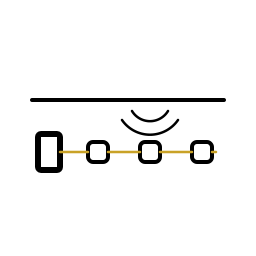
Perimeter · Gate · Checkpoint · Ship-Side · Static Post
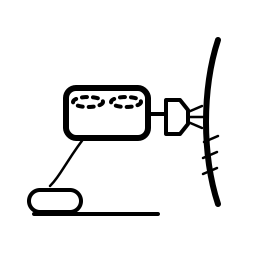
A direct-fire, hand- or mount-fired net launcher for the last-metres layer of counter-drone defence — the physical backstop for a threat that has closed inside the tube-launched Goose and Encapsulator envelope. The net stays tethered to the launcher: recover it, reset, fire again. Operator-aimed, operator-fired — non-explosive, every shot.
Aimed, direct-fire, tethered — the net that stays connected to the gun that threw it.
Perimeter · Gate · Checkpoint · Ship-Side · Static Post
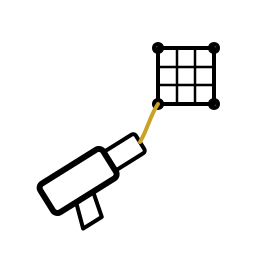
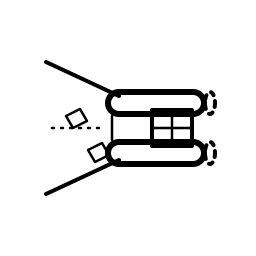
Matrix CS-112 is a direct-fire, tethered-net launcher for the last metres of counter-drone defence — the point where a threat has closed inside the reach of the tube-launched Goose CS-110 interceptor round and its capture sibling, Encapsulator CS-111. It is not a flying round. It is a compact, aimed gun a person carries or mounts, and it fires a net.
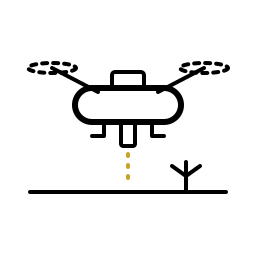
Every other tool in the Air family is a round that leaves the launcher and does not come back. Matrix is built the opposite way: the net stays tethered to the launch unit from the instant it leaves the muzzle. Fired at a target already inside the wire — hovering, slow, approaching, or already past the checkpoint — the net opens, fouls the target's propellers on contact, and the tether takes the load: a controlled lower to the ground instead of a free-fall crash, and a captured airframe instead of a debris field. The launcher, not a flying body, is where the engineering lives.
Matrix is a sibling in the family registry, not a nose variant riding the Goose round — it shares the family's doctrine (pneumatic/compressed-gas mechanism, no pyrotechnics, the GF-nylon structural boundary) but no Goose hardware. Its gas train sits orders of magnitude below the Goose ground launcher's energy, because its job is a few metres, not a few hundred.

Every round upstream in the family is spent on the shot. Matrix is spent on the mission. The tether means the net, the target and the launch point stay one system from trigger pull to recovery — so a static post can hold a threat down without ever losing sight of what it caught.
The mechanism is deliberately simple: a compressed-gas charge is the only stored energy in the entire system. An operator aims down an iron or reflex sight, cues the shot and pulls a purely mechanical trigger — no electrical firing chain, no arming sequence, nothing to spool up.
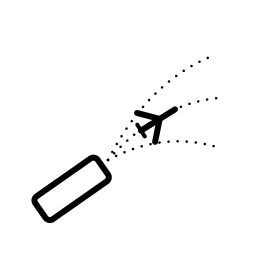
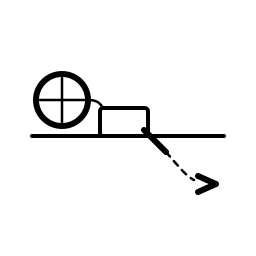
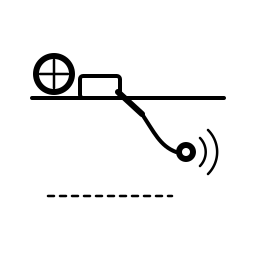
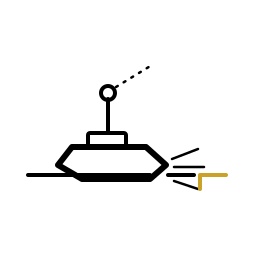
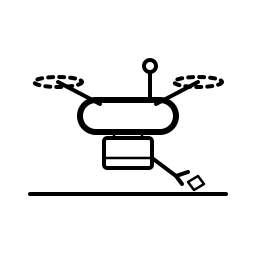
On release, the gas charge drives a net-round canister out of the launcher. Four corner masses carry the net open into a spreading lattice as it crosses the engagement window; on contact it fouls the target's propellers — a mechanical, not explosive, kill. The tether, paying out from a braked drum inside the launcher, then takes the load: friction arrests a fouled target as a firm pull rather than a snatch, so the target comes down under control instead of free-falling. The net, tether and canister remain connected to the launch point throughout — nothing is lost downrange, and the canister is built to be reset by the operator for the next shot.
There is no autonomy in the loop anywhere. Guidance sits at the doctrine's own floor: the fire-control computer is the operator, full stop — aim and fire are a person's job, on every shot, on this platform alone in the family.
The complete data card for the Matrix launcher — dimensions, launch performance, fire control, the net and tether, construction and compliance, grouped the way a fleet buyer compares them.
In-bore acceleration is stated as an average over the 0.30 m launch stroke. The engagement window is stated as a window, not a point range; the net’s deployed span is anchored to commercial net-launcher precedent, not a Canadian Shield measurement.
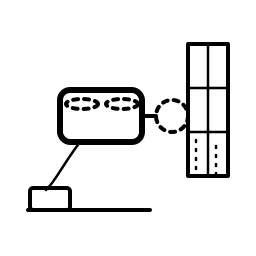
The Air family's interceptor stack is layered by design: Goose and Encapsulator reach out and engage at range, tube-launched and expended in salvo. Gyrfalcon adds powered reach for targets the unpowered round cannot catch. Matrix is the layer behind all of them — the tool for a target that is already close, already slow, already inside the wire, where a longer-reach round has no room left to work.
No radio, no GPS, no autonomous engagement — Matrix sits at the family's no-radio doctrine floor with nothing at all to jam, because there is nothing aboard to receive a signal in the first place. The fire-control computer is the operator: a human aims, a human decides, a human fires. That is not a limitation bolted on for policy reasons — it is the design point for a tool meant to be used at point-blank range around people and property. The manufacturing thesis carries through unchanged: a moulded GF-nylon launcher body, on dies cut in Canadian Shield's own shop, with rPET honestly confined to non-structural furniture.
Matrix stands beside Encapsulator as the family's capture tier — Encapsulator rides the Goose round and its launcher at range; Matrix is the close-in, hand-aimed answer with the net that never leaves the operator's control. Together they give the family the lowest-collateral option available: the target survives to be examined, not destroyed.
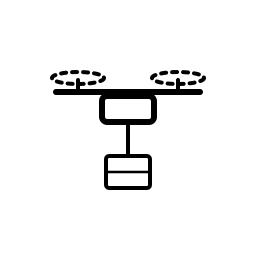
One post, walked end to end — illustrative of how the launcher is used, not a range record.
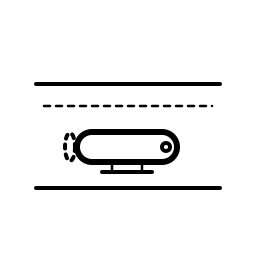
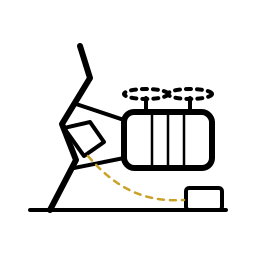
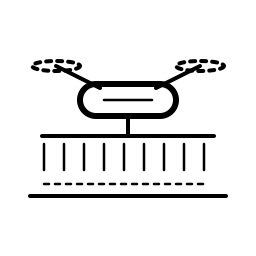
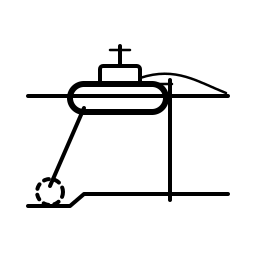
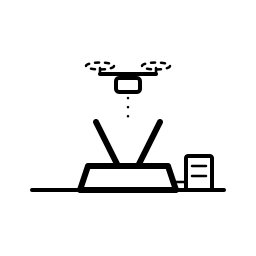
Matrix stands the post at a gate, checkpoint, ship-side rail or static perimeter point — carried on its shoulder kit or seated on a fixed-mount spigot. The operator checks the two-stage safety, confirms the canister is seated, and holds. No link check — there is no link to check.
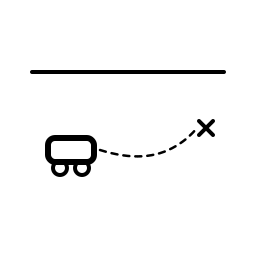
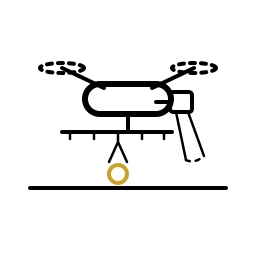
A target closes inside the engagement window — hovering, slow, or already past the outer layer. The operator aims down the sight, confirms the shot is theirs to take, and pulls the mechanical trigger. The net opens on its corner masses and fouls the target's propellers on contact.
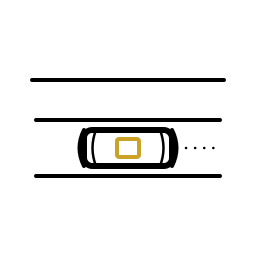
The braked tether takes the load and lowers the fouled target under control rather than letting it fall. The target is retrieved at the tether's end, still connected to the launch point throughout. The canister is inspected and the launcher reset for the next post — a launcher, not a round that is spent and gone.
Matrix is the capture tier's close-in tool. Two siblings engage at range on the tube-launched Goose line; one carries the powered-flight scope the capture tier gives up. Same no-radio thesis, different jobs.
Kinetic slug nose, fully unpowered — the round built to be bought in numbers.
Download PDF ↓The same round envelope and the same tube, with a capture nose for a controlled take-down.
Download PDF ↓A hand-launched tethered net for the final few metres — the capture tier's close-in tool.
Download PDF ↓The family's premium interceptor — carries the tail motor and bow-thruster scope that Goose gives up to stay cheap.
Download PDF ↓If you buy, build, integrate or regulate counter-UAS capability for Canada or its allies, the Matrix close-in layer is on the table.