Litter Collector · CS-630 · Industrial Series — Movers Block

PICK IT UP.
LEAVE EVERYTHING ELSE.

An uncrewed multirotor built to find litter, take only litter, and prove it did.

Search · Gate · Approach · Grasp · Verify · Stow

0
Energetic materials anywhere on the platform
1
Verified grasp per item — confirmed before anything counts
4
Movers on the CS-6xx block, one shared safety chain
6
Beats in the collection loop, every time
What It Is

A Mass Carrier That Happens
To Fly Over a Park.


The Litter Collector is an uncrewed multirotor that runs a closed autonomous loop over municipal streets, parks and public spaces: identify litter, approach it, attempt collection, verify the item is actually in the hopper, and repeat until the hopper is full — then return to a Self-Charging Dock to discharge, recharge, take updated tasking and depart again.

It sits in the CS-6xx Movers block alongside the Cargo Mover, Personnel Mover and Heavy-Lift Logger — grouped there because, like them, it flies and functions as a mass carrier, moving material into the hopper the way its siblings move freight or people. It shares the Industrial line's civil doctrine in full: radio and GNSS permitted, sovereign Canadian manufacturing behind it, a work machine bought to do a job, not a weapon.

What sets it apart on this line is the problem it accepts. A sprayer or seeder works against a bounded target class over a consistent background. Litter has no finite class: arbitrary shape, color, material and state of decay, scattered through cluttered urban scenes that are also full of things that must never be touched — a bench, a sign, a memorial, someone's dropped property, a resting animal. A miss costs nothing; a wrong take costs the public's trust. So the design leans conservative everywhere it can: a default-decline gate, a verified grasp before any item counts as collected, and a machine built to fail toward inaction.

The Discipline
Every other Industrial platform sorts a bounded class. This one refuses everything it isn't sure of.

The engineering honesty runs both directions: the perception and grasp problem here is harder than its Industrial-line siblings, and the design does not pretend otherwise. The end-effector stays an open trade rather than a rushed pick, and the gate is built to say no by default — because on a public street, refusing to act is always the safe failure.

  • CS-6xx Movers block — grouped with Cargo Mover, Personnel Mover and Heavy-Lift Logger.
  • Default-decline gate — fails toward inaction on any ambiguity.
  • Radio & GNSS permitted — the civil Industrial line's surface exception.

01 How It Works · Collection Loop

SEARCH, GATE, GRASP, VERIFY — IN THAT ORDER


A mast-mounted EO-plus-depth sensor scans the beat as the aircraft holds a low-altitude search pattern. Detections split into two streams before anything else happens: litter candidates, and the do-not-take set — benches, signage, personal property, memorials, anything animal or in motion. Only a candidate that clears the gate gets an approach.
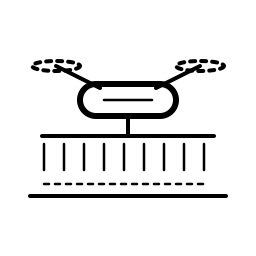
The end-effector then makes the pickup attempt. Which mechanism does that job is a live trade rather than a settled part: a vacuum head, a compliant gripper, a spike, and a sweep-and-scoop are the candidates on the table today, each suited to a different litter class, and no winner has been declared. Whichever one flies, the same rule governs it — a mass-delta or throat sensor confirms the item actually left the ground and entered the hopper before the machine logs a success, because an effector can report a clean grasp while holding nothing at all.

A refused or failed attempt is logged, not forced. The machine does not escalate grip force chasing a catch, and any motion or animal-class detection aborts the approach outright. The governing figure of merit is not speed — it is the gate's discipline: refusing correctly, every time, on a scene that is never the same scene twice.

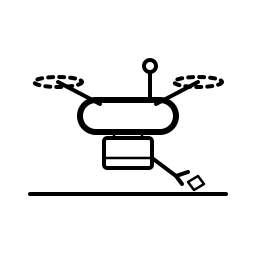
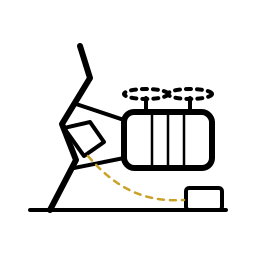
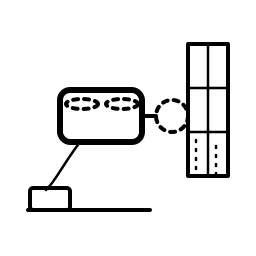
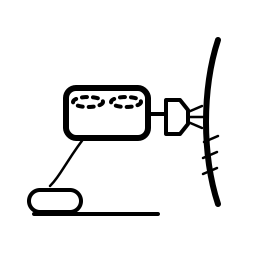
COLLECTION LOOP COLLECTION LOOP — SECTION OVER THE BEAT AIRFRAME — MULTIROTOR MAST — EO + DEPTH HOPPER — SINGLE STREAM FILL LEVEL — SENSED BENCH — SCENE DO-NOT-TAKE — REFUSED LITTER — GATE CLEAR END-EFFECTOR — OPEN TRADE VACUUM / GRIPPER / SPIKE / SWEEP VERIFY — MASS-DELTA OR THROAT SENSOR PUBLIC BEAT — STREET, PATHWAY OR PARK STRIP; PEOPLE, PROPERTY AND ANIMALS SHARE THE SCENE DOCK — CS-700 CS-630 · collection loop — search · gate · approach · grasp · verify · stow
1 · SearchThe mast scans the beat with EO plus depth.
2 · GateCandidates are checked against the do-not-take set.
3 · ApproachA cleared item gets a descent and a standoff.
4 · GraspThe end-effector makes one attempt — no forced retries.
5 · VerifyA mass-delta or throat sensor confirms the item is in.
6 · StowLogged, hopper updated, the beat continues.
Full Specification Sheet

The Numbers We Have.
The Ones We Don't, Named.


Figures below are drawn from the Litter Collector engineering drawing package (CSH-DWG-LITTER-001). This platform's package is unusually candid that most performance figures are not yet modelled — values shown as open trades are study points, not commitments, and are stated that way on purpose.

Litter Collector CS-630 · Municipal Waste-Retrieval Platform Industrial Family · Movers Block

01Dimensions & Mass

Configuration
Multirotor carrier
Rotor count & diameter
Under trade study — park noise vs. motor-out margin over people

02Performance

Role
Municipal waste retrieval — streetside litter & park scatter
Mission loop
Identify · approach · verify · stow · discharge · depart
Collection rate, hopper capacity, endurance
Not published as fixed figures — see Governing Variables below

03Perception & Guidance

Perception
EO + depth sensing on a mast/gimbal, on-board detection & gate compute — privacy-preferred on-board-only processing
Flight control & nav
Dual flight controllers, independent IMU, cross-checked; 3× GNSS receivers, 2-of-3 vote
Control & comms
Dual radio C2 — permitted on this civil Industrial line

04Payload & Effect

Do-not-take gate
Default-decline — refuses on ambiguity; any motion or animal-class detection aborts the approach
End-effector
Open trade — candidates: vacuum head, compliant gripper, spike, sweep-and-scoop
Grasp verification
Mass-delta or throat sensor confirms the item is in the hopper — a reported grasp is not a verified one
Hopper
Single-stream, bottom discharge door; capacity, fill sensing and wet-waste liner under study
Cargo only
Waste carrier only — no warhead, fuzing, energetic or terminal-effect content, ever

05Materials & Construction

Structure
Consistent with the fleet materials canon — moulded structure, non-structural articles in recycled PET
Dock interface
Precision-capture + discharge alignment to the Self-Charging Dock (CS-700)

06Signature & Power

Power
Dual independent battery packs and buses — either pack alone sized to land the aircraft
Safety chain
Whole-airframe ballistic parachute + SIG AT polyfoam encapsulation, standard fit; deployment envelope tuned for low-altitude, occupied-space work
Mission tasking
Beat coverage & hot-spot tasking refresh at the dock — changes ratified by a person before the next sortie

07Compliance

Patent status
Patent pending
Civil line
A work machine on the surface civil line — radio and GNSS are permitted here and used openly
Munitions classification
Waste carrier only — no warhead, no fuze, no energetic material, in any variant, ever
Collection Rate — The Governing Rule
We do not publish a headline figure because none of them is fixed yet.

Items-per-hour, hopper capacity and endurance are governed by variables the test program exists to close, and a number stated without them attached would be a guess dressed as a spec. What we will state is the shape of the answer: the bounded-target-class decision — which litter classes the product actually takes first — is the viability hinge everything else is measured against.

  • Litter density on the beat — site & season
  • Grasp attempts per item — litter class is unbounded
  • Effector energy per attempt — mechanism-dependent
  • Hopper capacity & wet-waste behavior
  • Dock turnaround & discharge time
  • Bounded target-class decision — the product scope call
In the Doctrine

The Machine That Would
Rather Miss Than Take.


Canadian Shield's thesis is that manufacturing is the decisive capability, and that a civil work fleet should share tooling, avionics doctrine and safety chain with the defence fleet rather than reinvent them per product. The Litter Collector carries that thesis into the hardest civil-line case: public space, with people, animals and property sharing the scene.

The overlap is physical, not rhetorical. Its dual-battery power architecture, dual flight controllers, 2-of-3 GNSS vote and dual radio links are fleet property, inherited whole from the same doctrine that governs the Cargo Mover and Personnel Mover beside it in the CS-6xx Movers block. Its whole-airframe parachute and SIG AT polyfoam are standard fit, the same safety chain the rest of the estate carries — engineered here for a low-altitude, occupied-space profile rather than the open ground its siblings usually work.

And up here, the estate's radio boundary runs the civil way. The no-radio rule governs the defence, underground and tethered platforms without exception — but the Industrial line is the surface civil exception where radio and GNSS are permitted, and the Litter Collector uses both openly: conventional radio for command and telemetry, GNSS for beat navigation and for the tasking record that keeps a person in the loop on every change. A city park is not a jammed battlefield, and we do not build for it like one.

Family Context
One block, four movers. One safety chain across all of them.

The CS-6xx Movers block carries the Cargo Mover (CS-600) and Personnel Mover (CS-610) freight and crew, the Heavy-Lift Logger (CS-620) beyond the freight ladder's ceiling, and the Litter Collector working the smallest, most public payload of the four — a single item at a time, verified before it counts. Every one of them turns around at the same Self-Charging Dock (CS-700) doctrine.

On the Beat

Tasking In.
Verified Record Out.


A Litter Collector shift is a loop, not a flight: a municipal tasking beat compiles at the dock, the machine works it item by item, and what comes home is a verified log — not a guess at how tidy the park looks. Here is the shift, end to end.

01 · Arrive

The Beat Compiles at the Dock

The machine departs the Self-Charging Dock already carrying its beat: the streets, pathways or park strips the municipal operator tasked at the last turnaround, with the do-not-take set — known fixtures, sensitive sites — flagged before the first metre of search. A person ratifies any change before the machine departs.

02 · Work

Search, Gate, Grasp, Verify, Repeat

The machine works the beat low and slow, cycling the six-beat loop on every candidate: search, gate, approach, grasp, verify, stow. Anything ambiguous, anything in the do-not-take set, or anything that moves gets a refusal, not a forced attempt — and the refusal is logged as carefully as a collection.
03 · Recover

Discharge, Recharge, Update, Depart

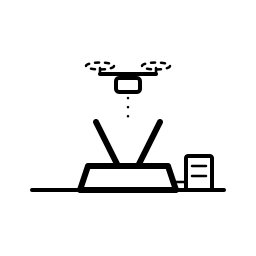
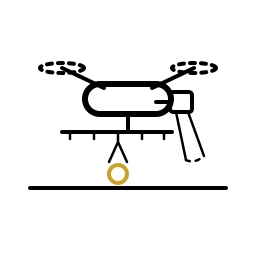
On hopper limit or beat end, the machine returns to the Self-Charging Dock, discharges through the hopper's bottom door, recharges, and picks up refreshed tasking — hot spots the municipal operator flags, beats reordered by need — before departing again. Nothing is collected without a verified record attached to it.

Scenario illustrates the design intent of the operating loop. Grasp success across real litter classes, hopper capacity and duty-cycle are exactly what the bench and field test program exists to measure — and the bounded-target-class decision, not the machine shop, sets where that program starts.

The CS-6xx Movers Block · At a Glance

One Block, Four Movers.
One Safety Chain.


The Litter Collector shares its dual-everything safety chain and its dock standard with three siblings on the Movers block — freight, crew and now the smallest, most public payload of the four.

This platform CS-630 · Movers Block

Litter Collector

Municipal waste retrieval — a verified, item-by-item collection loop over public space.

Download PDF
CS-600 · Movers Block

Cargo Mover

Freight, moved — the block's baseline mass carrier.

Download PDF
CS-610 · Movers Block

Personnel Mover

Crew, moved — the same safety chain, rated for people aboard.

Download PDF
CS-620 · Movers Block

Heavy-Lift Logger

Beyond the freight ladder's ceiling — the block's heaviest lift.

Download PDF
The Movers Block

The Street Doesn't Notice What's Missing.
The Log Proves What Was Taken.

If you manage streets, parks or public grounds with a litter obligation and an audit attached, the conversation starts with the beat you need covered — and with the gate built to refuse everything that isn't litter.

Full Marketing Package

The Rest of the Fleet.


Every Canadian Shield platform has a brochure like this one — same depth, same status discipline, same refusal to publish a number we cannot source. Organized by family below.

Air · 8
CS-110 · Air

Goose

No battery. No motor. No receiver. A kinetic carrier launched at ~189 m/s on shop air.

Read the brochure Download PDF
CS-111 · Air

Encapsulator

A capture-head variant on the Goose CS-110 launch line — fouls rotors and entangles the airframe instead of striking it down.

Read the brochure Download PDF
CS-112 · Air

Matrix

Aimed, direct-fire, tethered — the net that stays connected to the gun that threw it.

Read the brochure Download PDF
CS-120 · Air

Gyrfalcon

Goose's launch chain, plus the power Goose leaves out — a tail motor and bow-thruster ring for mid-flight correction.
Read the brochure Download PDF
CS-130 · Air

Raven

A moulded electric aircraft that carries the network — decoy, relay, electronic support. Non-kinetic. Recoverable.

Read the brochure Download PDF
CS-140 · Air

Owl

A big, slow propeller and an IR-biased eye — orbiting instead of hovering, unheard, unseen, unjammed.

Read the brochure Download PDF
CS-150 · Air

Loon

The bird that flies its whole leg without asking a satellite for a name.

Read the brochure Download PDF
CS-160 · Air

Kestrel

The Air family's smallest body — a tube-launched, motor-cruising scout priced to lose, not to last.

Read the brochure Download PDF
Ground · 6
CS-210 · Ground

Grizzly

Tracked. Battery-electric. 150 kg over muskeg — with nothing to jam.

Read the brochure Download PDF
CS-220 · Ground

Moose

600 kg of freight over bad ground. Payload is the product — mobility is the constraint it is bought within.
Read the brochure Download PDF
CS-230 · Ground

Wolf

Eight coordinated carriers. One fibre trunk. One operator. Nothing to jam.
Read the brochure Download PDF
CS-240 · Ground

Lynx

A wheeled route-picker with thermal eyes — and a watch mode measured in days.

Read the brochure Download PDF
CS-250 · Ground

Beaver

Tracked. Battery-electric. An anchored winch pulls roughly seven times what the tracks alone can.

Read the brochure Download PDF
CS-260 · Ground

Wolverine

A compact tracked carrier that places self-reacting tools at the work face — the force closes on the structure, not the machine.

Read the brochure Download PDF
Water · 2
CS-310 · Water

Orca

Persistent survey & carrier AUV — one moulded hull that surveys, carries and watches.

Read the brochure Download PDF
CS-320 · Water

Jellyfish

A soft pulsed-jet payload carrier — slower than the current on purpose.

Read the brochure Download PDF
Underground · 8
CS-410 · Underground

Badger

A surface plant that pushes a steerable head into ground with no line, no map, no signal.

Read the brochure Download PDF
CS-411 · Underground

Aquifer

Coiled-tubing bore, fibre-guided — conduit installed, water table mapped, nothing to jam.

Read the brochure Download PDF
CS-420 · Underground

Ferret

Recon, mapping and locating in existing tunnels and culverts — with a block-only interpose capability, always human-confirmed.

Read the brochure Download PDF
CS-430 · Underground

Mole

A passive seismic and acoustic node on long-life battery — reporting only over a buried fibre link.

Read the brochure Download PDF
CS-435 · Underground

Trembler Line

A chain of buried Mole nodes on a fibre trunk — detect, localize, cue. Nothing radiated, nothing to jam.

Read the brochure Download PDF
CS-440 · Underground

Muskrat

Hybrid swim/crawl. Zero visibility. No diver, no radio, no GPS.

Read the brochure Download PDF
CS-450 · Underground

Gopher

It maps, it marks, it parks. Cheap enough to send in numbers.

Read the brochure Download PDF
CS-460 · Underground

Farell Pig

Flow-driven, self-propelled or tethered — it rides the line, it doesn't bore one.

Read the brochure Download PDF
Industrial · 17
CS-510 · Industrial

Seeder

A pneumatic seed-pod launcher, retuned to gentleness. Pods down, evidence back.

Read the brochure Download PDF
CS-520 · Industrial

Skimmer

A small moulded surface craft — the information and marking layer of a spill response.

Read the brochure Download PDF
CS-530 · Industrial

Rock Scaler

A contact-tolerant aerial platform sets the hook. A ground-anchored winch does the pulling.

Read the brochure Download PDF
CS-540 · Industrial

Washer

A caged, umbilical-fed washing platform. Water up the line, evidence back down.

Read the brochure Download PDF
CS-550 · Industrial

Coater

An umbilical-fed applicator platform. The pressure stays on the ground; the machine flies the last few hundred millimetres.

Read the brochure Download PDF
CS-560 · Industrial

Sprayer

Full-width boom, drift-reduction nozzles, a metered rate held across the pass. The broadcast tool for the uniform job.

Read the brochure Download PDF
CS-561 · Industrial

Spot Sprayer

Machine vision finds the target; only that nozzle opens. Built to cut total product volume per acre.

Read the brochure Download PDF
CS-570 · Industrial

Dredger

A trailerable uncrewed dredger for ponds, marinas, lagoons and channels.

Read the brochure Download PDF
CS-580 · Industrial

Recovery

An uncrewed collection craft for the debris and spill material that floats.

Read the brochure Download PDF
CS-590 · Industrial

Enviro

A tracked, teleoperated manipulator platform for shoreline and land cleanup — reach, load and slope, enforced as one envelope.

Read the brochure Download PDF
This brochure CS-630 · Industrial

Litter Collector

An uncrewed multirotor built to find litter, take only litter, and prove it did.

Read the brochure Download PDF
CS-600 · Industrial

Cargo Mover

An uncrewed VTOL cargo family — four sizes of the same machine, from toolbox to bulk lift.

Read the brochure Download PDF
CS-610 · Industrial

Personnel Mover

A crew-carrying VTOL work machine. Two tiers — PM-8 single-seat, PM-12 two-seat.

Read the brochure Download PDF
CS-620 · Industrial

Heavy-Lift Logger

An uncrewed coaxial hybrid rotorcraft for long-line log extraction — turn after turn, hour after hour.

Read the brochure Download PDF
CS-700 · Industrial

Self-Charging Dock

A docking and replenishment station that lets a working fleet return, recharge and redeploy without a hand touching it.

Read the brochure Download PDF
CS-710 · Industrial

Relay Chain

A deployable chain of relay nodes — command, telemetry and position augmentation for civil fleets working past the edge of the network.

Read the brochure Download PDF
CS-C001 · Industrial

Fibre Spool Line

Guidance-fibre consumable cassettes — a physical tether option, alongside or instead of radio.

Read the brochure Download PDF
Defence · 1
CS-901 · Defence

Shield Pod

A canopy-retarded delivery pod: land on a crumple zone, right itself, open, release the carrier system.

Read the brochure Download PDF