THE LAST KILOMETRE
BELONGS TO THE QUIET
A soft pulsed-jet payload carrier — slower than the current on purpose.
Pulse · Drift · Emplace · Listen — no radio, no GPS, by physics
A small, soft, all-plastic underwater payload carrier that wins by arriving unnoticed: no screw, no cavitation, almost no metal. Orca does the tens-of-kilometres transit; Jellyfish does the last, quietest kilometre on pulse and drift.
A soft pulsed-jet payload carrier — slower than the current on purpose.
Pulse · Drift · Emplace · Listen — no radio, no GPS, by physics
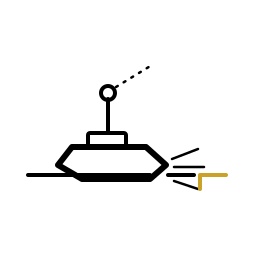
Jellyfish CS-320 is a ~12 kg / ~12 L soft-bodied underwater carrier built around one idea: below a certain speed, the quietest machine in the water is the one that barely moves. It creeps at 0.25 m/s on a pulsed elastomeric jet bell — no propeller, no cavitation, no blade-rate line, no wake.
It is the most-plastic platform in the fleet: a cast elastomer bell that is propulsor, fairing and compliance in a single moulded part, free-flooded polymer everywhere else, and minimal metal by design. Designed for low signature — and stated honestly: that is a design goal, not a measured property. Nothing on this page will ever be called undetectable.
In the family, it is the Orca's tool for the close work. The mothership does the tens-of-kilometres transit and releases the creeper at a surveyed start point; Jellyfish does the last, quietest kilometre and places a ~2 kg / 2 L non-kinetic cartridge exactly where it is needed.
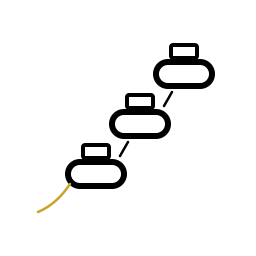
At 0.25 m/s the Jellyfish cannot fight a tide, and it doesn't try. It times its transit to the water, drifts the corridor, and pulses only for cross-set and final positioning. The current is treated as transit energy, not as a disturbance to overcome.
The bell is the machine: a cast elastomeric dome that contracts on a slow stroke, expels a ring of water, and refills on the recovery — 0.5 to 2 Hz, over and over, for days.
There is no shaft to seal, no gearbox to whine, no blade tip to cavitate. Propulsor, outer fairing and structural compliance are one moulded part, which is the manufacturing thesis speaking again: the cheapest way to build this vehicle is also the quietest shape it could take. Depth is held by a small pumped ballast tank and moving-mass trim; the abort is a spring-released drop weight with no electronics in the release path — the one subsystem that must work when nothing else does.
The mission grammar is autonomous from release to recovery: human authority lives in the mission plan and the abort criteria, not in a live link.
Navigation runs the family tiers scaled to a 12 kg hull. Tier 1 is preset dead-reckoning — compass, depth, time and the tide table, with the current term doing most of the work. Tier 2 is fibre-guided teleop where the mission affords the spool volume. Tier 3 is delivered precision: the Orca mothership carries the expensive navigation and releases the creeper at a surveyed point. A micro acoustic modem is an option, never a baseline — every transmission spends the signature budget the whole platform exists to conserve.
At ~12 kg / ~12 L, the Jellyfish fits the Orca CS-310's 20 kg / 20 L wet-bay envelope with margin — the creeper rides the mothership as one more cartridge on the define-once interface.
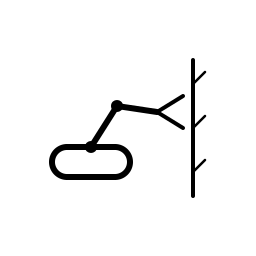
Its own payload cradle takes one ~2 kg / 2 L module from a six-cartridge, non-kinetic catalogue: passive sensor node, seabed tag or beacon, micro acoustic relay, covert emplace-and-retrieve of a small inert package, environmental sampler, or an inspection package for hulls, piers, intakes and outfalls — the nearest-term civil fit. One cradle, one connector, one release: a new payload is tooling, not redesign. It also launches by hand from a small boat or the shore, and a slow soft body is easy to net on recovery.
The complete data card for the Jellyfish creeper — dimensions, performance, propulsion and navigation, payload, construction, signature and compliance, grouped the way a fleet buyer compares them.
Endurance and best-range figures follow from still-water screening calculations, not trial results — a range figure without its current assumption is not one of ours.
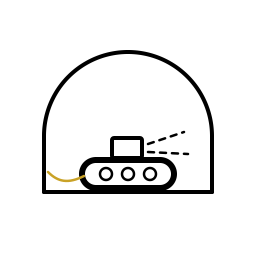
Seawater conductivity kills RF outright — the same way rock kills it underground. The fleet's no-radio, no-GPS doctrine costs nothing here, because the ocean enforces it for every side equally. Nothing to jam. Nothing to spoof.
The Jellyfish takes that free advantage and compounds it: where the doctrine removes the radio, the design removes the screw, the wake and most of the metal. What remains is a machine whose whole survivability case is that there is very little of it to find — and whose honesty case is that we will not claim even that until it is measured.
And the boundary is stated with unusual force: this is a carrier, not a munition. The limpet-mine framing is rejected outright — no warhead, no fuze, no energetic material, no attachment to a vessel, no mechanism whose purpose is harm. The creeper emplaces sensors, samplers, relays and inspection tools. That is the whole list.
A cast bell and a moulded chassis from the fleet's own tooling make the Jellyfish cheap enough to field in numbers — and the same mouldings are what leave so little signature to read. Sovereign manufacturing and quiet arrival are one engineering decision, made once.
A representative mission profile — a harbour-infrastructure inspection run, the nearest-term commercial fit. A design walkthrough of the intended use, illustrative of how the Jellyfish is deployed, not a mission record.
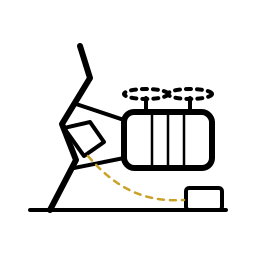
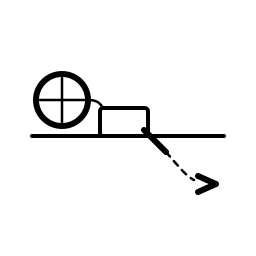
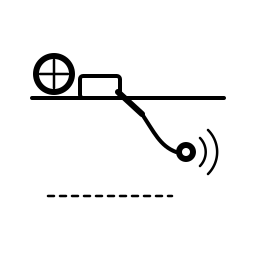
Charged and mission-loaded shoreside, pre-dive. Then one of two doors into the water: the Orca's wet bay for a delivered start at a surveyed point, or a one-person hand launch from small boat or shore. The transit window is chosen from the tide table, not fought.
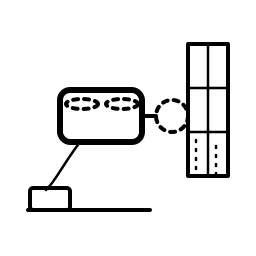
The creeper drifts the corridor, pulsing only to hold the line, and settles into the work band — hull plates, pier piles, intake screens, outfall crowns — with days of hotel-limited loiter to do it slowly and well. Silent by default: no link, no telemetry, human authority in the plan.
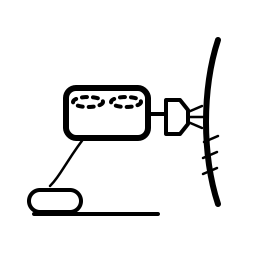
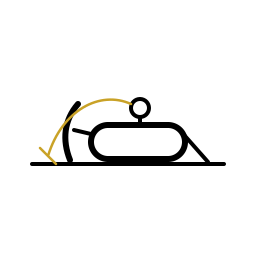
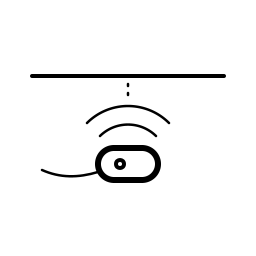
Nominal end is a slow rise at the recovery point — a soft body at creep speed is easy to net from a small boat. Off-nominal, the spring drops the lead and the vehicle surfaces itself. Data offloads shoreside; the cradle re-cartridges and turns around in minutes.
The water family is two platforms working one relationship: the Orca carries the range and the payload capacity; the Jellyfish carries the last, quietest kilometre inside it.
The last kilometre — a soft pulsed-jet carrier with no screw and almost no metal.
Download PDF ↓The long transit and the wet-bay carrier that gets the Jellyfish to its start point.
Download PDF ↓If you plan harbour security, underwater inspection or covert sensing, the last kilometre is the one that matters — and it belongs to the platform built to creep it.