THE STOOP.
POWERED TO CLOSE THE TURN.
Goose's launch chain, plus the power Goose leaves out — a tail motor and bow-thruster ring for mid-flight correction.
Cued Intercept · Course Correction · Premium Tier
Same pneumatic launch chain and airframe lineage as Goose — plus the tail sustain motor and bow-thruster ring Goose deliberately leaves out. Where Goose throws a ballistic salvo, Gyrfalcon throws a shot that corrects in flight and closes on a target that has already turned.
Goose's launch chain, plus the power Goose leaves out — a tail motor and bow-thruster ring for mid-flight correction.
Cued Intercept · Course Correction · Premium Tier
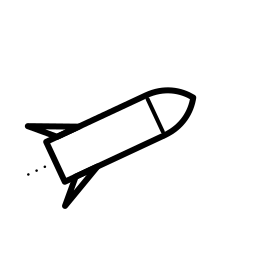
Gyrfalcon CS-120 is the Air family's premium interceptor — Tier 2, the stoop. It rides the same class of pneumatic launch chain as Goose, but it does not stay ballistic after the muzzle: a tail sustain motor holds it at cruise speed and a 4-axis bow-thruster ring bends its path toward a target that has already moved. Goose throws a salvo. Gyrfalcon throws a shot that chases.
The two rounds share a lineage on purpose. Both launch on the same class of shop-air chain, and both are kinetic carriers with nothing that detonates, deflagrates or fragments. What separates them is a single configuration ruling: Goose is fully unpowered by design — no battery, no motor, no bow-thruster ring, nothing aboard to jam. Every ounce of that powered-flight hardware was moved to Gyrfalcon instead of being banned from the family, and this round is where it is drawn as real hardware rather than a ghosted line item on someone else's sheet.
That makes Gyrfalcon the family's first round with a genuine electrical and mechanical interior — a flight computer, a shock-potted battery, four ring-mounted motor/fan units, an optical-fibre spool. All of it exists to answer one question a purely ballistic round cannot: what happens when the target turns after the shot is already away. The answer is premium-tier correction, reserved for cued intercepts worth the extra hardware — never a replacement for Goose's depth, only its complement.
Depth and precision are different jobs, and the family builds a different round for each rather than compromising one round to do both. Gyrfalcon spends mass and electronics so the round itself can correct — the premium a buyer pays only when a ballistic shot will not converge.
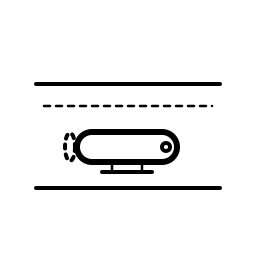
Four phases, and only the first is shared with Goose. Shop air fires the round from rest to an exit speed of ~74 m/s (~268 km/h) — slower than Goose's ~189 m/s, because a heavier round drawing on the same delivered energy leaves the tube at lower velocity. That trade is the whole design: everything downstream of the muzzle depends on it.
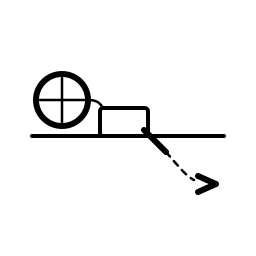
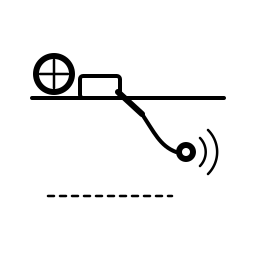
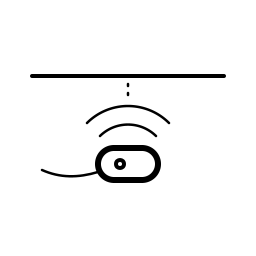
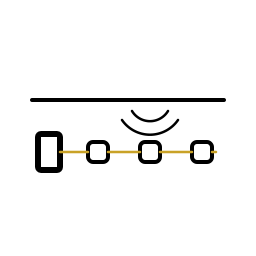
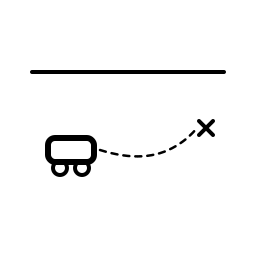
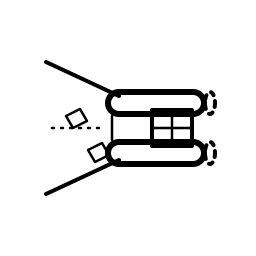
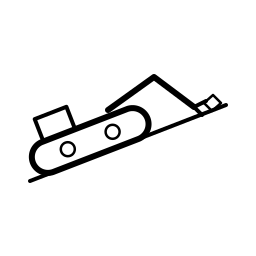
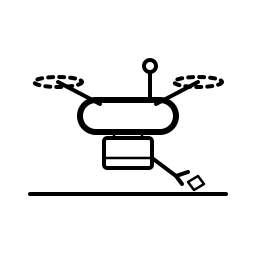
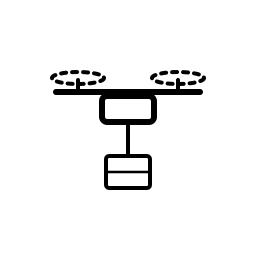
Clear of the tube, a folded propeller deploys from the tail and the sustain motor spins up — a ~1 kW-class electric drive holding the round at cruise for the length of the engagement, so drag is paid by the motor instead of bleeding off as ballistic decay. Four adjustable trim fins provide baseline steering, but at this speed they carry a fraction of the authority they would on a faster round. The 4-axis bow-thruster ring is what actually chases the turn: four motor/fan units at the nose apply pitch, yaw, roll and trim thrust independent of airspeed, cued down the trailing optical fibre by an operator in the loop. Where the target was is not where the round is aimed; where the target is now, is.
The arithmetic is why the family splits into two rounds. On a shared-energy launcher, exit velocity falls with the square root of mass, and sustain power falls roughly with the cube of velocity — powering Goose's 1.6 kg, ~189 m/s round would demand ~12.5 kW and a battery heavier than the round itself, while Gyrfalcon's 13 kg, ~74 m/s round needs ~0.97 kW and a ~0.6 kg pack, under five percent of the round. The same trade buys the family's gentlest launch — ~94 g average over the stroke, against the ~600 g Goose is built to survive — so the electronics-rich round gets the softest ride, on purpose. The margin left in the mission energy budget also carries a sized dash option: roughly +20 m/s above cruise for ~37 kJ of electrical energy, about double the instantaneous draw — a design option, not the baseline flight profile.

The complete data card for the Gyrfalcon round — dimensions, launch performance, sustain and correction, payload, construction, power and compliance, grouped the way a fleet buyer compares them.
Launch acceleration is stated as an average over the launch-tube stroke. Bore note: Gyrfalcon’s drawing package specifies a Ø101 mm bore — wider than the Ø90 mm tube Goose fires from. The two rounds share launch-chain physics and doctrine, not a barrel; whether a common bore ever closes that gap is an open design item, and this page does not claim one.
The family runs two tiers on purpose, not by accident. Goose is Tier 1 — a ballistic swarm bought deep because it is cheap, unpowered, and has nothing aboard for a jammer to find. Gyrfalcon is Tier 2 — the premium round for the cued intercept a purely ballistic shot will not converge on: a target that manoeuvres between the decision to fire and the moment of impact.
The link stays doctrine-consistent even with power added. Tier 2 fibre is Gyrfalcon's primary guidance, not a fallback — command steering over trailing glass, unjammable by construction, with a human in the loop for every correction. Tier 1 preset remains the degraded, safe-fail mode if the fibre is lost. Tier 3 — an EO/IR seeker for fully autonomous correction — stays partner-dependent and counsel-first on every platform in the family, Gyrfalcon included; it is never offered ahead of that gate.
Manufacturing follows the same sovereign path as the rest of the fleet: GF-nylon sectioned mouldings on Canadian Shield's own 5-axis dies, the same tooling that lets the Forward Manufacturing Cell put a magazine on an allied nation's own soil. A premium round still moulds cheaper than it flies, and the die shop that cuts Goose's tooling cuts Gyrfalcon's too.
Goose buys the volume that makes a swarm affordable to defeat in numbers; Gyrfalcon buys the correction that closes the gap a ballistic round leaves open. Encapsulator and Matrix supply the capture tier on the same doctrine; Raven, Owl, Loon and Kestrel round out the family as electric aircraft. One no-radio thesis, seven jobs.
One engagement, walked end to end — illustrative of how the round is used, not a mission record.
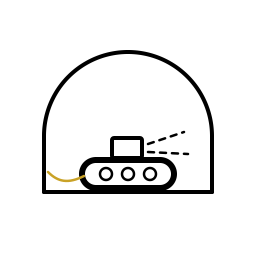
The round arrives sealed and inert, is chambered, and the fibre spool is seated — no arming step exists to skip, because none exists at all. Fire control — owned capability, built in-house — hands over a track that is manoeuvring, or expected to by the time a ballistic shot arrives. That judgment is what selects Gyrfalcon over Goose.
The accumulator fires and the round exits at ~74 m/s, the folded propeller deploying clear of the muzzle as the tail motor spins up to cruise. An operator on the fibre calls corrections; the 4-axis bow-thruster ring answers with pitch, yaw, roll and trim thrust independent of airspeed — authority the fins alone cannot supply at this speed.
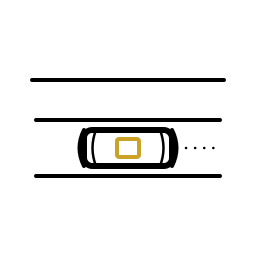
Convergence ends the engagement by collision alone in the baseline configuration, or by a capture nose shared with Encapsulator hardware where an intact recovery is worth the closing-speed risk. Either way, nothing detonates. A spent round is logged as a premium shot against a track that earned it — the magazine's depth still lives in Goose.
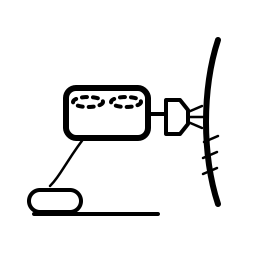
Gyrfalcon is the powered premium tier of the Air family's interceptor line. Three siblings hold the capture tier on the same no-radio doctrine; Gyrfalcon carries everything they deliberately give up. Same thesis, different jobs.
The family's premium interceptor — the tail motor, bow-thruster ring and fibre the capture tier leaves out.
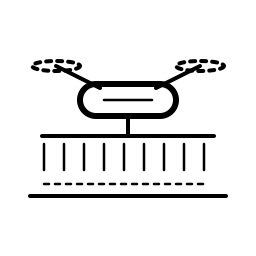
Download PDF ↓Kinetic slug nose, fully unpowered — the round built to be bought in numbers.
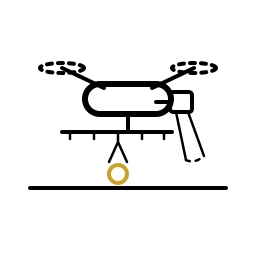
Download PDF ↓Goose's round envelope and tube, with a capture nose for a controlled take-down.
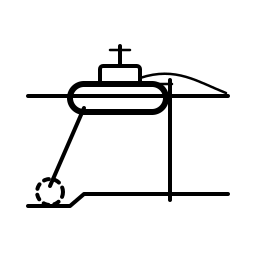
Download PDF ↓A hand-launched tethered net for the final few metres — the capture tier's close-in tool.
Download PDF ↓If you buy, build, integrate or regulate counter-UAS capability for Canada or its allies, the Gyrfalcon round — margins and open items included — is on the table.