PICK IT UP SELECTIVELY —
CARRY IT ALL AWAY
A tracked, teleoperated manipulator platform for shoreline and land cleanup — reach, load and slope, enforced as one envelope.
Position · Extend · Grasp · Retract · Deposit
A teleoperated, tracked shoreline and land environmental-cleanup platform: a forward manipulator that picks unstructured debris off shorelines, riverbanks and difficult ground without disturbing what surrounds it, and a swappable bin cassette that carries the material — and the contamination — off site with it. A work machine, not a weapon.
A tracked, teleoperated manipulator platform for shoreline and land cleanup — reach, load and slope, enforced as one envelope.
Position · Extend · Grasp · Retract · Deposit
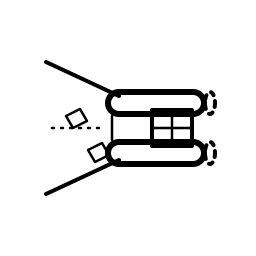
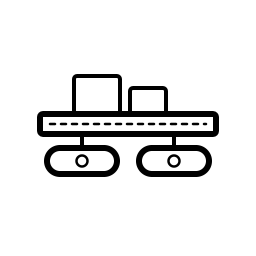
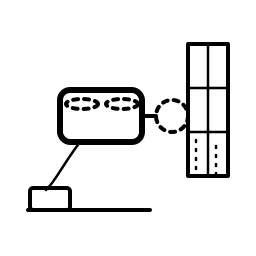
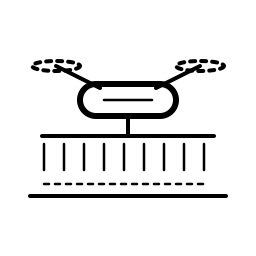
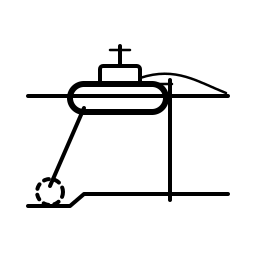
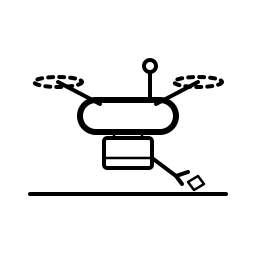
The Enviro is a teleoperated, tracked shoreline and land environmental-cleanup platform: a low, wide chassis carrying a forward-mounted articulated manipulator and a rear swappable bin cassette. It reaches into unstructured debris — timber, tyres, sheeting, netting, contaminated litter — on ground too soft, too steep, too remote or too unpleasant for a conventional machine, and lifts individual objects without disturbing what surrounds them.
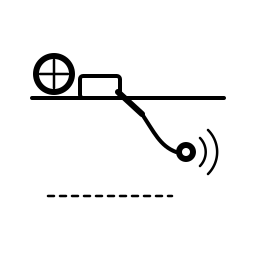
It closes the loop Recovery opens. Recovery works the water side of a spill or debris incident; Enviro works the land side — shorelines, riverbanks, contaminated ground — and between them the Industrial line covers both halves of a cleanup that neither Skimmer, nor Washer, nor Rock Scaler was ever scoped to do. Beaver moves bulk material; Enviro's job is the opposite — selective pickup of discrete objects, one at a time, without excavating or dragging.
The machine's real capability is not a single lift number. Reach, load and slope are one coupled constraint, not three independent specs, and usable capacity swings roughly four-to-one across the working envelope. The controller enforces that envelope in software, because an operator concentrating on a grasp cannot also be doing tipover arithmetic — and because the honest value case is measured in person-hours a remediation crew did not spend in a hazardous zone, not in tonnes moved.
Reach, load and slope trade against each other continuously — the same object is liftable at 2 m on the level and unliftable at 3 m on a bank. Quoting a single capacity figure would misdescribe the platform exactly where it matters most, so the controller carries the envelope instead of the operator.
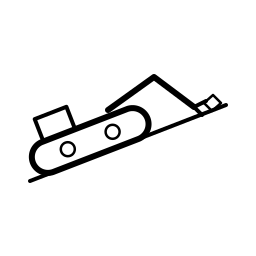
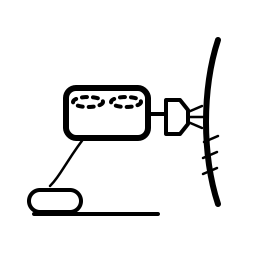
Forward tipover about the leading track edge governs the platform's whole capability. On a slope, facing downhill, the restoring moment falls with the cosine of the slope and the tipping moment rises with its sine — so usable load at any given reach is a function of both together, not of either alone.
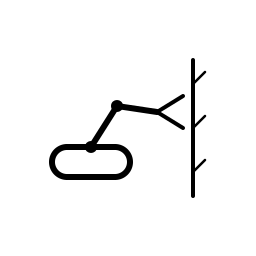
The arm extends on the quick-change tool interface it shares with Beaver — one estate standard, several heads: a grapple for the general run of unstructured debris, a bucket or scoop for loose aggregate material, a strictly mechanical shear for netting, rope and root mass, and a sampling head for crew-directed work. The grapple is the workhorse, and deliberately so — the correct instinct for wet, tangled, unpredictable shoreline debris is agricultural, not anthropomorphic; a robust jaw that closes on whatever is between it beats a dexterous hand trying to understand the object first.
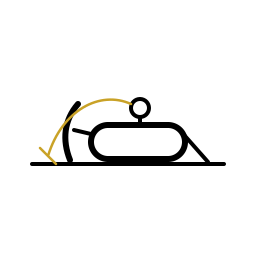
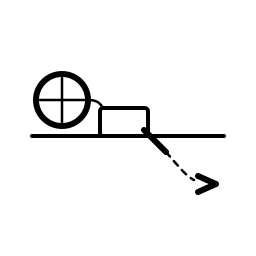
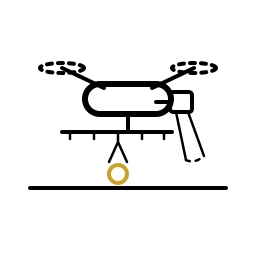
The governing figure of merit is not a headline lift rating. It is the envelope itself: the controller knows the machine's attitude and the arm's geometry, and refuses commands that would exceed the stability limit — at a factor of safety of 2.0 over the arithmetic tipover point. Facing uphill where the slope allows restores most of the lost envelope for free, a control-and-procedure fix rather than a hardware one. Teleoperation is the baseline mode — camera and force feedback, not a fallback — and the cycle runs the same five beats every time: position, extend, grasp, retract, deposit, with each object dropped into the bin cassette and geotagged into the pick log.
The complete data card for the Enviro — dimensions, stability, the manipulator envelope, control, power, serviceability and compliance, grouped the way a working fleet buyer compares them.
No headline tonnes-per-day figure is published — on this machine that number is not a property of the machine. Daily collection is governed by pick-cycle time, duty cycle, mean object mass and how tangled or buried it is, ground surface, slope and season, decontamination frequency and operator experience. On open, safe, accessible ground with ordinary litter, a crew with a truck is very probably faster and cheaper — and the honest recommendation is to use one; the Enviro’s case is the ground where that is not true.
Canadian Shield's thesis is that manufacturing is the decisive capability. Enviro is that thesis pointed at cleanup and remediation: the same sovereign Canadian production base, the same materials canon, doing land-side work no existing platform in the fleet was ever scoped to do.
The overlap is physical, not rhetorical. The 5-axis shop that cuts structural moulds for the rest of the fleet cuts Enviro's frame and arm-mount tooling; the sacrificial rPET covers, belly pan and bin liner run on the same recycled-line rules as every other platform's non-structural parts — and Enviro needs more of them than any other machine in the line, because a cleanup vehicle that cannot be washed is a liability, not an asset. The quick-change tool interface is deliberately shared with Beaver (CS-250): one estate standard, not two.
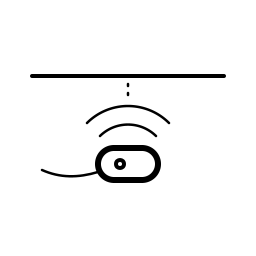
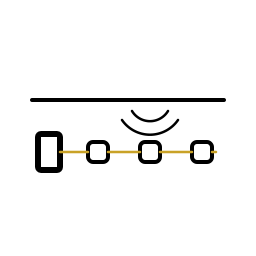
And up here, the estate's radio boundary runs the civil way. The no-radio rule governs the defence, underground and tethered platforms without exception — but the Industrial line is the surface civil exception where radio and GNSS are permitted, and Enviro depends on both openly: teleoperation is the baseline control mode and needs a live commercial radio link with camera and force feedback, and GNSS geotags every pick into the chain-of-custody record. A contaminated riverbank is not a jammed battlefield, and we do not price it like one.

Against an open, accessible site and a crew with rakes and a truck, Enviro is not obviously the faster or cheaper answer, and we say so plainly. Its case is the ground where sending a person is the wrong call — and the honest measure is how many hours inside a hazardous zone a crew never had to spend, not how many kilograms the machine carried.
An Enviro job is a loop, not a shift: the site is tasked, the crew works the envelope, and what leaves is the machine, the reusable articles, and a record of exactly what was collected — never the contamination. Here is the day, end to end — illustrative of the operating loop, not a job record.
The crew arrives with the machine, a clean bin cassette and the decon station. On a shoreline incident the tasking picture is shared with Recovery on the water side — Enviro works the land, and the tide line is the handoff. The operator sets up the teleoperation station clear of the hot zone; material classification and site access are the site owner's and the regulator's call — never ours — and crew lanes and exclusion zones are set before the arm moves.
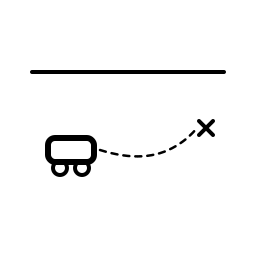
The operator drives into position — facing uphill where the slope allows, which restores most of the lost envelope for free — extends the arm, and grasps. The controller checks every command against the reach-load-slope envelope before it commits; each pick is geotagged and logged, and the bin fills. The operator directs the grasp, watches the machine and owns the exceptions; the machine stays inside the envelope, and proves what it picked up.
The full cassette swaps for a clean one at the 4-point seat — the contaminated volume leaves the site with the material, not attached to the machine. The vehicle then runs the wash cycle at the decon station; effluent is captured, not discharged, and the client gets the pick-by-pick record. What leaves is the machine, clean, and every reusable article; what goes for disposal is the bin cassette, manifested, and the wash effluent.
The Enviro works the land side of a job Recovery works from the water — the tide line is the handoff — and carries its arm on the same quick-change tool standard as Beaver. Same engineering canon, one shop floor, different jobs.
Selective pickup of discrete objects on difficult ground — reach, load and slope enforced as one envelope.
Download PDF ↓The water half of the same incident — Enviro closes the loop Recovery opens, at the tide line.
Download PDF ↓Moves bulk material — the opposite job — and shares the quick-change tool interface: one estate standard, not two.
Download PDF ↓If you manage shoreline debris, riverbank litter, spill-affected ground or a remediation crew you'd rather keep out of the hot zone, the conversation starts with the site — and with the machine built to reach in and carry it away.