SAME TUBE. SAME ROUND.
A NOSE THAT CATCHES.
A capture-head variant on the Goose CS-110 launch line — fouls rotors and entangles the airframe instead of striking it down.
Capture · Recovery · Evidence · Layered Defence
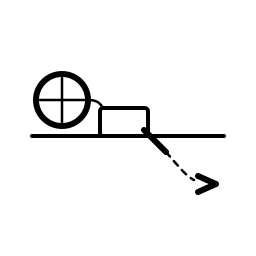
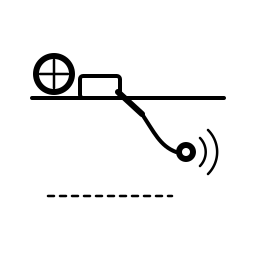
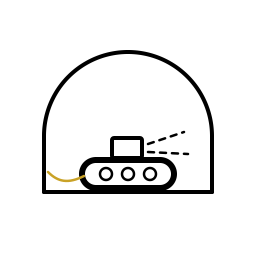
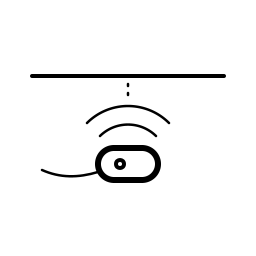
A capture-head variant on the Goose CS-110 launch line — same pneumatic tube, same magazine, same unpowered airframe. In place of a kinetic mass the nose carries a mechanical capture bay: a deployable net lattice that fouls a threat drone's rotors and entangles its airframe, instead of striking it down. No warhead, no propellant, no energetics — a mechanical carrier, not a munition.
A capture-head variant on the Goose CS-110 launch line — fouls rotors and entangles the airframe instead of striking it down.
Capture · Recovery · Evidence · Layered Defence
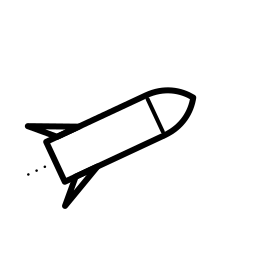
Encapsulator CS-111 is the capture-nose variant on the Goose CS-110 launch line: the same pneumatic tube, the same magazine indexing, the same unpowered airframe — with the kinetic mass in the nose replaced by a mechanical capture bay. It is not a new launcher program. It is a second nose on the round Canadian Shield already builds.
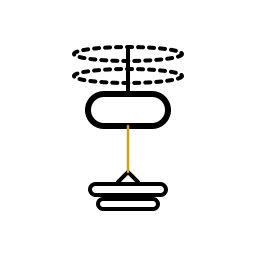
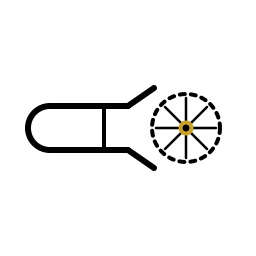
Where Goose defeats a target by collision, Encapsulator fouls it. In place of a kinetic slug, the nose carries a stored-gas capture bay: a packed textile envelope or net lattice that deploys at short standoff into a low-density, high-drag structure. The target flies into it. Rotors foul, the airframe entangles, and the aircraft comes down under its own broken lift rather than being struck apart. The magazine gets a second nose without changing lines.
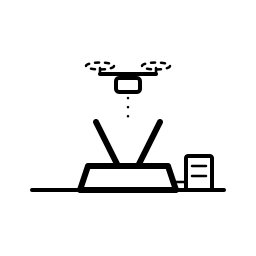
Because Encapsulator matches the Goose round's external envelope, all-up mass and indexing features exactly — 1.6 kg, Ø90 mm, the same ~189 m/s exit — a kinetic Goose and a capture Encapsulator sit side by side in the same magazine, fired from the same tube, chambered by the same crew drill. A mixed salvo — some rounds built to destroy, some built to catch — is a loadout decision, not a procurement of two different systems.
Some intercepts call for a kill. Some call for a target that survives to be traced — recovered, examined, attributed. Encapsulator is the round for the second case: a mechanical carrier that fouls and entangles, with no warhead, no fuze and no energetic material anywhere in the round.
The launch chain is Goose's, unchanged: a fully unpowered, tube-launched moulded body rides the same ~30-bar-class pneumatic tube to a ~189 m/s muzzle exit. Nothing about how the round leaves the tube is different. Everything different is forward of the bulkhead.
Behind the nose sits a capture bay: a small stored-gas bottle and a packed capture envelope, separated from the payload's inertial load by a nose bulkhead built to carry it into the hull sidewall through launch. At standoff the bay executes a positive mechanical release — never pressure-triggered, because the payload itself self-pressurises under the launch pulse and would otherwise deploy prematurely. This is not "proximity fuzing", and Canadian Shield does not use the term: the correct name is standoff release or deployment trigger — a mechanism that opens a bay. It initiates nothing.
Once released, stored gas inflates the packed envelope into a low-density, high-drag net lattice in the target's path. The effect is stated plainly: a round of this mass budgets roughly a fifth of the payload a full envelope capture would need, so the claim is localised rotor fouling and airframe entanglement — enough to take away lift and control, not enough to wrap a target whole. Canadian Shield publishes the true effect, not the dramatic one.
The complete data card for the Encapsulator round — dimensions, launch performance, guidance, the capture payload and compliance, grouped the way a fleet buyer compares them.
Launch acceleration and the bulkhead load are stated as averages over the ~3.0 m launch stroke. Capture effect is stated as localised rotor fouling and airframe entanglement — a round of this mass does not wrap a target whole.
Encapsulator inherits Goose's jam-proof case in full: Tier-1 guidance is set at the barrel, there is no receiver and no emitter aboard, and there is nothing for an adversary to attack electronically. The capture nose changes what happens at the target, not what the round is vulnerable to.
Not every intercept should be lethal-equivalent. Over a populated area, near a runway, or wherever the target needs to be recovered rather than scattered — for forensics, attribution, or simply to avoid a debris field under a crowd — a hit-to-kill slug is the wrong tool even when it is the available one. Encapsulator is the non-lethal-optional answer already sitting in the same magazine as the kinetic round, selectable at the point of load rather than procured as a separate system.
The salvo economics follow from the shared line. Encapsulator does not require a new mould, a new launcher, or a new production run — it requires a different nose on tooling Canadian Shield already owns and cuts on its own 5-axis floor. That is the manufacturing thesis applied to a mission variant: the capability the Forward Manufacturing Cell exports and the capability a domestic buyer gets at home are the same one line, building two outcomes.
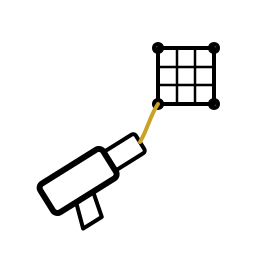
Encapsulator sits in the Goose family's capture tier alongside Matrix CS-112, a close-in tethered-net direct-fire launcher for the last few metres. Together they state the layered-defence argument in one line: destroy by collision when you must, capture intact when you can — from the same launch platform, on the same production floor.
One intercept, walked end to end — illustrative of how the round is used, not a mission record.
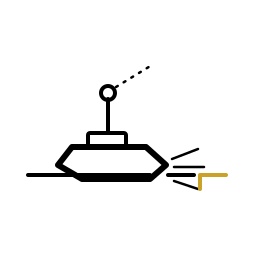
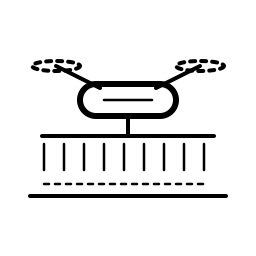
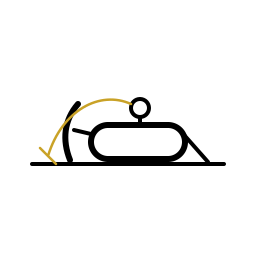
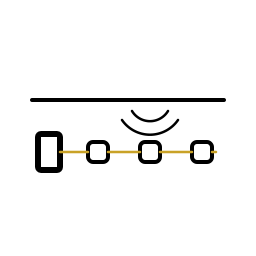
An Encapsulator round chambers exactly like a kinetic Goose — same bore, same indexing, same crew drill. A magazine can carry both side by side; which nose comes out of the tube next is a loadout decision made at the point of load, not a different weapon system to train on.
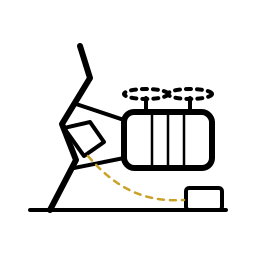
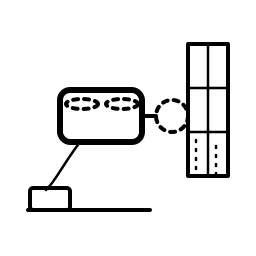
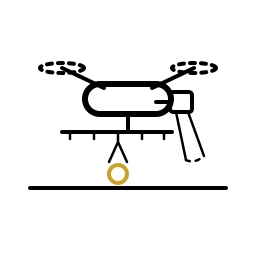
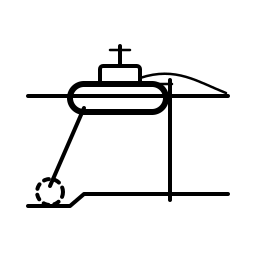
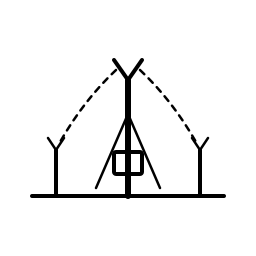
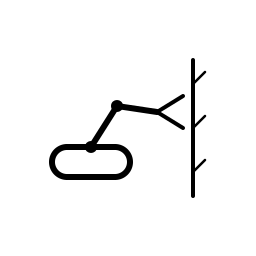
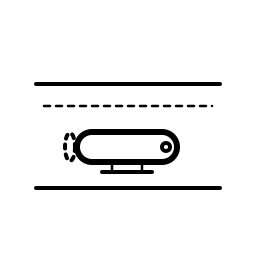
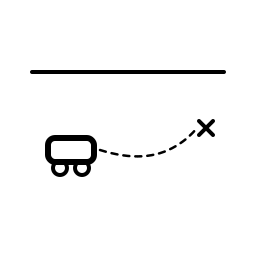
The round flies the same ~189 m/s arc as Goose. Near the target, the nose bay executes its positive mechanical release — never pressure-triggered — and the packed capture envelope deploys into a low-density, high-drag net lattice directly in the target's path.
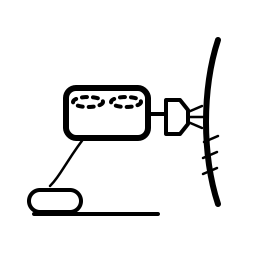
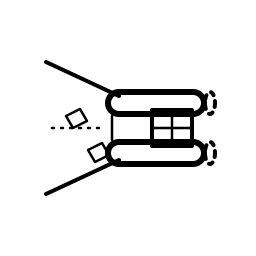
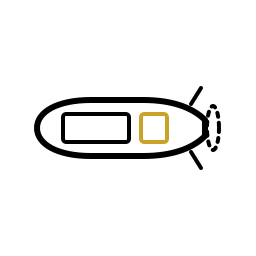
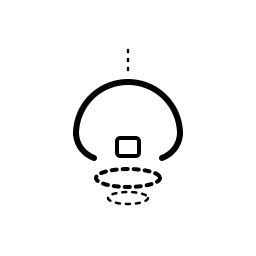
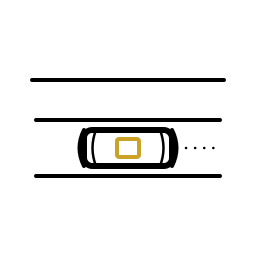
Rotors foul, the airframe entangles, and the target comes down under its own broken lift rather than as a free-fall debris field. What lands is available for recovery, forensics and attribution — the outcome a kinetic hit forecloses.
Encapsulator is the capture nose on the Goose line. Two siblings share the round envelope and doctrine; one carries the powered-flight scope the capture tier gives up. Same no-radio thesis, different jobs.
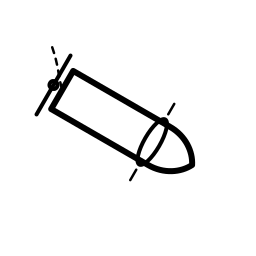
Kinetic slug nose, fully unpowered — the round built to be bought in numbers.
Download PDF ↓The same round envelope and the same tube, with a capture nose for a controlled take-down.
Download PDF ↓A hand-launched tethered net for the final few metres — the capture tier's close-in tool.
Download PDF ↓The family's premium interceptor — carries the powered-flight scope the capture tier gives up to stay cheap.
Download PDF ↓If you buy, build, integrate or regulate counter-UAS capability for Canada or its allies, the capture tier — Encapsulator and all — is on the table alongside the kinetic round.