Coater · CS-550 · Industrial Series

HOLD THE STANDOFF.
APPLY THE COAT.

An umbilical-fed applicator platform. The pressure stays on the ground; the machine flies the last few hundred millimetres.

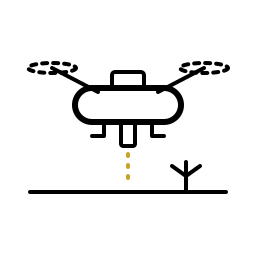
Ground · Umbilical · Standoff · Trigger · Film

~0.2 KG
Fluid mass aloft — head, short whip, trigger valve
150–300 MM
Working standoff, held mechanically by compliant feelers
150 BAR
Pressure class — generated and held at the ground station
0
Litres of bulk coating carried aloft — the tank stays on the ground
What It Is

An Excellent Positioner.
Not a Tank.


The Coater CS-550 is an umbilical-fed multirotor built to apply protective coating and sealant to infrastructure surfaces — steel towers, storage tanks, bridge structures, façades and marine structures — from a hover a few hundred millimetres off the work. A shrouded applicator head, a short fluid whip and a trigger valve are the only fluid mass it carries; everything else — the bulk fluid, the proportioner, the pump, the pressure — stays on the ground.

The design logic starts from arithmetic, not preference: a hovering platform is an excellent positioner and a hopeless tank. A single maintenance coat moves roughly 0.58 kg of wet material per square metre; an onboard reservoir sized to a sensible airframe buys minutes of gun time, not a shift. So the Coater does not carry the coating — it carries the aim. Ground pump, ground proportioner, ground metering; the platform's job is to hold a repeatable few hundred millimetres of standoff against a real surface in real wind, and let the umbilical do the rest.

It sits in the Industrial line beside the Seeder CS-510, the Sprayer CS-560 and its closest sibling, the Washer CS-540 — a caged, umbilical-fed platform that shares its airframe, feelers and ground pump architecture so closely that the two are, by design, roughly the same machine wearing a different wetted path.

The Finding
Every ounce of pressure stays on the ground. Only the aim leaves it.

An onboard-reservoir, free-flying architecture buys minutes of gun time before it needs to land and refill — arithmetic that survives every plausible revision of the inputs. It survives on this machine only as a touch-up mode, where a small area is the whole job and rigging an umbilical is not worth it. Production work rides the umbilical.

  • All mass on the ground — bulk fluid, proportioner, pump and pressure never leave the skid.
  • Mechanical standoff — 150–300 mm held by compliant feelers, not by free-flight position hold.
  • No surface preparation — coating application only; product, prep and acceptance belong to the asset owner.
01 How It Works · The Fluid Chain

GROUND TO SURFACE — ONLY TWO STAGES FLY


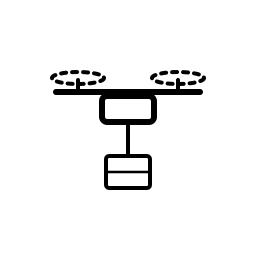
Bulk coating, filter, proportioner, pump and flow meter sit on a skid at the base of the work — all the mass, all the pressure energy and all the pot-life risk, racked into a truck or skid, never carried aloft. A pressure-rated umbilical — hose, power and comms in a managed jacket on a tensioning reel — pays that pressure up to the aircraft.

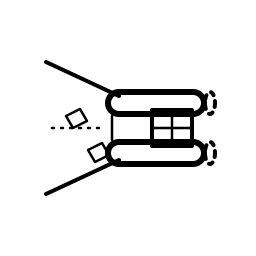
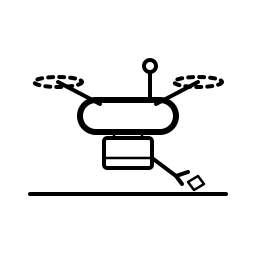
At the platform, the umbilical loads directly into the lift core at a hard point: the single most safety-critical structural detail on the machine, because the platform-side quick-disconnect has to leave a 150-bar-class line safe if it ever separates. From there the fluid runs a short whip to a shrouded applicator head, firing below the rotor wash. Two to four compliant standoff feelers ride or lightly touch the surface ahead of the head — a mechanical datum, not an optical one, because a ±50 mm standoff error swings film build by roughly −15% / +20%, which is most of the industry tolerance band before wind, overlap or traverse-speed error are even counted.

The trigger only opens inside an interlocked envelope — valid standoff, on-surface, inside the environmental window — and the machine works bottom-to-top, so its own downwash sweeps the uncoated surface ahead of it rather than the wet film behind it. Command and control rides conventional radio C2 and GNSS position hold, permitted on this civil line; the umbilical adds a hard-line comms path for the fluid work itself, removing RF dropout as a close-work failure mode.

FLUID CHAIN THE FLUID CHAIN — GROUND TO SURFACE, TWO STAGES AIRBORNE BULK · FILTER · 2K PROPORTIONER · PUMP GROUND FLUID STATION — ALL MASS, ALL PRESSURE, ALL POT-LIFE RISK TENSIONING REEL UMBILICAL — 150 bar CLASS · ~0.35 kg/m LOADED HARD POINT + QUICK-DISCONNECT — MUST FAIL SAFE CAGED PLATFORM — FULL PERIMETER ROTOR PROTECTION SHROUDED HEAD ≈0.2 kg FEELERS — MECHANICAL STANDOFF DATUM 150–300 mm FACE STANDOFF + FLOW LOGGED PER PASS FILM BUILD IS INFERRED & SAMPLED, NEVER CONTROLLED — ACCEPTANCE STAYS WITH THE CERTIFIED COATINGS INSPECTOR CS-550 · fluid chain — ground station · umbilical · hard point · head · feelers · film
Full Specification Sheet

Every Number, Grouped for the Walk-Around.


The complete data card for the Coater — dimensions, delivery performance, control, the applicator head, construction, safety and compliance, grouped the way a fleet buyer compares them.

Coater CS-550 · Umbilical-Fed Coatings-Application Platform Industrial Family · Civil Line · Fluid-Work Family

01Dimensions & Mass

All-up mass, reference
~25 kg class
Airborne fluid mass
~0.2 kg — head, short whip and trigger valve only
Umbilical loading
~0.35 kg/m loaded → ~10 kg at 30 m, ≈40% of the reference all-up mass
Configuration
Caged, umbilical-fed multirotor — short-standoff spray

02Delivery Performance

Working pressure
150 bar class — generated and held at the ground station
Delivered flow
~1.1 L/min at the tip
Static lift line loss
~0.098 bar/m
Jet reaction
~3.8 N — ≈1.5% of the reference all-up mass, a trim load, not a structural one
Pass strategy, baseline
4 passes · 0.61 m/s traverse · ~52 µm wet film per pass
Coverage, baseline
~63 m²/h at the baseline pass strategy — moves with the governing variables below

03Control & Standoff

Flight control
Commercial RF C2 + GNSS position hold — permitted on this civil line
Hard-line comms
Down the umbilical — removes RF dropout as a close-work failure mode
Working standoff
150–300 mm, held mechanically by 2–4 compliant feelers
Working height band
5–40 m AGL — umbilical weight, not flow, limits height
Working direction
Bottom-to-top — downwash sweeps the uncoated surface, never the wet film

04Applicator & Record

Applicator head
Shrouded spray head — ~0.43 mm swappable tip family · 0.30 m fan width
Film build
125 µm dry · 208 µm wet, at 60% volume solids — the asset owner's specification governs
Transfer efficiency
50% working figure at the surface
Touch-up mode
Small onboard reservoir for small-area work — production work rides the umbilical
Mission record
Per-square-metre applied-volume map — position, standoff, flow, traverse speed, ambient and surface conditions, batch/lot ID

05Materials & Construction

Load path
GF-nylon
Cage & fairings
rPET / rPET-GF sacrificial panels — coated, solvent-washed and eventually replaced; cheap mouldings by design
Wetted path
Solvent-rated engineered assembly — bought, not moulded; no recycled-PET part ever touches the coating or its solvent (Rule FH-1)
Shared module
Fluid-handling module common with Sprayer CS-560 and Washer CS-540 · ~80% commonality with the Washer

06Safety & Interlocks

Trigger interlocks
No flow off-surface, outside the environmental window, or without valid standoff
Rotor protection
Full perimeter cage
Umbilical hard point
Platform-side quick-disconnect leaves a 150-bar-class line safe if it separates
Pot-life protection
Automatic line flush on pause — an interlock, not a procedure; waste solvent handled as a regulated stream

07Compliance

Patent status
Patent pending
Classification
Civil work machine — Industrial line; commercial radio, telemetry and GNSS permitted on this line
Energetic content
None — carriers and working tools, not munitions; no energetic content in any variant
Scope
Coating application only — no abrasive blasting, washing, stripping or coating removal; product, prep grade and acceptance belong to the asset owner

Coverage is stated at the baseline pass strategy and moves with the coating chosen, standoff accuracy in wind, transfer efficiency at the surface, umbilical length and working height, and ground-station resupply and flush cadence. Film build is inferred and sampled, never controlled — acceptance stays with the asset owner's certified coatings inspector.
In the Doctrine

One Fluid Canon.
Three Work Machines.


Canadian Shield's thesis is that manufacturing is the decisive capability, built sovereign and priced like a tool. The Coater advances that thesis with a fluid-handling grammar held once, in a shared library, and instanced across every wet-work product on the civil line.

The Coater does not draw its own fluid-handling engineering from scratch. It instances the five-stage process grammar, the wetted-path boundary and the umbilical hard-point rule that the Sprayer and the Washer also draw from — a single canon, amortised across three products instead of reinvented per machine. The Coater and the Washer in particular share the airframe, the cage, the feelers, the umbilical and the ground pump station so closely that the honest read is platform commonality: two members of one civil fluid-work family, differing mainly in the fluid, the pressure class and the wetted-material set.

And the estate's radio boundary runs the way it does across the whole Industrial line: the no-radio rule governs the defence, underground and tethered platforms without exception — but the surface civil line is the exception, and the Coater uses both radio and GNSS openly for flight, with the umbilical adding a hard-line path for the fluid work itself. A tank shell is not a jammed battlefield, and we do not engineer it like one.

The Accountable Coat
Not a better film than a person. An accountable one.

The machine does not sell a superior finish — it sells a metered, logged, per-square-metre applied-volume record: position, standoff, flow, traverse speed, ambient and surface conditions, batch and lot. Film build stays inferred and sampled, never controlled, and acceptance stays exactly where it belongs — with the client's certified coatings inspector.

  • One shared fluid canon — Sprayer, Washer and Coater instance one grammar, three machines.
  • ~80% commonality with the Washer — airframe, cage, feelers, umbilical, ground station.
  • No specifications set by Canadian Shield — product, prep grade and acceptance always belong to the asset owner.
Deployment

Specification In.
Applied-Volume Map Out.


A Coater job is a loop anchored to the ground, not a free flight — illustrative of how the machine is used, not a work record. The asset owner's coating specification sets the target, the machine holds standoff and executes the pass strategy, and what comes home is a record.

01 · Arrive

The Ground Station Sets Up

The crew stages the ground fluid station at the base of the tower or tank — bulk coating, filter, proportioner, pump, heater and flush line on a skid — and spools out the umbilical. Before any real coating touches the line, the fan pattern and film-build model are calibrated against an inert medium: pigmented water matched for viscosity and density, never the coating itself. The coating specification is the asset owner's specifier and certified inspector's call — never ours.

02 · Work

Standoff Holds, the Fan Opens

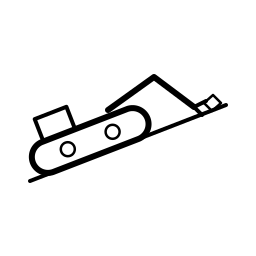
The Coater lifts on the umbilical and brings its compliant feelers against the face, holding 150–300 mm mechanically as it works bottom-to-top so its own downwash sweeps ahead of the wet film, not through it. The trigger opens only inside the interlocked envelope — valid standoff, on-surface, inside the environmental window — and closes the moment any of the three drops out. The operator flies the plan and owns the exceptions; the machine holds the standoff, meters the flow and logs every pass.

03 · Recover

The Line Flushes, the Record Ships

At the end of a run — or the moment a pause threatens pot life on a two-component product — an automatic flush clears the umbilical before the coating can cure inside it; it is an interlock, not a procedure. Captured waste solvent is handled as the regulated stream it is. The client receives the per-square-metre applied-volume map: an auditable record ready for their own inspector's sign-off — never an acceptance call.

The Fluid-Work Family · At a Glance

One Canon. Three Machines.


Three wet-work machines on the civil line instance one shared fluid-handling canon — the same process grammar, wetted-path boundary and umbilical hard-point rule, amortised across the family instead of reinvented per machine.

This machine CS-550 · Coatings application

Coater

Holds mechanical standoff and applies protective coating through a shrouded head — the accountable coat.

Download PDF
CS-540 · Closest sibling

Washer

Roughly the same machine wearing a different wetted path — shared airframe, cage, feelers, umbilical and ground pump station.

Download PDF
CS-560 · Same canon

Sprayer

The third member of the fluid-work family, drawing on the same shared fluid-handling module and process grammar.

Download PDF
Hold the Standoff

The Surface Doesn't Care Who Coated It.
The Record Proves Who Did.

If you manage steel towers, storage tanks, bridge structures or façade maintenance with a specification and an inspector attached, the conversation starts with your coating spec — and with the machine built to hold standoff and execute it, band by band.

Full Marketing Package

The Rest of the Fleet.


Every Canadian Shield platform has a brochure like this one — same depth, same status discipline, same refusal to publish a number we cannot source. Organized by family below.

Air · 8
CS-110 · Air

Goose

No battery. No motor. No receiver. A kinetic carrier launched at ~189 m/s on shop air.

Read the brochure Download PDF
CS-111 · Air

Encapsulator

A capture-head variant on the Goose CS-110 launch line — fouls rotors and entangles the airframe instead of striking it down.

Read the brochure Download PDF
CS-112 · Air

Matrix

Aimed, direct-fire, tethered — the net that stays connected to the gun that threw it.

Read the brochure Download PDF
CS-120 · Air

Gyrfalcon

Goose's launch chain, plus the power Goose leaves out — a tail motor and bow-thruster ring for mid-flight correction.

Read the brochure Download PDF
CS-130 · Air

Raven

A moulded electric aircraft that carries the network — decoy, relay, electronic support. Non-kinetic. Recoverable.

Read the brochure Download PDF
CS-140 · Air

Owl

A big, slow propeller and an IR-biased eye — orbiting instead of hovering, unheard, unseen, unjammed.

Read the brochure Download PDF
CS-150 · Air

Loon

The bird that flies its whole leg without asking a satellite for a name.

Read the brochure Download PDF
CS-160 · Air

Kestrel

The Air family's smallest body — a tube-launched, motor-cruising scout priced to lose, not to last.

Read the brochure Download PDF
Ground · 6
CS-210 · Ground

Grizzly

Tracked. Battery-electric. 150 kg over muskeg — with nothing to jam.

Read the brochure Download PDF
CS-220 · Ground

Moose

600 kg of freight over bad ground. Payload is the product — mobility is the constraint it is bought within.

Read the brochure Download PDF
CS-230 · Ground

Wolf

Eight coordinated carriers. One fibre trunk. One operator. Nothing to jam.

Read the brochure Download PDF
CS-240 · Ground

Lynx

A wheeled route-picker with thermal eyes — and a watch mode measured in days.

Read the brochure Download PDF
CS-250 · Ground

Beaver

Tracked. Battery-electric. An anchored winch pulls roughly seven times what the tracks alone can.

Read the brochure Download PDF
CS-260 · Ground

Wolverine

A compact tracked carrier that places self-reacting tools at the work face — the force closes on the structure, not the machine.

Read the brochure Download PDF
Water · 2
CS-310 · Water

Orca

Persistent survey & carrier AUV — one moulded hull that surveys, carries and watches.

Read the brochure Download PDF
CS-320 · Water

Jellyfish

A soft pulsed-jet payload carrier — slower than the current on purpose.

Read the brochure Download PDF
Underground · 8
CS-410 · Underground

Badger

A surface plant that pushes a steerable head into ground with no line, no map, no signal.

Read the brochure Download PDF
CS-411 · Underground

Aquifer

Coiled-tubing bore, fibre-guided — conduit installed, water table mapped, nothing to jam.

Read the brochure Download PDF
CS-420 · Underground

Ferret

Recon, mapping and locating in existing tunnels and culverts — with a block-only interpose capability, always human-confirmed.

Read the brochure Download PDF
CS-430 · Underground

Mole

A passive seismic and acoustic node on long-life battery — reporting only over a buried fibre link.

Read the brochure Download PDF
CS-435 · Underground

Trembler Line

A chain of buried Mole nodes on a fibre trunk — detect, localize, cue. Nothing radiated, nothing to jam.

Read the brochure Download PDF
CS-440 · Underground

Muskrat

Hybrid swim/crawl. Zero visibility. No diver, no radio, no GPS.

Read the brochure Download PDF
CS-450 · Underground

Gopher

It maps, it marks, it parks. Cheap enough to send in numbers.

Read the brochure Download PDF
CS-460 · Underground

Farell Pig

Flow-driven, self-propelled or tethered — it rides the line, it doesn't bore one.

Read the brochure Download PDF
Industrial · 17
CS-510 · Industrial

Seeder

A pneumatic seed-pod launcher, retuned to gentleness. Pods down, evidence back.

Read the brochure Download PDF
CS-520 · Industrial

Skimmer

A small moulded surface craft — the information and marking layer of a spill response.

Read the brochure Download PDF
CS-530 · Industrial

Rock Scaler

A contact-tolerant aerial platform sets the hook. A ground-anchored winch does the pulling.

Read the brochure Download PDF
CS-540 · Industrial

Washer

A caged, umbilical-fed washing platform. Water up the line, evidence back down.

Read the brochure Download PDF
This brochure CS-550 · Industrial

Coater

An umbilical-fed applicator platform. The pressure stays on the ground; the machine flies the last few hundred millimetres.

Read the brochure Download PDF
CS-560 · Industrial

Sprayer

Full-width boom, drift-reduction nozzles, a metered rate held across the pass. The broadcast tool for the uniform job.

Read the brochure Download PDF
CS-561 · Industrial

Spot Sprayer

Machine vision finds the target; only that nozzle opens. Built to cut total product volume per acre.

Read the brochure Download PDF
CS-570 · Industrial

Dredger

A trailerable uncrewed dredger for ponds, marinas, lagoons and channels.

Read the brochure Download PDF
CS-580 · Industrial

Recovery

An uncrewed collection craft for the debris and spill material that floats.

Read the brochure Download PDF
CS-590 · Industrial

Enviro

A tracked, teleoperated manipulator platform for shoreline and land cleanup — reach, load and slope, enforced as one envelope.

Read the brochure Download PDF
CS-630 · Industrial

Litter Collector

An uncrewed multirotor built to find litter, take only litter, and prove it did.

Read the brochure Download PDF
CS-600 · Industrial

Cargo Mover

An uncrewed VTOL cargo family — four sizes of the same machine, from toolbox to bulk lift.

Read the brochure Download PDF
CS-610 · Industrial

Personnel Mover

A crew-carrying VTOL work machine. Two tiers — PM-8 single-seat, PM-12 two-seat.

Read the brochure Download PDF
CS-620 · Industrial

Heavy-Lift Logger

An uncrewed coaxial hybrid rotorcraft for long-line log extraction — turn after turn, hour after hour.

Read the brochure Download PDF
CS-700 · Industrial

Self-Charging Dock

A docking and replenishment station that lets a working fleet return, recharge and redeploy without a hand touching it.

Read the brochure Download PDF
CS-710 · Industrial

Relay Chain

A deployable chain of relay nodes — command, telemetry and position augmentation for civil fleets working past the edge of the network.

Read the brochure Download PDF
CS-C001 · Industrial

Fibre Spool Line

Guidance-fibre consumable cassettes — a physical tether option, alongside or instead of radio.

Read the brochure Download PDF
Defence · 1
CS-901 · Defence

Shield Pod

A canopy-retarded delivery pod: land on a crumple zone, right itself, open, release the carrier system.

Read the brochure Download PDF