THE FREIGHT LADDER:
LIFT WHAT THE JOB NEEDS
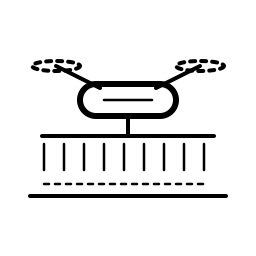
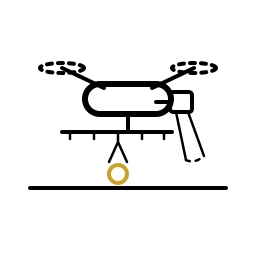
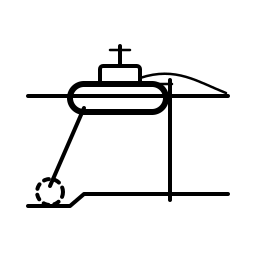
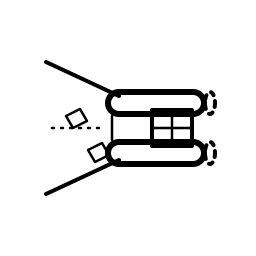
An uncrewed VTOL cargo family — four sizes of the same machine, from toolbox to bulk lift.
CM-4 · CM-6 · CM-8 · CM-12
An uncrewed heavy-lift multirotor cargo family — CM-4, CM-6, CM-8 and CM-12 — one airframe grammar scaled by motor count, the way our HDD rigs scale by pullback. A civil work machine for site logistics and remote resupply: dual-everything redundancy, a whole-airframe parachute and SIG AT polyfoam on every tier, and conventional radio C2 with GNSS — permitted on this line, because this is a truck, not a weapon.
An uncrewed VTOL cargo family — four sizes of the same machine, from toolbox to bulk lift.
CM-4 · CM-6 · CM-8 · CM-12
The Cargo Mover CS-600 is an uncrewed heavy-lift multirotor cargo family: one architecture, built in four discrete size tiers — CM-4, CM-6, CM-8 and CM-12 — scaled by motor count the way the drilling industry scales rigs by pullback. Pick the rung the load needs; the doctrine stays the same on every one.
Arms, pods and bays grow between tiers; the avionics doctrine, the safety chain and the payload interface do not. A crew trained on the CM-4 that shuttles tool kits across a work site is already trained on the CM-8 that moves site logistics — and ground kit is shared up the ladder, because the payload interface is common across tiers by design rule.
It sits in Canadian Shield's Industrial line — the civil CS-5xx/6xx family of machines bought to do actual work. And because it is a civil work machine, it carries conventional radio command-and-control and GNSS navigation, unlike the defence line: the no-radio doctrine is a defence rule, and forcing it onto a freight truck would serve nobody. This is a truck. It flies, but it is a truck.
Three decades of designing and operating mobile HDD rigs taught the group one lesson worth exporting to the air: don't build a new machine for every job — build one architecture in size tiers, and let the buyer climb the ladder as the work grows. The Cargo Mover is that lesson with rotors.
Motor count is the tier variable. Everything else — arm grammar, hub core, battery doctrine, safety chain, payload interface — is common from the smallest quad to the twelve-motor flagship.
The CM-4 quad is the runabout: tool and parts resupply, light last-mile lift. The CM-6 hex takes corridor lifts, sensor pods and small material moves. The CM-8 octo is the site logistics workhorse. The CM-12 tops the ladder for bulk lift — and it is also where the engineering honesty lives: at the top of the ladder, battery energy density is the binding constraint, and the operating answer is logistics — shuttle profiles, swap-pack cycles and tether-power options, matched to the job rather than wished away.
The design rule comes from commercial-airliner practice: fail-operational, not merely fail-safe, wherever the airframe physically permits it. Everything critical exists twice; navigation exists three times.
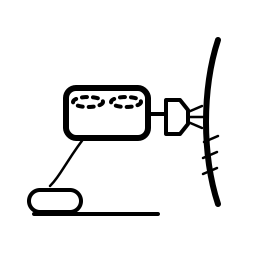
Two independent battery packs feed two independent power buses, with adjacent motors wired to opposite buses — so a bus loss thins thrust evenly around the ring instead of dropping one side. Two flight controllers, each with its own IMU, cross-check each other through an arbiter. Three GNSS receivers vote two-of-three, and the outlier is excluded. Either battery pack alone is sized to land the aircraft.
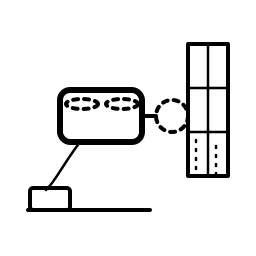
Command-and-control is dual radio — conventional, licensed, permitted on the civil line — with an optional fibre fly-by-wire tail for the missions that want it: precision lifts beside live infrastructure, RF-quiet sites, heavy-EMI environments. And on this family, a severed fibre is benign: the aircraft simply fails over to its radio links. On the higher tiers the rotor ring itself degrades gracefully — a motor out on the hex, octo or twelve-motor is a reduced-margin event, not an emergency.
A machine that carries hundreds of kilograms over a work site owes the people below it more than good intentions. The Cargo Mover's safety chain is standard fit on every tier — never an option.
The chain runs in order. First, reconfigure: on a detected fault the flight control arbiter re-allocates thrust and continues or diverts — the fail-operational attempt the redundancy architecture exists to make. Second, the whole-airframe ballistic parachute: if the vote declares controlled flight lost, a canopy takes airframe and cargo down together. Third, SIG AT polyfoam — a patent-pending rapid-expanding foam that encapsulates airframe and cargo on an unrecoverable failure, cutting scatter, spill and post-impact hazard where a parachute has no room to work.
Deployment envelopes, chute floors and foam behavior are set by the drop-test program, tier by tier — the chain's fit is a design rule; its numbers are earned on the range.
The complete data card for the Cargo Mover family — the four-tier freight ladder, airframe, power, control, carriage, safety chain and compliance, grouped the way a fleet buyer compares them.
Payload classes are working ranges per tier; endurance, MTOW, dimensions and unit economics publish when the lift and energy model closes. Crewed carriage is Personnel Mover CS-610 scope and appears nowhere on this family.
Canadian Shield's house thesis is sovereign Canadian manufacturing with cost discipline — machines designed to be built here, priced like tools, and shared across a fleet instead of reinvented per product.
The Cargo Mover advances that thesis from the middle of the Industrial line. Its airframe grammar, avionics doctrine and safety chain are fleet property, not one-off engineering: the dual-everything rule, the 2-of-3 nav vote and the SIG AT polyfoam chain are shared with its siblings, and its motors, packs and ground kit ride the same sovereign supply chain as the rest of the CS-5xx/6xx family. The size-ladder logic itself is the group's oldest asset — three decades of building mobile drilling rigs in discrete size tiers, applied to lift. A work fleet bought by the rung, maintained from one parts bin, built in Canada: that is the civil line's argument, and the Cargo Mover is its freight deck.
Below the Cargo Mover on the Industrial roster sit the CS-5xx work platforms — seeding, spraying, washing, dredging, spill response. Above it, the CS-610 Personnel Mover and CS-620 Heavy-Lift Logger extend the same lift doctrine to crews and to loads beyond the ladder's ceiling. One line, one grammar, one supply chain.
Picture a work camp two hundred kilometres past the end of the road — a mine, a line camp, a research station. The resupply run is a float plane when weather allows and a very long wait when it doesn't. This is the Cargo Mover's shift — illustrative of how the family is used, not a mission record.
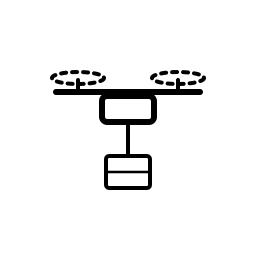
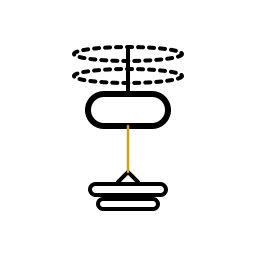
A CM-8 lifts from the depot pad with a slung load on the long-line, climbs onto the corridor and tracks GNSS waypoints under dual radio C2 — a licensed, conventional link, watched from a console, not a trench. The crew at the far end sees it on the feed before they hear it.
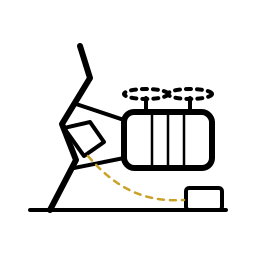
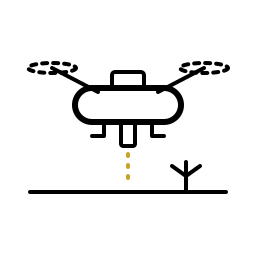
Over the site it holds hover, pays out the winch and sets the load on the marked square without touching down — no precision pad needed, no ground handling under the rotors. Where the job calls for palletized cargo instead, the same keel plate takes the hard deck. Hook releases, line spools home, and the return leg lifts the empties out.
Back at the depot it settles beside the swap-pack station; depleted packs come out, charged packs go in, and the next leg loads while the batteries are still warm. Shuttle legs, swapped packs, one machine cycling all shift — endurance bought with logistics, the way a truck fleet buys it.
The Cargo Mover anchors the Industrial line's lift roster. Its siblings ride the same arm-pod-rotor grammar and the same safety chain — one carries the crew, one carries what the ladder can't.
Four size tiers on one architecture — CM-4 to CM-12, from toolbox runs to bulk lift.
Download PDF ↓The crewed tiers of the mover family — PM-8 and PM-12, engineered toward the certification bar.
Download PDF ↓The same lift doctrine extended to loads beyond the freight ladder's ceiling.
Download PDF ↓If you move material to places roads don't reach — mines, line camps, coastal work, disaster response — the conversation worth having is about the ladder, and which rung your heaviest regular load sits on.