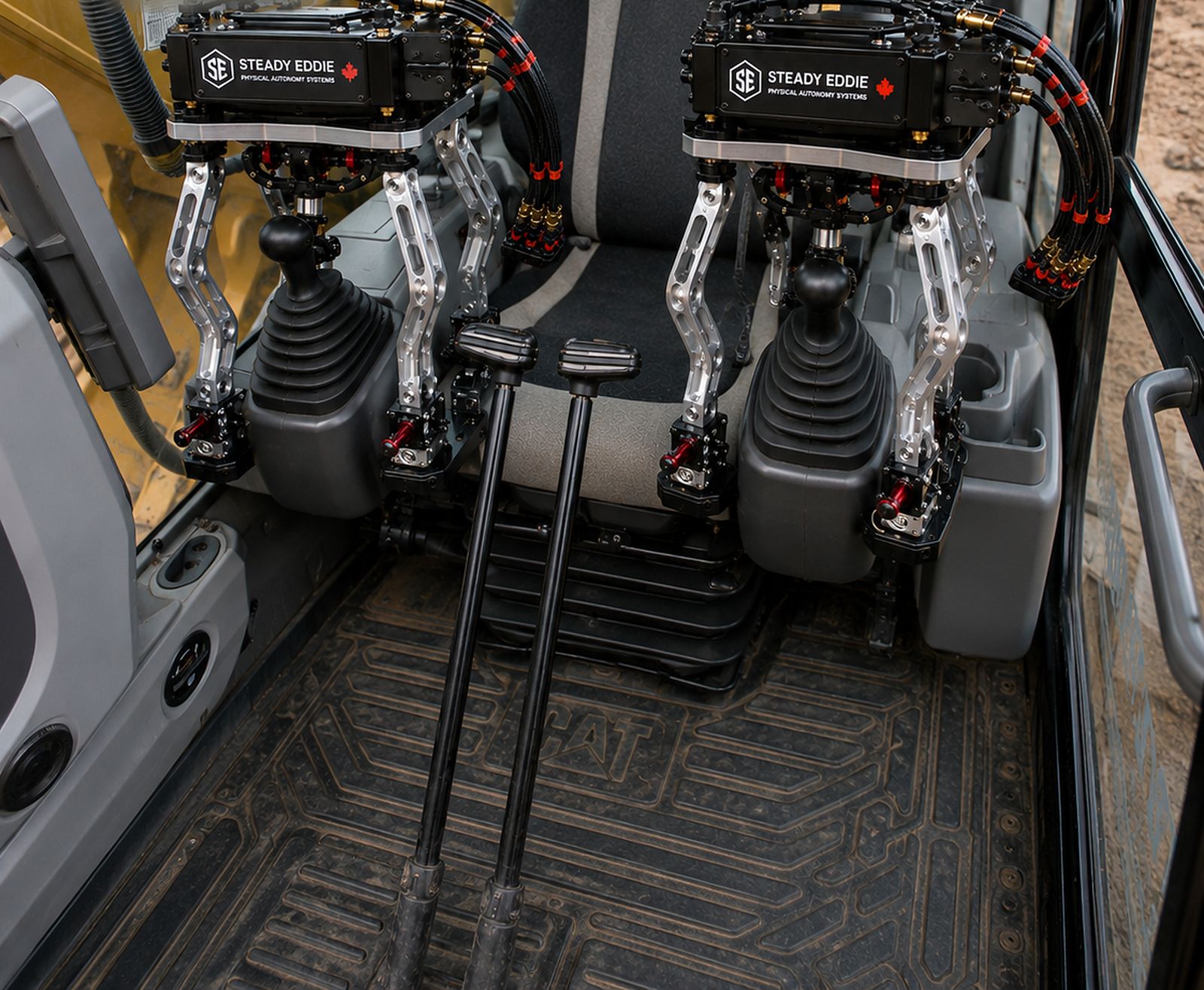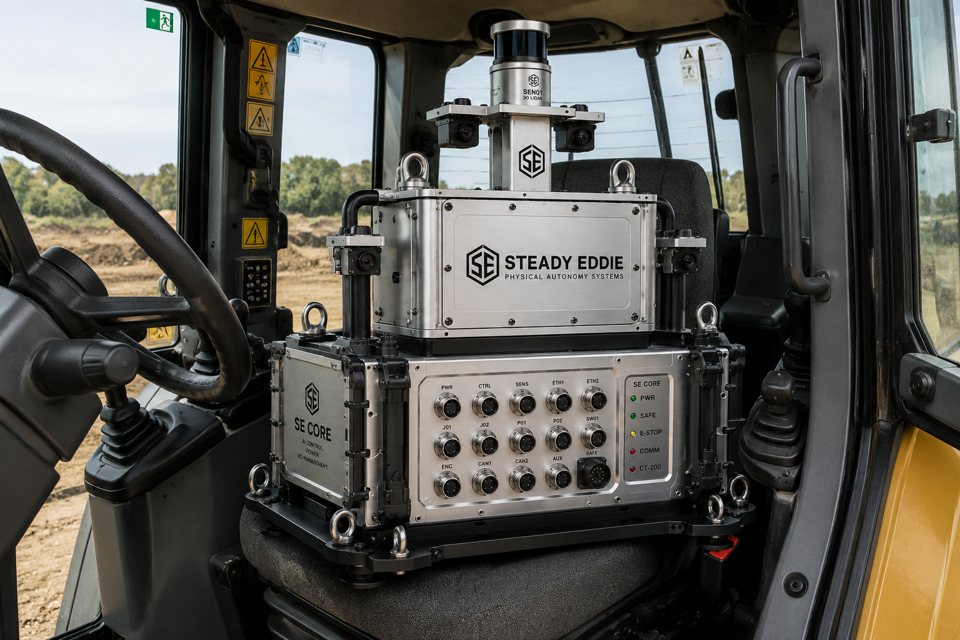
The seat is the most exposed place on the machine. Eddie is a removable operator that takes it —
it sits in the seat of a machine you already own, works that machine's own joysticks, levers,
pedals and switches, reads its dash with a camera, and lifts back out. Nothing is cut, wired or
reprogrammed. And, the fleet way: no radio, no GPS.
Responder CS-810 · Emergency ServicesDefender CS-820 · Field EngineeringFits Machines Already in the YardPatent Pending
VDC, family-wide. Wired CAN 2.0 / Ethernet only — wireless never carries the safety loop
Mass, reach, endurance and cycle figures are machine-specific and are not published here — this
family is defined by what it fits and what it is allowed to do, not by a single chassis number.
Full Marketing Package
The Eddie Family. One Brochure Each.
Two brochures — one per profile in the Eddie family — mechanism, specifications, doctrine and deployment, each with a print-ready PDF. The full library covers all 27 platforms across the fleet.
Eddie · The Removable Operator · 2
CS-810 · Eddie
Responder
The removable operator for emergency services — fire, rescue, hazmat and disaster response. The machine goes in; the crew stays out.
Not a New Vehicle. The Operator for the Ones You Have.
Every other family in this fleet is a machine we build. Eddie is not: it is the operator. It turns
an excavator, dozer, loader, grader or tractor that is already in the yard — or already in
theatre — into an uncrewed one, and turns it back when it lifts out. The capability travels as a
case and a fit kit, not as another vehicle to ship, park, fuel and train on.
How it holds the machine, and what it never touches
The dock is the machine's own seat-belt anchors and pins, and it stays with the machine. The unit's
body sits on the operator's seat in a cradle that rests on the seat pan, with the machine's own lap
belt threaded through a closed tunnel between the cradle rails. Actuator modules pin to the
machine's own controls — hand levers, tillers, the steering wheel from its centre, pedals, gates,
rotaries and switch stations. A camera reads the dash. Nothing connects to the machine's
CAN bus, ECU or firmware; the only wire between Eddie and the machine is a fused feed from
the accessory point. There is no integration work to buy, no new fault codes in the shop, and
nothing to undo when the unit comes off.
It calibrates itself, every day it works
You tell the software what kind of machine it is, and the unit works each control through a set of
steps — learning where neutral sits, where the limits are, and how the control comes back when it
is released. It does that every day it works, because an old machine's controls wear and no two
machines are alike. Key rotation is deliberately excluded from the actuator set: keys are human
authority tokens.
The radio boundary, both halves
No radio and no GNSS anywhere in this family. Eddie runs on preset task programs loaded at the
dock, on a trailed optical fibre with a human in the loop, or on onboard optical-AI inside its own
sealed rule set. There is no surface exception anywhere in the fleet. Design standards named at design are ISO 12100, ISO 13849,
ISO 17757 and ISO 19014; no conformity assessment has been performed, and we will not describe one
that has not happened.
Where it comes from
Eddie is built by Steady Eddie · Physical Autonomy Systems, the group's
physical-autonomy division and Canadian Shield's sister platform under SIG. The civil product —
industrial ground, civil sites, the farm and first response — is sold there, at
steadyeddie.ca. The
Responder and Defender profiles on this page are the Canadian Shield line: the same removable
operator, programmed for the seats that get people hurt, and built to the fleet's no-radio rule.
Status: IFC — In Test.
02 · Platform Roster
Two Profiles. One Unit, Programmed Apart.
The hardware is one family. What separates the two profiles is the rule set: the tasks each is
allowed to run, the movement space it may use, and the safe state it goes to when something is
outside the rules. Both are mechanical scope only — carriers and operators, never a strike
platform.
Emergency Services
Responder CS-810
For the seats agencies should not fill: fire ground, structural collapse, hazmat, flood and
wildfire earthworks, rubble and route clearance. The machine goes in; the crew stays out. The
dock is fitted once and the unit lifts in when a seat needs filling.
Rule set written for civil response tasks · per-task safe states —
because in a burning structure, stopping and waiting for a person can itself put a person in
harm's way
Earthworks, berms and revetments, obstacle reduction, route and rubble clearance, and remote
handling on ground where a person should not sit. Where Grizzly and Beaver are new vehicles,
Defender is the operator for the plant a unit already has.
Mechanical scope only — never operates a weapon, never handles energetics,
never fitted to a weapon platform. Weaponization is not a product decision
Designations and profile names are current as issued and are subject to change without notice.
Nothing on this page is an offer, a commitment or a representation to any government body.
03 · Guidance
Three Tiers in the Seat. Nothing to Jam.
Eddie runs the fleet's three no-radio tiers from inside the cab. There is no fourth tier and no
radio option: an authorization that cannot be jammed is worth more than one that is convenient.
Tier 1
Preset at the Dock
The task program is loaded when the unit is set into the dock, and it runs with no link of any
kind. Nothing is emitted, so there is nothing to jam and nothing to geolocate.
Tier 2
Fibre-Tethered · Human-in-Loop
An optical fibre back to an operator at a stand-off station: command guidance that is
unjammable by construction, with a person authorizing every decision that matters — and out of
the seat while they do it.
Tier 3
Optical-AI
Onboard passive perception and planning, inside the sealed rule set. No emissions, no link, no
GPS. The planner proposes; the rules govern; a human authorizes; safety keeps its veto.
04 · The Limits Are the Product
It Does What Its Rules Allow. And the Rules Are Ours.
A machine that can be talked into anything is not a safe machine. Eddie does only what its rule
set allows, inside a defined task and movement space — and the rule set is not a setting the
customer edits.
Sealed
Signed, Locked, Self-Reporting
Signed rule sets and firmware; a hardware root of trust that runs nothing unsigned; no debug
access on shipped units; tamper detection that ends in a safe stop and a retained log. Keys are
held in Canada. We say "limit tampering", not "prevent" it: the design goal is that interfering
with a unit is expensive, slow, obvious, and self-defeating — a tampered unit stops being an
Eddie.
Leased
Authorization We Can Withdraw
Authorization is issued for a period and can be withdrawn. It is delivered by wire or at the
dock — never over a radio link. Withdrawal or expiry ends in a safe stop and then the minimum
risk condition; the unit stays installed and will not run until it is re-authorized. Your
machine is never touched: we can withdraw the operator, we can never reach your iron.
Never Locked
The Release Stays Physical
The lock is on the logic, never on safety. A hardwired stop and a red manual
release on every actuator are always present, always mechanical, and always available
to the person standing next to the machine. Wireless never carries the safety loop or a motion
command — that is a fleet rule, not a configuration.
Owned Apart
Your Hardware. Our Application.
You own the machine and you own the hardware. The configuration and the application — the rule
sets, the profiles, the calibration and the authority model — are ours, licensed and revocable.
That division is what makes the limits credible: they are not a promise in a contract, they are
a property of the thing.
Five mechanical states. The machine is standard in the first one.
State 0
OEM
No unit fitted. The machine is exactly what the manufacturer built.
State 1
Installed / Disengaged
The unit is in the dock and belted in; couplers are parked on the controls, force-free. A person can sit down and drive.
State 2
Armed
Authorized and calibrated, holding. Wrong-side or wrong-configuration seating is blocked here, electronically.
State 3
Autonomous Control
Running the authorized task, inside the defined movement space, under the tier in force.
State 4
Fault / Safe
Outside the rules, tampered with, or de-authorized: the task's own defined safe state, then the minimum risk condition, then a human is called.
The last row is where the two profiles genuinely differ. "Stop and call a human" is the right answer
on a work site and the wrong one inside a burning structure, so each task in each profile carries its
own defined safe state — withdraw to the dock line, ground the implement and hold, or run to the
tether end. It is designed per task, in advance, and never chosen in the moment.
05 · Why Eddie
What Makes This Family Worth Building.
Nobody in Harm's Way
The Seat Is the Exposure
Under a highwall, on contaminated ground, in a structure that is still moving, on a route that
has not been cleared — the machine can be there. The operator does not have to be.
No New Fleet
It Fits What You Already Own
No vehicle to procure, ship, park, fuel or train a crew on. The capability arrives as a dock,
a fit kit and a unit, for plant that is already on the ground.
The Machine Stays Stock
Nothing Cut, Wired or Flashed
No harness tapped, no controller flashed, no manufacturer software touched. Everything the
machine's builder put in it is still there, still doing its job — and the unit comes off.
Nothing to Jam
The Doctrine, Inside the Cab
Preset, fibre or onboard optical-AI. No radio and no GNSS in the family, so there is no link
to deny, no emission to find and no satellite to spoof.
Older Iron Counts
If a Person Can Work It, Eddie Can
The interface is the human interface. A machine does not need electronics, a data bus or a
model year to be operated by software this way.
The Named Limits
What We Will Not Claim
No conformity assessment has been performed against the standards named at design. No
performance figure is published that we cannot source. And this family never operates a weapon,
handles energetics, or mounts to a weapon platform — carriers and operators, not munitions.
Proof, Not Promotion
Send the Machine. Not the Operator.
If you run emergency plant, engineer plant, or the seats that are hardest to fill safely, the Eddie
family is on the table — with its limits, its status and its refusals stated in the open.